


Taiwan and the US are to jointly enhance artificial intelligence (AI) applications in Mandarin education and traditional Chinese corpus development to protect Mandarin learning from authoritarian censorship and control, Deputy Minister of Foreign Affairs Chen Ming-chi (陳明祺) said yesterday.
The fifth high-level dialogue of the US-Taiwan Education Initiative was held in Taipei yesterday.
Attendees from the US included US Deputy Assistant Secretary for Regional Security Policy and Public Diplomacy Robert Koepcke and American Institute in Taiwan (AIT) Washington Office Managing Director Ingrid Larson.
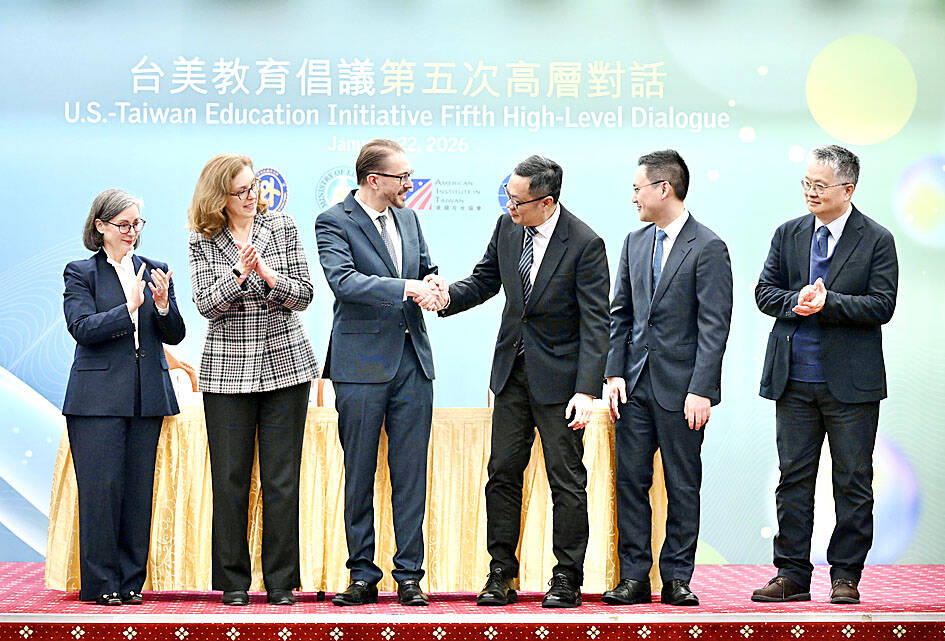
Photo: Lo Pei-de, Taipei Times
Speaking at a post-dialogue briefing at the Ministry of Foreign Affairs, Chen said US Department of State senior bureau official Darren Beattie expressed strong support for deepening the bilateral educational partnership.
The initiative was launched in 2020 during US President Donald Trump’s first term and has proven to be a cornerstone of the Taiwan-US partnership, he said.
Yesterday was the initiative’s first dialogue for Trump’s second term, reflecting mutual commitment to sustaining and deepening educational cooperation between the two nations, Chen said.
Both sides agreed to prioritize building bilateral talent training pathways, improving Mandarin education and cross-cultural influence, enhancing Taiwan’s bilingual education and expanding Taiwan-US educational cooperative platforms, he said.
This year marks the 250th anniversary of US independence and the 30th anniversary of Taiwan’s first direct presidential election, a milestone of shared commitment to democracy and freedom, Chen said.
Taiwan would collaborate with US partners on extending AI applications in Mandarin-language teaching and developing trustworthy traditional Chinese corpora in large language models, he said.
That would not only contribute to the global language technology standards, but also ensure that Mandarin learning worldwide remains free from authoritarian censorship and control, he added.
Larson said traditional Chinese characters is a vital foundation for Mandarin education and that cultural literacy would be stressed, adding that exchanges through programs such as the Fulbright program continue to be expanded.
Taiwan has set up 64 Mandarin learning centers across the US, which has created durable bilateral ties as well as real opportunities for learners and institutions, she said.
AIT Deputy Director Karin Lang said that Taiwan is an outstanding partner in bringing capability and creativity to educational exchanges and talent development.
Bilateral cooperation would focus on preparing talent in critical, emerging technologies such as semiconductors, advanced manufacturing and AI, she said, adding that language learning skills and cross-cultural competence would remain essential for a workforce operating in global high-tech environments.
Lang also reaffirmed the AIT’s commitment to working closely with Taiwan as the education initiative moves into the next phase, which would advance workforce development initiatives and deepen institutional partnerships.
Deputy Minister of Education Liu Kuo-wei (劉國偉) said New York was the first US state to recognize Taiwan’s Mandarin language test as a Seal of Biliteracy in 2023, and that recognition has expanded to 28 states.
The goal is to be recognized across all 50 states, he said.
Taiwan in 2023 formed an academic alliance between 12 top domestic universities and three major US university systems — the University of Illinois, Texas A&M and the University of Texas systems, Liu said.
The collaboration focused on high-tech research such as AI, semiconductors and quantum science, with more than US$4 million invested in 42 related projects over the past two years, he said, adding that the ministry expects to continue the collaboration with the US and involve more young people over the next three years.

FUKUOKA SITUATION: Japanese media reported that the pathogen is expected to be identified by the summer, while the CDC downplayed the idea that it was hMPV A “mysterious cold-like illness” reported in Japan’s Fukuoka Prefecture does not seem to be a new disease, but Japanese authorities have been asked about the situation, the Centers for Disease Control (CDC) said yesterday. The Fukuoka Prefectural Medical Association on Wednesday told a news conference that a “mystery cold” that has become a hot topic on social media is “highly likely to be caused by some kind of viral infection,” Japan’s KBC News reported. “Many people are experiencing symptoms starting with a sore throat, followed by a runny nose, phlegm and a severe cough,” KBC News reported, citing association officials. Health authorities are

Nvidia Corp CEO Jensen Huang (黃仁勳) arrived in Taiwan yesterday ahead of upcoming AI and technology events, saying he plans to meet with clients and Taiwan Semiconductor Manufacturing Co Chairman C.C. Wei (魏哲家) during his visit. After landing at Taipei Songshan Airport, Huang posed for photos with fans and handed out Yakult drinks to reporters and supporters waiting at the scene, saying he has “a lot to do” during the trip. Asked about reports that Nvidia’s planned headquarters site in Taipei’s Beitou Shilin Technology Park could break ground on May 27, Huang said that if the company holds an event, he would

The Ministry of Finance this afternoon announced the winning numbers for the March-April uniform invoice lottery. The winning number for the NT$10 million (US$318,060) special prize is 19531471, and the winning number for the NT$2 million grand prize is 85941329. Three numbers were drawn for the NT$200,000 first prize: 07225810, 20231230 and 83518781. Those with receipts matching the last seven digits of any of the first-prize numbers will win the NT$40,000 second prize, while those matching the last six digits will win the NT$10,000 third prize. Those whose receipts match the last five digits of the first-prize numbers can claim the NT$4,000 fourth prize,
Taiwan Travelogue (臺灣漫遊錄), which earlier this week became the first Taiwanese novel to win the International Booker Prize, is to be adapted into a television series through a Taiwan-Japan coproduction, producer Chang Chen-yu (張辰漁) said yesterday. Chang, a producer at World Softest Production Film Co, wrote on Facebook that the company had been searching for projects with international appeal that retain a strong Taiwanese identity after colleagues and Japanese partners strongly recommended the novel. After reading the book, Chang said he immediately decided to pursue the screen rights. “A great story has the power to transcend time and borders, and connect countless people,”


 RSS
RSS