


A large Chinese merchant vessel equipped with weapons systems has been spotted departing port and is possibly set to conduct testing, military expert Wang Chen-ming (王臻明) said today on Facebook.
The Zhongda 79 (中達79) civilian container ship has reportedly been fitted with weapons systems, including vertical launching systems, four close-in weapon systems (CIWS) and decoy launchers, he said.
The “military-civil fusion” strategy of disguising weapons systems within standard shipping containers is a “gray zone” warfare tactic to complicate targeting decisions for Beijing’s opponents, a TechTimes report said.
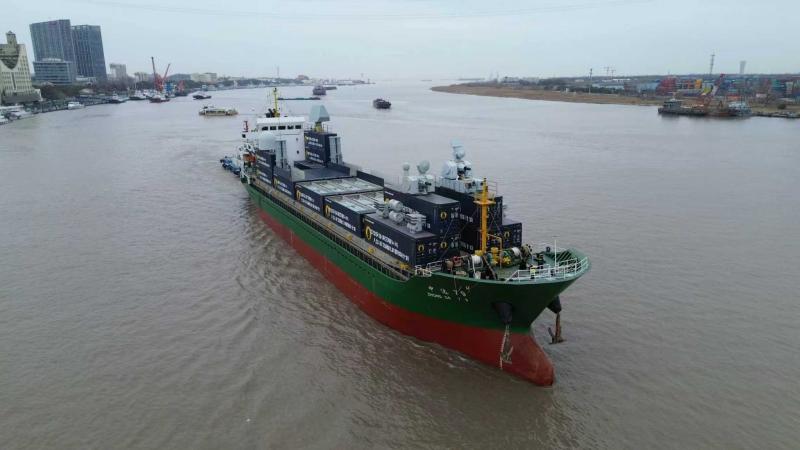
Photo from Wang Chen-ming’s Facebook
The “arsenal merchant vessel” was first observed last month and again earlier this month at Shanghai’s Hudong-Zhudong shipyard as it received multiple containerized armaments, a report by US Naval Institute News said.
Armaments included a system resembling a loyal wingman — an artificial intelligence-controlled uncrewed aerial vehicle designed to fly alongside crewed fighter jets — and an electromagnetic aircraft launch system used to launch aircraft from the deck of naval aircraft carriers, Wang said.
Observing the ship’s movements, it could be testing for seaworthiness, he added.
This indicates that the ship is not a movie prop or deckside test platform, but a fully seaworthy vessel, he said.
However, only live-fire tests would prove whether the onboard weapons systems are fully operational, he added.
The ship appears to be equipped with 15 containerized guided missile launchers, which could amount to up to 60 launch cells, he said.
Four different CIWS units are installed on the fore of the ship, while the aft features large radar systems and communications antennas, he said.
If the sea test proves successful, China could gain the capability to rapidly convert ordinary cargo ships into firepower launch platforms, posing a substantial threat, he added.
Zhongda 79 is an example of China’s growing capability to equip hundreds of civilian merchant ships with launch platforms to potentially support large-scale combat operations and surprise attacks, particularly in the first and second island chains, US Naval Institute News said.

FUKUOKA SITUATION: Japanese media reported that the pathogen is expected to be identified by the summer, while the CDC downplayed the idea that it was hMPV A “mysterious cold-like illness” reported in Japan’s Fukuoka Prefecture does not seem to be a new disease, but Japanese authorities have been asked about the situation, the Centers for Disease Control (CDC) said yesterday. The Fukuoka Prefectural Medical Association on Wednesday told a news conference that a “mystery cold” that has become a hot topic on social media is “highly likely to be caused by some kind of viral infection,” Japan’s KBC News reported. “Many people are experiencing symptoms starting with a sore throat, followed by a runny nose, phlegm and a severe cough,” KBC News reported, citing association officials. Health authorities are

Nvidia Corp CEO Jensen Huang (黃仁勳) arrived in Taiwan yesterday ahead of upcoming AI and technology events, saying he plans to meet with clients and Taiwan Semiconductor Manufacturing Co Chairman C.C. Wei (魏哲家) during his visit. After landing at Taipei Songshan Airport, Huang posed for photos with fans and handed out Yakult drinks to reporters and supporters waiting at the scene, saying he has “a lot to do” during the trip. Asked about reports that Nvidia’s planned headquarters site in Taipei’s Beitou Shilin Technology Park could break ground on May 27, Huang said that if the company holds an event, he would

The Ministry of Finance this afternoon announced the winning numbers for the March-April uniform invoice lottery. The winning number for the NT$10 million (US$318,060) special prize is 19531471, and the winning number for the NT$2 million grand prize is 85941329. Three numbers were drawn for the NT$200,000 first prize: 07225810, 20231230 and 83518781. Those with receipts matching the last seven digits of any of the first-prize numbers will win the NT$40,000 second prize, while those matching the last six digits will win the NT$10,000 third prize. Those whose receipts match the last five digits of the first-prize numbers can claim the NT$4,000 fourth prize,
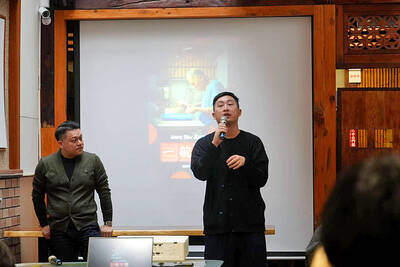
Taiwan Travelogue (臺灣漫遊錄), which earlier this week became the first Taiwanese novel to win the International Booker Prize, is to be adapted into a television series through a Taiwan-Japan coproduction, producer Chang Chen-yu (張辰漁) said yesterday. Chang, a producer at World Softest Production Film Co, wrote on Facebook that the company had been searching for projects with international appeal that retain a strong Taiwanese identity after colleagues and Japanese partners strongly recommended the novel. After reading the book, Chang said he immediately decided to pursue the screen rights. “A great story has the power to transcend time and borders, and connect countless people,”


 RSS
RSS