


A Taipei third-grader brandished a pair of scissors in class, a parent said, adding that the incident has raised concerns about campus safety and the handling of students with behavioral issues.
The parent, speaking anonymously, said that when the student became upset in the classroom and began waving scissors, teachers and staff intervened, preventing serious injuries.
According to the parent, the student had repeatedly exhibited aggressive behavior, including stabbing others with pens, attacking classmates, attempting to strike a teacher’s eyes and smashing a teacher’s cellphone, adding that in one instance, a teacher reportedly grabbed the student’s arm to stop an outburst, only for the child’s parent to accuse the teacher of injuring the student and threatening legal action.
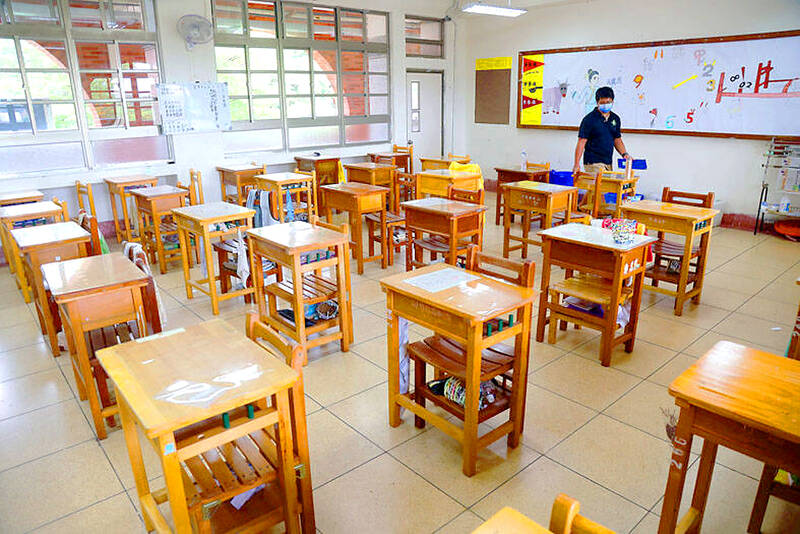
Photo: CNA
The student’s mother, who occasionally accompanies the child at school, has accused other students of misbehavior, saying they triggered her child’s outbursts and alleging bullying, the parent said.
Parents of other students rejected that claim, saying other students are afraid of the outburst-prone classmate.
The school’s director of student affairs said it has offered counseling and proactive support for the student.
The Taipei City Department of Education said the school has established standard operating procedures for emergency incidents and strengthened classroom safety management.
Measures include controlling access to sharp school property, switching to safety scissors when necessary and placing them under centralized teacher supervision as well as implementing emergency classroom support mechanisms, it said.
When reached for comment on the case, Wang Po-chi (王伯頎), a professor in Ming Chuan University’s criminal justice department, said that teachers are legally permitted to take necessary physical measures to block or restrain a student to protect others.
Referring to guidelines on teachers’ counseling and discipline measures, he said that teachers can employ defensive measures to stop attacks, damage or loss of control without facing punishment.
Given that elementary-Aschool students have limited offensive and defensive capabilities, schools should take the lead in risk management, he said.
Possible measures include adjusting seating arrangements, providing close supervision and placing high-risk students where homeroom teachers can easily monitor them, he said.
When necessary, guardians could be asked to accompany the student during classes to reduce the risk of sudden incidents, he said.
On-site responses should prioritize de-escalation and avoid accusatory or provocative language, he said, adding that teachers should maintain a neutral tone, keep appropriate distance and ensure the child feels safe.
In case of a conflict, teachers should prioritize evacuating other students, remove dangerous items such as scissors, prevent escalation in anger, avoid crowds gathering and activate cross-unit support, he said.
Campus violence should not be treated merely as “behavioral deviation,” he said, adding that schools should first determine whether a student might have special needs through professional assessment and institutional intervention.
Family dynamics should also be examined, he said, adding that social safety nets and external resources should be referred to high-risk or vulnerable households.
A veteran juvenile and family court judge, speaking on condition of anonymity, said that children under the age of 12 who stab others with pencils or wave scissors are considered to have “violated the law” rather than “committed a crime,” as criminal liability applies only to those aged 14 or older.
Relying solely on judicial coercion can only suppress behavior in the short term and fails to address underlying emotional, cognitive and family issues, often leading to relapse once pressure is eased, the judge said.
The key issue is not whether punishment can be imposed, but whether schools and authorities promptly report, assess and refer cases to prevent issues from growing and leading to irreversible consequences, the judge said.

FUKUOKA SITUATION: Japanese media reported that the pathogen is expected to be identified by the summer, while the CDC downplayed the idea that it was hMPV A “mysterious cold-like illness” reported in Japan’s Fukuoka Prefecture does not seem to be a new disease, but Japanese authorities have been asked about the situation, the Centers for Disease Control (CDC) said yesterday. The Fukuoka Prefectural Medical Association on Wednesday told a news conference that a “mystery cold” that has become a hot topic on social media is “highly likely to be caused by some kind of viral infection,” Japan’s KBC News reported. “Many people are experiencing symptoms starting with a sore throat, followed by a runny nose, phlegm and a severe cough,” KBC News reported, citing association officials. Health authorities are

Nvidia Corp CEO Jensen Huang (黃仁勳) arrived in Taiwan yesterday ahead of upcoming AI and technology events, saying he plans to meet with clients and Taiwan Semiconductor Manufacturing Co Chairman C.C. Wei (魏哲家) during his visit. After landing at Taipei Songshan Airport, Huang posed for photos with fans and handed out Yakult drinks to reporters and supporters waiting at the scene, saying he has “a lot to do” during the trip. Asked about reports that Nvidia’s planned headquarters site in Taipei’s Beitou Shilin Technology Park could break ground on May 27, Huang said that if the company holds an event, he would

The Ministry of Finance this afternoon announced the winning numbers for the March-April uniform invoice lottery. The winning number for the NT$10 million (US$318,060) special prize is 19531471, and the winning number for the NT$2 million grand prize is 85941329. Three numbers were drawn for the NT$200,000 first prize: 07225810, 20231230 and 83518781. Those with receipts matching the last seven digits of any of the first-prize numbers will win the NT$40,000 second prize, while those matching the last six digits will win the NT$10,000 third prize. Those whose receipts match the last five digits of the first-prize numbers can claim the NT$4,000 fourth prize,
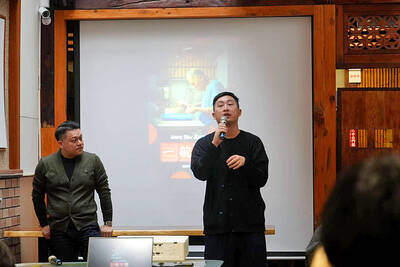
Taiwan Travelogue (臺灣漫遊錄), which earlier this week became the first Taiwanese novel to win the International Booker Prize, is to be adapted into a television series through a Taiwan-Japan coproduction, producer Chang Chen-yu (張辰漁) said yesterday. Chang, a producer at World Softest Production Film Co, wrote on Facebook that the company had been searching for projects with international appeal that retain a strong Taiwanese identity after colleagues and Japanese partners strongly recommended the novel. After reading the book, Chang said he immediately decided to pursue the screen rights. “A great story has the power to transcend time and borders, and connect countless people,”


 RSS
RSS