


The Taiwan People’s Party (TPP) yesterday unveiled its policy platform for the local elections.
The TPP’s 80-page policy white paper is more substantive and practical than typical reports submitted by central ministries to the legislature, TPP Chairman Huang Kuo-chang (黃國昌) said.
The party’s platform has on four core goals: stabilizing society, supporting families, safeguarding health and safety, and bolstering industries, he said.
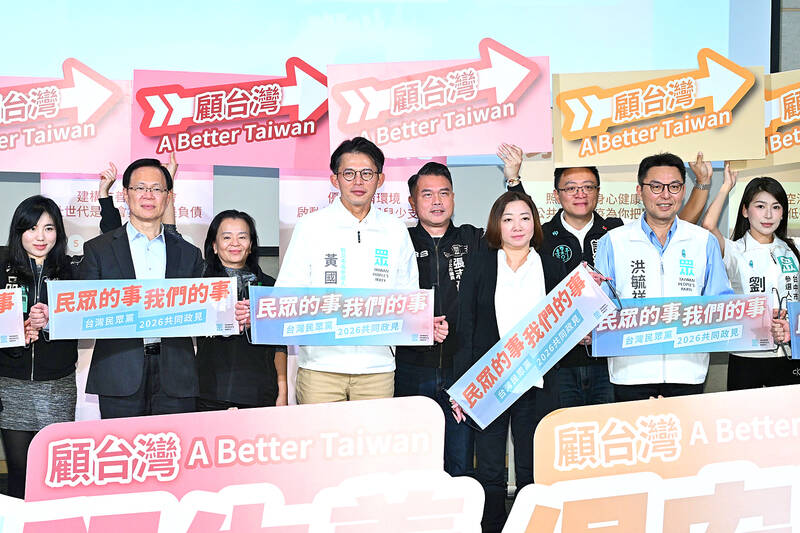
Photo: Chen Yi-kuan, Taipei Times
It includes housing justice, people-oriented transportation, family support, age-friendly communities, education, physical and mental health, low-carbon development, industrial upgrading and social inclusion, he added.
The amendments to the Act Governing the Allocation of Government Revenues and Expenditures (財政收支劃分法) would give local governments adequate funding through a more transparent fiscal system, Huang said.
The TPP intends to monitor spending closely to ensure public funds are used effectively, he said, adding that mayors and county heads would no longer need political connections to secure budgets for infrastructure projects.
Several TPP candidates also outlined their local priorities.
Chiayi mayoral candidate Chang Chi-kai (張啟楷) said his platform includes building a light rail system and urging full central funding for an elevated railway project.
Chang said he also intends to push for National Health Insurance premiums for seniors aged 65 and older, and providing free lunches for elementary and junior-high school students.
Yilan chapter head Chen Wan-hui (陳琬惠), who is running for Yilan county commissioner, said economic development, transportation and healthcare are the county’s most pressing needs.
She proposed a model similar to Taipei’s Nangang Software Park to create jobs in creative, research and software industries, allowing residents to work closer to home as well as potentially attracting talent from across Taiwan.
The local elections is to take place on Nov. 28.
Meanwhile, Huang said a joint agenda with the Chinese Nationalist Party (KMT) has been largely drafted and is awaiting ratification.
The KMT still needs to carry out internal candidate nomination procedures, which the TPP respects, he said.

FUKUOKA SITUATION: Japanese media reported that the pathogen is expected to be identified by the summer, while the CDC downplayed the idea that it was hMPV A “mysterious cold-like illness” reported in Japan’s Fukuoka Prefecture does not seem to be a new disease, but Japanese authorities have been asked about the situation, the Centers for Disease Control (CDC) said yesterday. The Fukuoka Prefectural Medical Association on Wednesday told a news conference that a “mystery cold” that has become a hot topic on social media is “highly likely to be caused by some kind of viral infection,” Japan’s KBC News reported. “Many people are experiencing symptoms starting with a sore throat, followed by a runny nose, phlegm and a severe cough,” KBC News reported, citing association officials. Health authorities are

Nvidia Corp CEO Jensen Huang (黃仁勳) arrived in Taiwan yesterday ahead of upcoming AI and technology events, saying he plans to meet with clients and Taiwan Semiconductor Manufacturing Co Chairman C.C. Wei (魏哲家) during his visit. After landing at Taipei Songshan Airport, Huang posed for photos with fans and handed out Yakult drinks to reporters and supporters waiting at the scene, saying he has “a lot to do” during the trip. Asked about reports that Nvidia’s planned headquarters site in Taipei’s Beitou Shilin Technology Park could break ground on May 27, Huang said that if the company holds an event, he would

Carrefour Taiwan is to begin using a new name from the start of July, but it cannot divulge the name until then, the chairman of the supermarket chain's parent company said today. President Chain Store Co chairman Lo Chih-hsien (羅智先) was asked by reporters after a shareholders' meeting to confirm whether the company has settled on a new name for the supermarket brand. In March, the government-registered name of two Carrefour Taiwan branches was quietly changed to "Le Chia Kang" (樂家康) in Chinese, raising speculation that has been selected as the name. Lo said that because of local regulations and contractual obligations, the
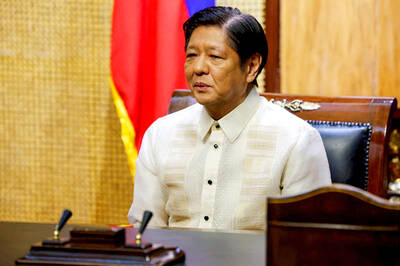
The Philippines would likely be involved in any conflict over Taiwan due to its proximity to the democracy claimed by China, President Ferdinand Marcos Jr said, reiterating a stance that risks angering Beijing. “In the Philippines, we do not have a choice because Taiwan is so close to the Philippines and we have almost 200,000 Filipino nationals living and working in Taiwan,” Marcos said in an interview with Japanese media in Manila on Monday. The Philippine leader’s comments come ahead of a state visit to Japan next week, where he is to meet with Japanese Prime Minister Sanae Takaichi to discuss security


 RSS
RSS