


A demand by Sun Yat-sen School president Chang Ya-chung (張亞中) that Democratic Progressive Party (DPP) Legislator Wang Yi-chuan (王義川) speak Mandarin during a public hearing at the Legislative Yuan has been condemned by linguists and pan-green camp politicians.
Experts, academics and politicians had been invited to take part in a hearing on Thursday regarding the opposition’s proposed motion to impeach President William Lai (賴清德), to present their viewpoints and deliberate on the issue
During Wang’s turn, he spoke Hoklo, commonly known as Taiwanese. Chang then interrupted him, saying: “Please speak Guoyu [國語, Mandarin].”
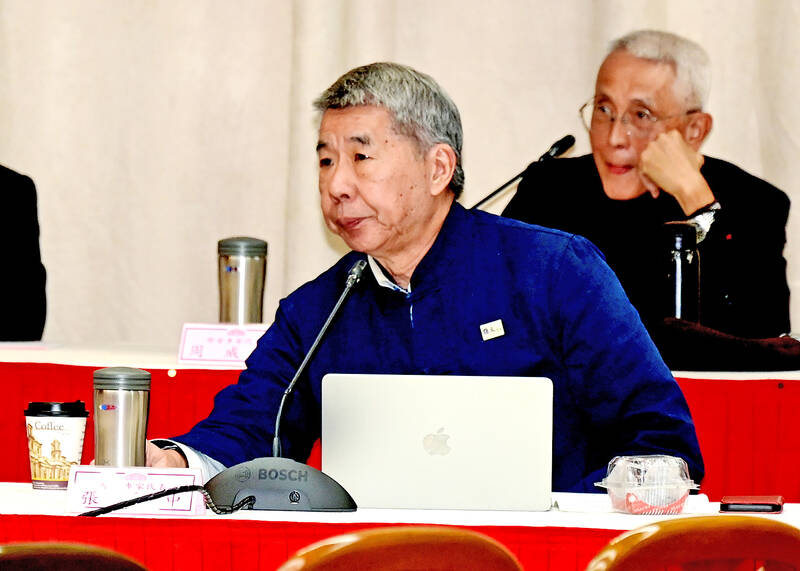
Photo: Wang Yi-sung, Taipei Times
Surprised, Wang paused for a few seconds before asking the session’s chairman what that meant.
“I have the right to use the language of my choosing. If you cannot understand what I said, you can use a translator,” Wang told Chang in Hoklo.
Videos of the incident circulated on social media, sparking discussions.
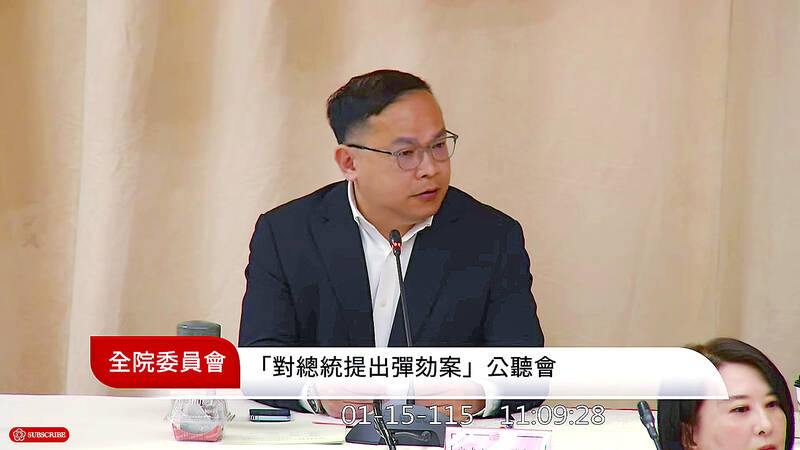
Photo: Screen grab from the Legislative Yuan’s livestream
Most people online castigated Chang, saying that he continues to live in the Chinese Nationalist Party (KMT) authoritarian era, when only Mandarin could be used in the government, media and public sectors.
Chang was discriminating against Hoklo speakers and does not know that under the law, it is now one of Taiwan’s national languages, some people said.
Chang ran an unsuccessful bid for the KMT chair election in October last year.
DPP Legislator Puma Shen (沈伯洋) said that under the Development of National Languages Act (國家語言發展法), all of Taiwan’s national languages are equal and protected by the law, and “shall not be discriminated against or face restrictions.”
These include Mandarin, Hoklo, Hakka and languages spoken by indigenous people, he said.
Taiwanese Language Policy Promotion Alliance convener Hsu Hui-ying (許慧盈) said it is Wang’s legal right to use Hoklo, one of Taiwan’s national languages, inside the Legislative Yuan, adding that it was improper of Chang to stop someone from speaking their mother tongue.

Actor Darren Wang (王大陸) was sentenced to six months in prison, commutable to a fine, by the New Taipei District Court today for contravening the Personal Data Protection Act (個人資料保護法) in a case linked to an alleged draft-dodging scheme. Wang allegedly paid NT$3.6 million (US$114,380) to an illegal group to help him evade mandatory military service through falsified medical documents, prosecutors said. He transferred the funds to Chen Chih-ming (陳志明), the alleged mastermind of a draft-evasion ring, although he lost contact with him as he was already in detention on fraud charges, they said. Chen is accused of helping a

SECURITY: Starlink owner Elon Musk has taken pro-Beijing positions, and allowing pro-China companies to control Taiwan’s critical infrastructure is risky, a legislator said Starlink was reluctant to offer services in Taiwan because of the nation’s extremely high penetration rates in 4G and 5G services, the Ministry of Digital Affairs said yesterday. The ministry made the comments at a meeting of the legislature’s Transportation Committee, which reviewed amendments to Article 36 of the Telecommunications Management Act (電信管理法). Article 36 bans foreigners from holding more than 49 percent of shares in public telecommunications networks, while shares foreigners directly and indirectly hold are also capped at 60 percent of the total, unless specified otherwise by law. The amendments, sponsored by Chinese Nationalist Party (KMT) Legislator Ko

UNREASONABLE SURVEILLANCE: A camera targeted on an road by a neighbor captured a man’s habitual unsignaled turn into home, netting him dozens of tickets The Taichung High Administrative Court has canceled all 45 tickets given to a man for failing to use a turn signal while driving, as it considered long-term surveillance of his privacy more problematic than the traffic violations. The man, surnamed Tseng (曾), lives in Changhua County and was reported 45 times within a month for failing to signal while driving when he turned into the alley where his residence is. The reports were filed by his neighbor, who set up security cameras that constantly monitored not only the alley but also the door and yard of Tseng’s house. The surveillance occurred from July

‘SAME OLD TRICK’: Even if Beijing resumes individual travel to Taiwan, it would only benefit Chinese tourism companies, the Economic Democracy Union convener said China’s 10 new “incentives” are “sugar-coated poison,” an official said yesterday, adding that Taiwanese businesses see them clearly for what they are, but that Beijing would inevitably find some local collaborators to try to drums up support. The official, speaking on condition of anonymity, made the remark ahead of a news conference the General Chamber of Commerce is to hold today. The event, titled “Industry Perspectives on China’s Recent Pro-Taiwan Policies,” is expected to include representatives from industry associations — such as those in travel, hotels, food and agriculture — to request the government cooperate with China’s new measures, people familiar with


 RSS
RSS