


In the event of a cross-Taiwan Strait crisis, China would likely wage an information operation in Japan to make people question why they should “risk their lives for Taiwan,” a Japanese international relations expert said.
Satoru Mori, deputy director of the Keio Center for Strategy at Keio University, made the comments on Monday during a forum on the US-Japan Alliance hosted by the Washington-based Center for Strategic and International Studies.
“It’s going to be a pretty potent strategic communication tactic that the Chinese would likely use,” and since Japan is a parliamentary democracy, any loss of public opinion could lead to a change of government, Mori said.
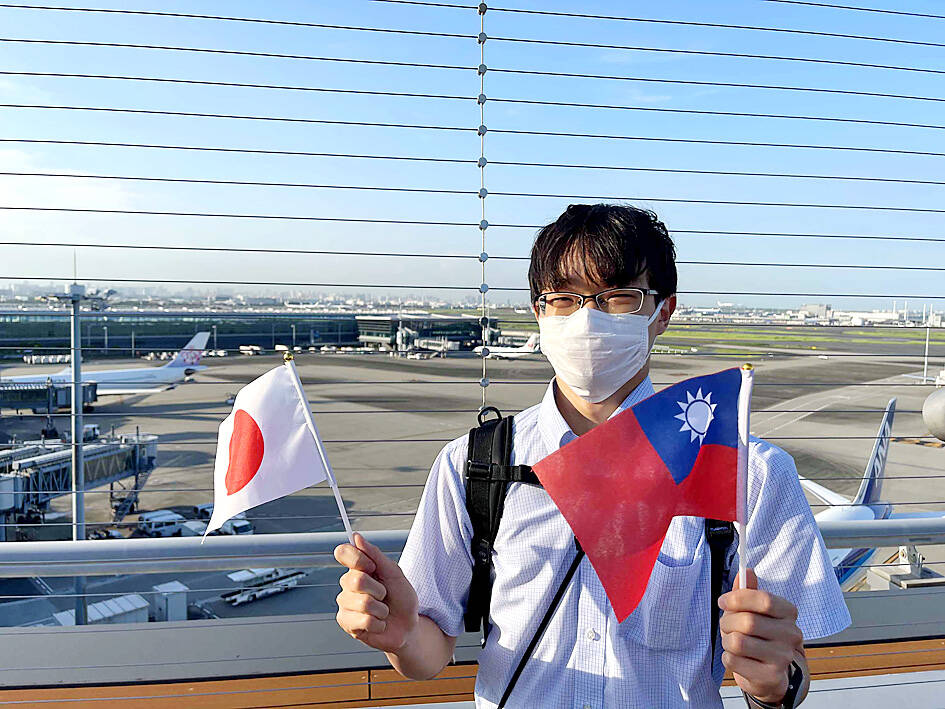
Photo: Yang Ming-chu, Taipei Times
Any such reversal would be a “nightmare scenario” for the Japan-US alliance, as the US would no longer be able to wage effective military operations to defend Taiwan, Mori said.
Seeing Japan opt out of such an effort could also cause Taiwan to “lose faith” and undermine its will to fight, Mori said, adding that China would thus be able to “kill three birds with one stone” by going after Japanese public opinion.
To avoid such a situation, efforts should be taken during peacetime to convince the Japanese public that Taiwan matters very much for Japan’s security, thereby building public resolve to withstand such information operations in the event of a crisis, Mori said.
Motohiro Tsuchiya, a professor at Keio University’s Graduate School of Media and Governance, said it is instructive to look at Taiwan’s elections — including the upcoming local elections in November — to understand how such information operations are waged.
“From my experiences in Taiwan, there are a lot of interference interventions,” although it is not always clear if they are coming from China, from actors within Taiwan, or from other countries, he said.
In some cases, these messages could be easily identified, such as those using simplified Chinese characters, but they could still sway people’s mindset due to their huge volume, Tsuchiya said.
To date, Japan has not faced extensive interference in its elections, Tsuchiya said, adding that that could change if Japanese Prime Minister Sanae Takaichi — who has taken a strong stance in support of Taiwan — decides to call elections next month.
According to Reuters, Japanese media reported that Takaichi is considering dissolving the lower house next week and calling snap elections for Feb. 8 to capitalize on her high approval ratings and stabilize her coalition.

Actor Darren Wang (王大陸) was sentenced to six months in prison, commutable to a fine, by the New Taipei District Court today for contravening the Personal Data Protection Act (個人資料保護法) in a case linked to an alleged draft-dodging scheme. Wang allegedly paid NT$3.6 million (US$114,380) to an illegal group to help him evade mandatory military service through falsified medical documents, prosecutors said. He transferred the funds to Chen Chih-ming (陳志明), the alleged mastermind of a draft-evasion ring, although he lost contact with him as he was already in detention on fraud charges, they said. Chen is accused of helping a

SECURITY: Starlink owner Elon Musk has taken pro-Beijing positions, and allowing pro-China companies to control Taiwan’s critical infrastructure is risky, a legislator said Starlink was reluctant to offer services in Taiwan because of the nation’s extremely high penetration rates in 4G and 5G services, the Ministry of Digital Affairs said yesterday. The ministry made the comments at a meeting of the legislature’s Transportation Committee, which reviewed amendments to Article 36 of the Telecommunications Management Act (電信管理法). Article 36 bans foreigners from holding more than 49 percent of shares in public telecommunications networks, while shares foreigners directly and indirectly hold are also capped at 60 percent of the total, unless specified otherwise by law. The amendments, sponsored by Chinese Nationalist Party (KMT) Legislator Ko

UNREASONABLE SURVEILLANCE: A camera targeted on an road by a neighbor captured a man’s habitual unsignaled turn into home, netting him dozens of tickets The Taichung High Administrative Court has canceled all 45 tickets given to a man for failing to use a turn signal while driving, as it considered long-term surveillance of his privacy more problematic than the traffic violations. The man, surnamed Tseng (曾), lives in Changhua County and was reported 45 times within a month for failing to signal while driving when he turned into the alley where his residence is. The reports were filed by his neighbor, who set up security cameras that constantly monitored not only the alley but also the door and yard of Tseng’s house. The surveillance occurred from July

‘SAME OLD TRICK’: Even if Beijing resumes individual travel to Taiwan, it would only benefit Chinese tourism companies, the Economic Democracy Union convener said China’s 10 new “incentives” are “sugar-coated poison,” an official said yesterday, adding that Taiwanese businesses see them clearly for what they are, but that Beijing would inevitably find some local collaborators to try to drums up support. The official, speaking on condition of anonymity, made the remark ahead of a news conference the General Chamber of Commerce is to hold today. The event, titled “Industry Perspectives on China’s Recent Pro-Taiwan Policies,” is expected to include representatives from industry associations — such as those in travel, hotels, food and agriculture — to request the government cooperate with China’s new measures, people familiar with


 RSS
RSS