


If Taiwan Semiconductor Manufacturing Co (TSMC) increases its investment in Arizona, it would likely operate dual production hubs in Taiwan and the US, with US capacity nearly sufficient to meet that country’s local demand, an economist said yesterday.
Liu Pei-chen (劉佩真), a researcher at the Taiwan Institute of Economic Research, was responding to a New York Times report which said TSMC could build more chip facilities in Arizona as part of a tariff deal with the US.
TSMC would commit to building more factories in the US in exchange for a reduction in the standard duty on imported goods from Taiwan to 15 percent from 20 percent, the report said.
Photo: Bloomberg
The chipmaker could build new advanced wafer fabs as well as IC packaging and testing facilities as part of the arrangement, Liu said.
The number of TSMC fabs in Arizona would likely rise to six to eight, with total monthly production capacity of at least 150,000 wafers, which would come close to meeting the demand for high-performance computing and artificial intelligence chips in the US, she said.
That would be considered a gamble for Taiwan, given that many in the country believe TSMC offers the country a “silicon shield,” as some countries such as the US need TSMC’s advanced chips.
Should those chips all be made and packaged in the US, Washington might be less likely to support Taiwan in deterring a potential attack by China.
TSMC could build more advanced IC assembly plants to provide advanced 3D chip-on-wafer-on-substrate and system-on-integrated-chips IC packaging services to its clients, establishing the US as a complete semiconductor hub, Liu said.
A one-stop comprehensive production model in which TSMC rolls out chips and provides assembly services would meet demand from its US clients such as Nvidia and Advanced Micro Devices (AMD) to lower their risks at a time of geopolitical unease, she said.
“If TSMC builds new wafer fabs in Arizona, a dual-hub production model will take shape, gradually moving away from the current model of a single hub in Taiwan,” Liu said.
However, costs could become an issue for such a model, she said.
TSMC faces extremely high depreciation costs due to the high expense of building production capacity in the US, and it would also have to adjust the utilization rates of its fabs in Taiwan, which could affect the company’s bottom line, she added.
TSMC is investing US$65 billion to build three advanced wafer fabs in Arizona. The first fab started mass production in the fourth quarter of 2024.
The structure for the second fab was completed last year, with volume production targeted for 2028.
Ground was broken on a third fab in April last year.
In March last year, TSMC pledged to invest an additional US$100 billion to build three more fabs, two IC assembly plants and a research-and-development center.
The government did not comment on the New York Times report, while TSMC has been quiet before its latest investor conference tomorrow.

NATIONAL SECURITY: Authorities are working to confirm the identities of the military personnel involved and investigating possible illegal conduct and regulatory violations Authorities are probing possible national security implications after Kinmen police and immigration officers on Sunday found a Chinese woman allegedly posing as a tourist while engaging in prostitution involving more than 10 military personnel. The woman, surnamed Chen (陳), has since been deported, authorities said, adding that investigators are still working to confirm the identities of those implicated, as the records only listed code names and aliases. The case stemmed from a report received by the Kinmen District Prosecutors’ Office on Friday last week from the Jinhu Precinct of the Kinmen County Police Bureau. On Sunday, police, along with the National Immigration
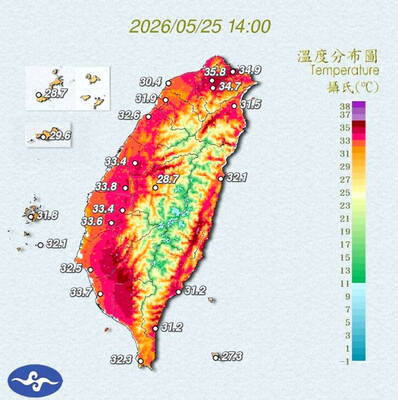
STAY COOL: The HPA recommended that people stay hydrated, use air-conditioning or fans while indoors, wear loose-fitting clothes and walk in the shade while outdoors Employers must implement measures such as installing cooling equipment, and providing drinking water and rest breaks for outdoor workers starting from Monday next week, the Taipei Department of Labor said on Sunday. Employers who fail to comply could face fines of NT$30,000 to NT$300,000 under the Occupational Safety and Health Act (職業安全衛生法), the department said. Businesses in Taipei employing fewer than 100 workers, as well as registered self-employed workers with labor insurance coverage, could receive on-site assessments and guidance from occupational safety consultants to help them apply for central government subsidies to implement or improve heat-protection measures, it said. Under the Ministry of

GLOBALGIVING: ‘ Caving to external pressure is not acceptable for an organization that has cultivated justice reform and human rights for 30 years,’ one NGO said A slew of non-government organizations (NGOs) have withdrawn from the GlobalGiving fundraising platform after it announced it would use “Chinese Taipei” instead of “Taiwan” from next month. The Taiwan Good Rice Association wrote on Facebook on Friday that it was informed on April 28 via a teleconference call of the change, which was made because the platform wanted to operate in China. Taiwan Good Rice is to terminate all cooperative relationships with GlobalGiving in response to the platform’s “unilateral and non-negotiable” decision to remove references to Taiwan, the NGO said. “Taiwan is in the official name of Taiwan Good Rice Association and the
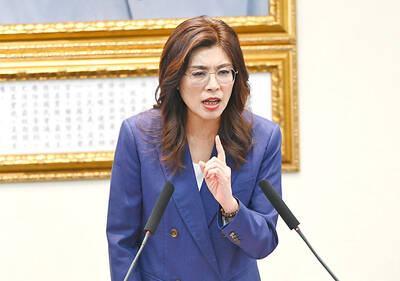
Chinese Nationalist Party (KMT) Chairwoman Cheng Li-wun (鄭麗文) yesterday briefed her party’s Central Standing Committee regarding her scheduled visit to the US between Monday next week and June 16, saying that her purpose would be to persuade the US that the Republic of China (ROC) Constitution was a “one China” constitution that would foster stable and peaceful cross-strait relations. The ROC Constitution is the most important defense for all Taiwanese citizens, as it upholds our democracy and has contributed to our robust economy, which aligns with international and US interests, she said. “We would not be troublemakers and drag the US under,”


 RSS
RSS