


Police detectives and their staff in Changhua County have received praise for their diligence after recording a 90 percent success rate in locating or identifying missing persons in the past five years.
Changhua County Police Department logistics section chief Chung Chen-pang (鐘振邦) told reporters that last year he was given a case to find an elderly woman who had been missing for 20 years and whose family had filed a new missing persons report.
Chung said he began by searching databases, including national health insurance files, vehicle registration, traffic violation issued tickets, exit and entry records, and bank accounts, but found nothing under her name.
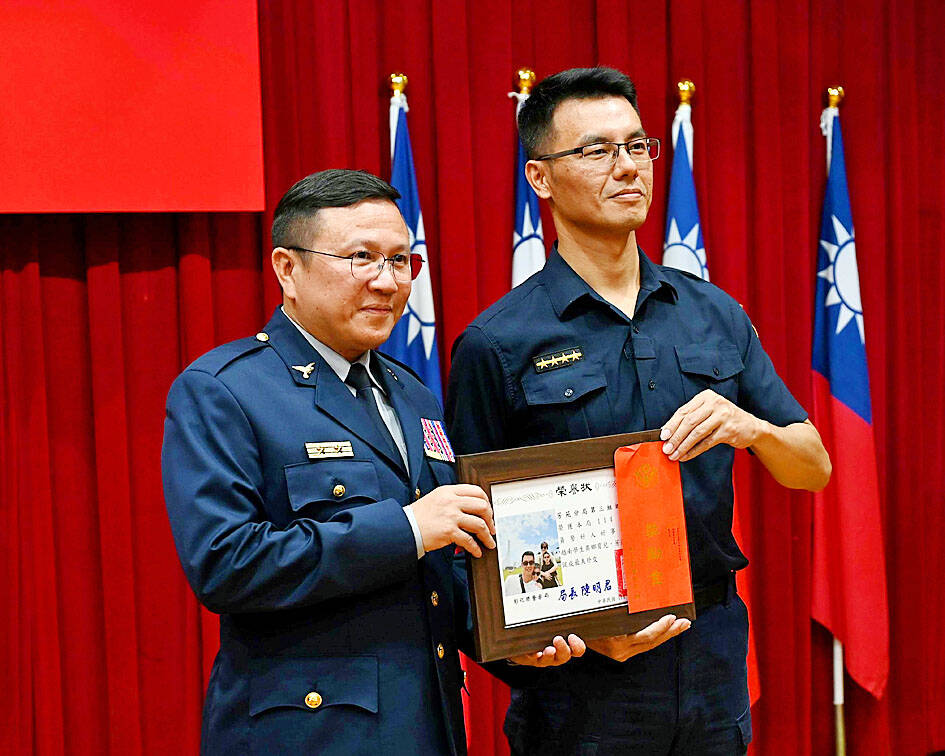
Photo courtesy of the Changhua County Police Department
“We knew that New Taipei City had started to collect DNA samples for found missing persons in their jurisdiction. So it happened the woman had mental health issues and was located in New Taipei City, but they did not know her family or address, so she had been transferred to Yuli Hospital, which is well-known for caring and treating mental patients, in Hualien County’s Yuli Township (玉里),” Chung said.
After asking the family members to take a DNA test, the team was able to verify that the elderly woman was related, he said, adding that it allowed a mother and daughter to reunite after two decades apart.
Fangyuan Township (芳苑) Precinct Police Inspector Hsu Hong-jung (許宏榮) said that his team worked to locate 44 missing persons in 2023, and was honored with a top award as the most successful search unit in Taiwan.
“It is my core belief that one must have empathy for the families when working on missing persons cases. It is the key to finding those who go missing and helping them return back to their families,” Hsu said.
Prevention section head Chiu Yun-ju (邱韻儒) said they received 5,620 requests for missing persons in past five years overall, with 5,110 successfully located, an almost 90 percent success rate.
“The success is due to tireless work by our officers and their spirit of not being willing to give up, helped by advances in the science of DNA matching,” Chiu said.
The initial “golden period” is the most important time for finding a missing person, as personal information such as age, features, clothing and locations can help police locate them early, she said.
After the initial golden period, DNA testing can provide another opportunity to find the missing person, she added.
When filing a missing persons report, it is also important to bring identification papers that could help prove the relationship with the missing person, allowing police to begin their investigation, Chiu said, adding that the data would be registered in a database to aid police in their search.
Any other details such as photographs or information about vehicles used, as well as possible destinations and events that occurred before the disappearance, would also be recorded to help police, she added.
“Afterward, the police officer would ask for consent to post a public ‘missing person’ notice, and permission to have photographs added to the police file,” she said.
If the person is located or returns home, the police should be contacted as soon as possible, Chiu said, adding that all police stations are open 24 hours every day.
Family members can also check the progress of their case on the official Web site of the National Police Agency, she said.

A strong continental cold air mass is to bring pollutants to Taiwan from tomorrow, the Ministry of Environment said today, as it issued an “orange” air quality alert for most of the country. All of Taiwan except for Hualien and Taitung counties is to be under an “orange” air quality alert tomorrow, indicating air quality that is unhealthy for sensitive groups. In China, areas from Shandong to Shanghai have been enveloped in haze since Saturday, the ministry said in a news release. Yesterday, hourly concentrations of PM2.5 in these areas ranged from 65 to 160 micrograms per cubic meter (mg/m³), and pollutants were
Taiwan’s armed forces have established response protocols for a wide range of sudden contingencies, including the “Wan Chun Plan” to protect the head of state, the Ministry of Defense (MND) said today. After US President Donald Trump on Saturday launched a series of airstrikes in Venezuela and kidnapped Venezuelan President Nicolas Maduro, concerns have been raised as to whether China would launch a similar “decapitation strike” on Taiwan. The armed forces regularly coordinate with relevant agencies and practice drills to ensure preparedness for a wide range of scenarios, Vice Minister of National Defense Hsu Szu-chien (徐斯儉) told reporters before a

EVA Airways on Saturday said that it had suspended a pilot and opened an investigation after he allegedly lost his temper and punched the first officer several times as their plane was taxiing before takeoff at Los Angeles International Airport. According to a report published on Thursday by The Reporter, the incident occurred after the flight’s Malaysian first officer tried to warn the Taiwanese pilot, surnamed Wen (文), that he was taxiing faster than the speed limit of 30 knots (55.6kph). After alerting the pilot several times without response, the first officer manually applied the brakes in accordance with standard operating

Japanese Councilor Hei Seki (石平) on Wednesday said that he plans to visit Taiwan, saying that would “prove that Taiwan is an independent country and does not belong to China.” Seki, a member of the Japan Innovation Party, was born in Chengdu in China’s Sichuan Province and became a naturalized Japanese in 2007. He was elected to the House of Concilors last year. His views on the Chinese Communist Party (CCP) — espoused in a series of books on politics and history — prompted Beijing to sanction him, including barring Seki from traveling to China. Seki wrote on X that he intends


 RSS
RSS