


Japanese Councilor Hei Seki (石平) on Wednesday said that he plans to visit Taiwan, saying that would “prove that Taiwan is an independent country and does not belong to China.”
Seki, a member of the Japan Innovation Party, was born in Chengdu in China’s Sichuan Province and became a naturalized Japanese in 2007. He was elected to the House of Concilors last year. His views on the Chinese Communist Party (CCP) — espoused in a series of books on politics and history — prompted Beijing to sanction him, including barring Seki from traveling to China.
Seki wrote on X that he intends to visit Taiwan early this year.
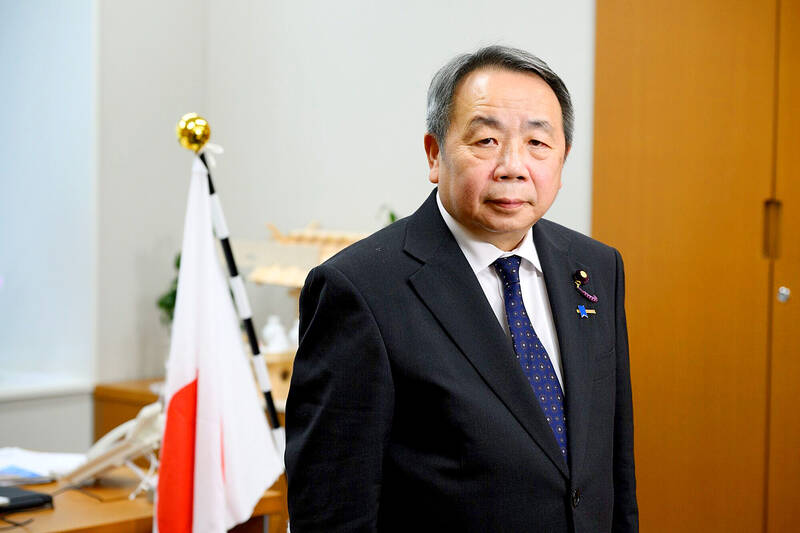
Photo: Bloomberg
The visit would have two purposes, he said.
The first is to meet with government officials to exchange views on the situation in the Taiwan Strait, and to discuss possible defense cooperation between Taiwan and Japan, he wrote.
“The second is to show that Taiwan is an independent country,” he wrote. “The Chinese government has banned me from entering China, but if I make the visit, it would prove that Taiwan is not part of China.”
Seki studied philosophy at Peking University before moving to Japan in 1988, where he attended graduate school at Kobe University, earning a doctorate in cultural studies. Later, he was a university lecturer, political commentator and author of Japanese-language books, including one on “why I abandoned China.”
While he was studying in Japan, the student democracy movement rose in China, leading to the Tiananmen Square Massacre in 1989.
Other books that Seki wrote focused on the history of massacres in China and his reasons for denouncing the CCP.
Seki’s campaign platform leading up to the elections in July focused on “protecting Japan from China’s military threat.”
“The Senkaku Islands [which Taiwan also claims and calls the Diaoyutais, 釣魚台列嶼] and political issues over Taiwan are fundamental to safeguard Japan’s national security,” he said at the time. “If Taiwan faces a contingency situation, Japan’s lifelines on the sea would be cut, and Okinawa would become the front line of a military conflict.”
“The Japanese government has a political responsibility to prepare for such a contingency,” he added.
The Chinese Ministry of Foreign Affairs in September announced sanctions targeting Seki, banning him from entering China, including Hong Kong and Macau. It also froze his assets in China.
Beijing accused him of spreading fallacies regarding Taiwan, the Diaoyutais — which China also claims — and other issues.
It also criticized him for advocating that Japanese worship at the Yasukuni Shrine in Tokyo, which is dedicated to people who died fighting on behalf of the Japanese emperor, including 30,304 Taiwanese soldiers killed in World War II.

UPGRADE: The Kang Ding-class frigate is replacing its Chaparall missiles with Tien Chien II and Hua Yang VLS, which would provide it with long-range, 360° air defense Taiwan plans to produce 1,200 to 1,376 Hai Chien II missiles (海劍二, Sea Sword II) — also known as TC-2N — to serve as the standard air defense system of the navy’s surface combatant fleet, a source said yesterday. Last week, the Hai Chien II, the naval version of the Tien Kung II missile (天劍二, Sky Sword II), completed a live-fire test in waters off the National Chungshan Institute of Science and Technology’s Jiupeng facility (九鵬) in Pingtung County’s Manjhou Township (滿州). The MIM72 Chaparral and other dated air defense missiles that currently arm Taiwanese ships have inadequate range to combat Chinese

REASONS FOR TRAVEL: An assistant professor said that proposed amendments to penalize drivers if they used drugs overseas would not deter people from traveling People who operate a motor vehicle under the influence of marijuana would have their driver’s license revoked, even if they used the substance while overseas, the Ministry of Transportation and Communications said yesterday, citing proposed amendments to the Road Traffic Management and Penalty Act (道路交通管理處罰條例). The amendments would also authorize the government to revoke the licenses of people determined to have used Category 1 or Category 2 narcotics, even if they were not operating a vehicle while under the influence of drugs, as well as ban them from taking the license test for three years, the ministry said. People aged 18 or

HEAVY WEATHER: Typhoon Jangmi is due to crash straight into the Ryukyus as airlines look to shift flights to larger aircraft or cancel flights to Okinawa entirely Taiwan’s international air carriers announced flight adjustments over the weekend as Typhoon Jangmi is forecast to hit the Ryukyu Islands today and tomorrow. The Central Weather Administration (CWA) upgraded Jangmi from a tropical storm to a typhoon at 8am yesterday, with the eye located 580km south of Naha city. It was moving north at 19kph. Today, China Airlines’ CI-120, CI-121, CI-122 and CI-123 flights between Taoyuan and Naha, Okinawa, have been canceled as well as CI-132 and CI-133 between Kaohsiung and Naha. EVA Air’s BR-112, BR-113, BR-186 and BR-185 flights between Taoyuan and Naha are also canceled. Low-cost carrier Tigerair Taiwan canceled IT-230,
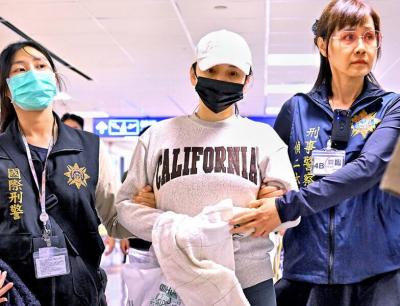
Johanne Liou (劉喬安), a Taiwanese woman who shot to unwanted fame during the Sunflower movement protests in 2014, returned to Taiwan last night after being deported from the US. She is to stand trial in Taiwan for charges involving embezzlement, fraud and drug crimes. The Criminal Investigation Bureau (CIB) said it took her into custody at Taiwan Taoyuan International Airport and would first question her before transferring her to the New Taipei District Prosecutors’ Office. She was arrested upon disembarking a flight from San Francisco that landed shortly before 7pm. Liou absconded to the US in 2019 after jumping bail


 RSS
RSS