


Chinese Nationalist Party (KMT) Chairwoman Cheng Li-wun (鄭麗文) yesterday accused a US think tank of being “in cooperation with the Democratic Progressive Party’s (DPP) rumormongering” following its claim that she echoes the Chinese Communist Party’s (CCP) narrative.
A recent report by the US-based Institute for the Study of War said Cheng’s comments during China’s “Justice Mission 2025” military exercises “echo CCP narratives,” adding that the CCP benefits from the spread of such narratives within Taiwan to undermine the legitimacy of President William Lai’s (賴清德) administration.
Cheng criticized the report’s claim, saying that it is “in coordination with the DPP’s rumormongering supply chain.”
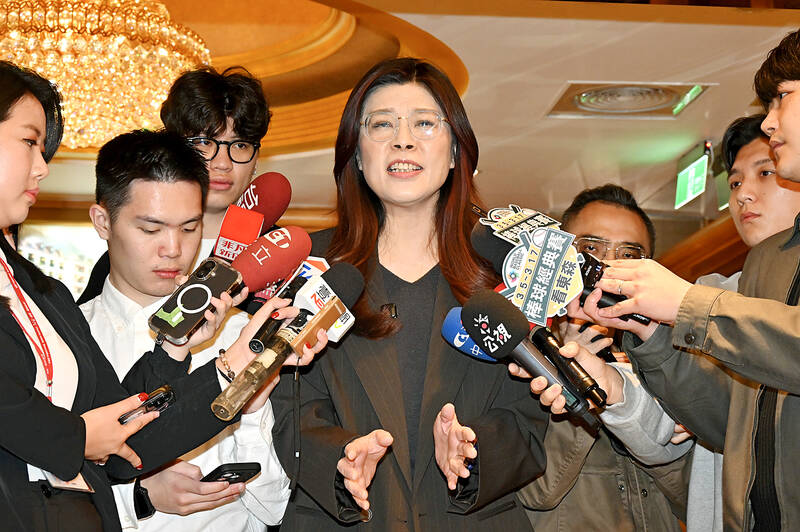
Photo: George Tsorng, Taipei Time
She also took aim at Lai, who is chairman of the DPP.
“Lai should focus on being president of the Republic of China, rather than constantly resorting to unnecessary internal political confrontation, which does nothing to resist China or safeguard Taiwan,” she said.
During the military exercise, which took place on Monday and Tuesday last week, Lai’s national security team did not propose any effective measures to protect Taiwan, she said.
“The source of your national security crisis is your mistaken cross-strait policy, not the KMT,” she said, addressing Lai.
“Since President Lai has said he would not declare independence, if the DPP removes its pro-independence party platform and embraces the ‘1992 consensus,’ cross-strait relations would immediately turn springlike,” Cheng said.
The “1992 consensus” — a term that former Mainland Affairs Council chairman Su Chi (蘇起) in 2006 admitted making up in 2000 — refers to a tacit understanding between the KMT and the CCP that both sides of the Taiwan Strait acknowledge that there is “one China,” with each side having its own interpretation of what “China” means.
The DPP has never acknowledged the “1992 consensus,” saying that Beijing does not recognize the Republic of China and its acceptance would imply agreement with China’s claim over Taiwan.
“Taiwan’s 23 million people overwhelmingly do not want the flames of war to erupt in the Taiwan Strait,” she said. “Lai should reassess the situation, rethink Taiwan’s strategy and readjust how Taiwan can effectively defend itself to create peaceful and stable cross-strait relations, which would be a test of his leadership and wisdom.”
DPP spokesman Lee Kun-cheng (李坤城) yesterday lambasted Cheng for criticizing Lai during China’s military exercise last week, while failing to condemn Beijing for the drills, which “endangered people’s lives and property.”
During the exercises, opposition parties for the fifth time blocked review of a NT$1.25 trillion (US$39.78 billion) special arms procurement bill in the Legislative Yuan’s Procedure Committee, Lee said.
The opposition also passed censure motions against Premier Cho Jung-tai (卓榮泰) and National Security Council Secretary-General Joseph Wu (吳釗燮) when the DPP proposed a motion to condemn China’s drills, he added.
“What the opposition did was to weaken Taiwan’s sovereignty and security while echoing China’s claims that Taiwan is the provocateur and that China’s drills are about maintaining order,” he said. “No wonder a US think tank identified Cheng’s remarks during the exercises as echoing CCP narratives.”
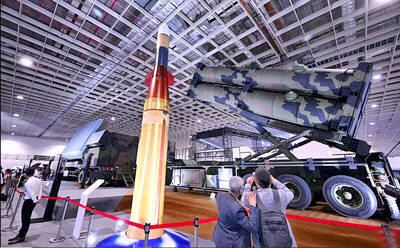
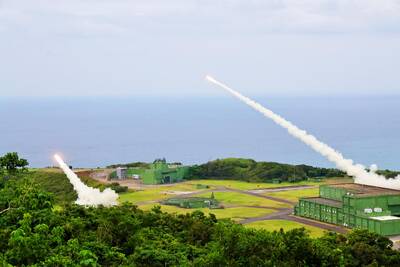
Taiwan is to commence mass production of the Tien Kung (天弓, “Sky Bow”) III, IV and V missiles by the second quarter of this year if the legislature approves the government’s NT$1.25 trillion (US$39.78 billion) special defense budget, an official said yesterday. Commenting on condition of anonymity, a defense official with knowledge of the matter said that the advanced systems are expected to provide crucial capabilities against ballistic and cruise missiles for the proposed “T-Dome,” an advanced, multi-layered air defense network. The Tien Kung III is an air defense missile with a maximum interception altitude of 35km. The Tien Kung IV and V
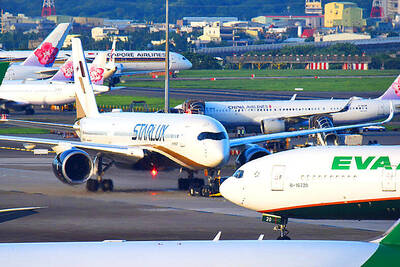
The disruption of 941 flights in and out of Taiwan due to China’s large-scale military exercises was no accident, but rather the result of a “quasi-blockade” used to simulate creating the air and sea routes needed for an amphibious landing, a military expert said. The disruptions occurred on Tuesday and lasted about 10 hours as China conducted live-fire drills in the Taiwan Strait. The Civil Aviation Administration (CAA) said the exercises affected 857 international flights and 84 domestic flights, affecting more than 100,000 travelers. Su Tzu-yun (蘇紫雲), a research fellow at the government-sponsored Institute for National Defense and Security Research, said the air
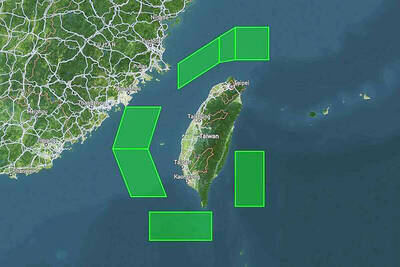
Trips for more than 100,000 international and domestic air travelers could be disrupted as China launches a military exercise around Taiwan today, Taiwan’s Civil Aviation Administration (CAA) said yesterday. The exercise could affect nearly 900 flights scheduled to enter the Taipei Flight Information Region (FIR) during the exercise window, it added. A notice issued by the Chinese Civil Aviation Administration showed there would be seven temporary zones around the Taiwan Strait which would be used for live-fire exercises, lasting from 8am to 6pm today. All aircraft are prohibited from entering during exercise, it says. Taipei FIR has 14 international air routes and
Taiwan lacks effective and cost-efficient armaments to intercept rockets, making the planned “T-Dome” interception system necessary, two experts said on Tuesday. The concerns were raised after China’s military fired two waves of rockets during live-fire drills around Taiwan on Tuesday, part of two-day exercises code-named “Justice Mission 2025.” The first wave involved 17 rockets launched at 9am from Pingtan in China’s Fujian Province, according to Lieutenant General Hsieh Jih-sheng (謝日升) of the Office of the Deputy Chief of the General Staff for Intelligence at the Ministry of National Defense. Those rockets landed 70 nautical miles (129.6km) northeast of Keelung without flying over Taiwan,


 RSS
RSS