


Chinese vessels flying another nation’s flag could be deployed in “gray zone” operations around Taiwan, a civil preparedness advocate said on Friday.
Taiwan National Security Institute deputy secretary-general Ho Cheng-hui (何澄輝) made the remarks after the Yomiuri Shimbun on Thursday reported on the security risk posed by China’s militarized ferries.
The Japanese newspaper said that the Chinese People’s Liberation Army (PLA) Navy has enhanced its capability to conduct fast-moving amphibious assaults on Taiwan by growing its civilian fleet of roll-on/roll-off transports.
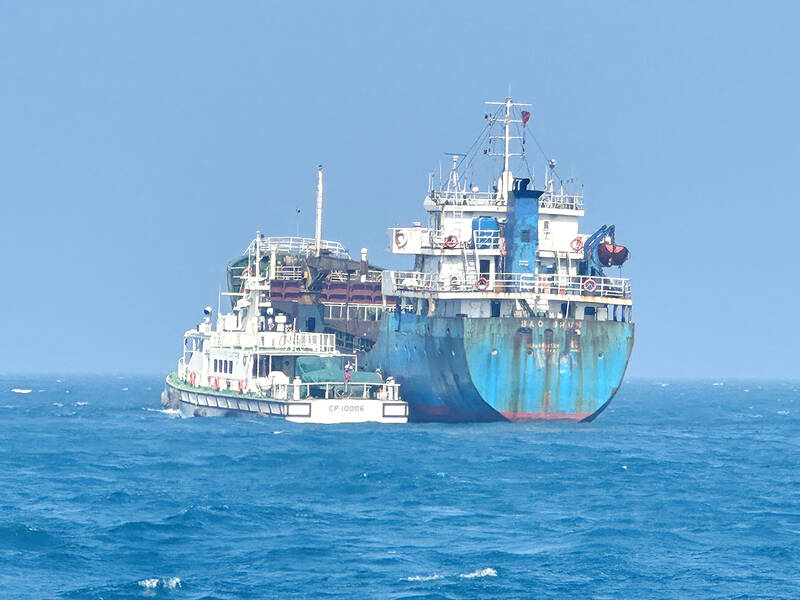
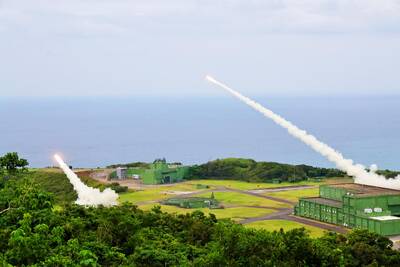
Photo courtesy of the Coast Guard Administration
This class of vessels was heavily featured in the Chinese military’s drills around Taiwan proper, it said.
Former US Department of Defense senior director for China, Taiwan and Mongolia Tony Hsu (胡振東) in 2024 told an online program that continued reliance on civilian ferries reflected a lack of genuine amphibious assault capabilities on China’s part.
Deploying slow and vulnerable ships in an opposed naval landing would incur heavy losses of troops and equipment, although overwhelming numbers might confound the target identification capabilities of the defenders, he said.
Institute of National Defense and Security Research analyst Chen Chia-sheng (陳嘉生) last month said the PLA could use field modifications to transform civilian vessels into disposable missile platforms.
Ho on Friday said that civilian shipping represents a cheap and expedient option for the PLA to meet Chinese President Xi Jinping’s (習近平) target to be ready to invade Taiwan by next year.
However, the low survivability of civilian cargo vessels meant that they could not be deployed effectively without air and sea control, and seizing one or more Taiwanese ports, he said.
Merchant ships refitted to serve as missile platforms should not overly concern Taiwan, because a lack of fire control capabilities makes them relatively easy to defeat after they reveal their position by shooting, he said.
The real threat is the potential use of false-flagged ships in covert operations, which has been showcased by the ongoing Chinese military exercise, he said.
Citing government reports, Ho said the coast guard so far discovered eight Chinese state-owned ships operating in the waters surrounding Taiwan, including seven that requested permission to dock.
Covert deployment of ships could enable the PLA to launch fiber-optic drones, cut undersea cables, or dispatch special operations teams to attack Taiwanese military forces and infrastructure, he said.
Fiber-optic drones use an optical fiber as their teleoperation link and are impervious to jamming.
A multi-layered response is key to dealing with “gray zone” tactics, Ho said.
Effectively countering China’s use of maritime militia forces would require the government to augment the Coast Guard Administration’s capabilities, including aerial drones and uncrewed boats, he said.
In addition, Taipei should study how other countries handle China’s phantom fleet, and conduct joint maritime enforcement operations with the US, Japan and the Philippines, he added.
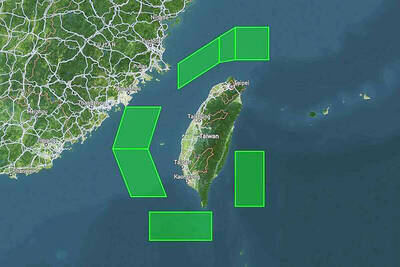
The disruption of 941 flights in and out of Taiwan due to China’s large-scale military exercises was no accident, but rather the result of a “quasi-blockade” used to simulate creating the air and sea routes needed for an amphibious landing, a military expert said. The disruptions occurred on Tuesday and lasted about 10 hours as China conducted live-fire drills in the Taiwan Strait. The Civil Aviation Administration (CAA) said the exercises affected 857 international flights and 84 domestic flights, affecting more than 100,000 travelers. Su Tzu-yun (蘇紫雲), a research fellow at the government-sponsored Institute for National Defense and Security Research, said the air
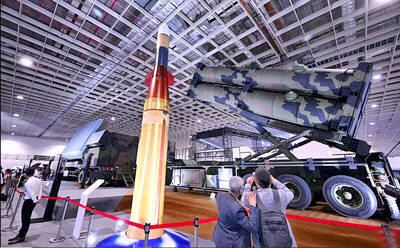
Taiwan is to commence mass production of the Tien Kung (天弓, “Sky Bow”) III, IV and V missiles by the second quarter of this year if the legislature approves the government’s NT$1.25 trillion (US$39.78 billion) special defense budget, an official said yesterday. Commenting on condition of anonymity, a defense official with knowledge of the matter said that the advanced systems are expected to provide crucial capabilities against ballistic and cruise missiles for the proposed “T-Dome,” an advanced, multi-layered air defense network. The Tien Kung III is an air defense missile with a maximum interception altitude of 35km. The Tien Kung IV and V
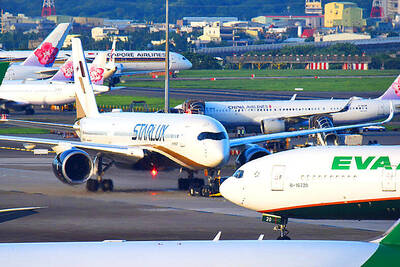
Trips for more than 100,000 international and domestic air travelers could be disrupted as China launches a military exercise around Taiwan today, Taiwan’s Civil Aviation Administration (CAA) said yesterday. The exercise could affect nearly 900 flights scheduled to enter the Taipei Flight Information Region (FIR) during the exercise window, it added. A notice issued by the Chinese Civil Aviation Administration showed there would be seven temporary zones around the Taiwan Strait which would be used for live-fire exercises, lasting from 8am to 6pm today. All aircraft are prohibited from entering during exercise, it says. Taipei FIR has 14 international air routes and
Taiwan lacks effective and cost-efficient armaments to intercept rockets, making the planned “T-Dome” interception system necessary, two experts said on Tuesday. The concerns were raised after China’s military fired two waves of rockets during live-fire drills around Taiwan on Tuesday, part of two-day exercises code-named “Justice Mission 2025.” The first wave involved 17 rockets launched at 9am from Pingtan in China’s Fujian Province, according to Lieutenant General Hsieh Jih-sheng (謝日升) of the Office of the Deputy Chief of the General Staff for Intelligence at the Ministry of National Defense. Those rockets landed 70 nautical miles (129.6km) northeast of Keelung without flying over Taiwan,


 RSS
RSS