


The Mainland Affairs Council (MAC) yesterday reiterated that cross-strait affairs should be handled under the framework of the Act Governing Relations Between the People of the Taiwan Area and the Mainland Area (兩岸人民關係條例), following a proposed amendment to the Offshore Islands Development Act (離島建設條例) that would legalize the establishment of free-trade zones in the nation’s outlying islands.
The amendment, proposed by the Chinese Nationalist Party (KMT) Legislator Chen Yu-jen (陳玉珍), would allow the establishment of free-trade zones on designated outlying islands.
Procedures required for urban renewal projects and environmental impact assessment inside the free-trade zones would be streamlined, while rules governing the establishment and management of free-trade zones would be set by the local governments of outlying islands, the draft says.
Photo: Chung Li-hua, Taipei Times
The draft amendment would stipulate that rules governing the entry and exit of Chinese citizens, companies, groups, funding, goods and services into outlying islands would be jointly established by the local and central governments, and approved by the Executive Yuan.
The proposed amendments were sent directly to a second reading on Dec. 2 last year, and could be approved by the legislature as early as this week, as the one-month negotiation freeze period has expired.
The Democratic Progressive Party criticized the proposal, saying it is designed as a way for Chinese manufacturers to pass off goods as being made in another country.
An official familiar with cross-strait issues said on condition of anonymity that such a matter should be handled based on the cross-strait act.
The proposed amendments carry national security risks and should not be passed in the legislature, otherwise Taiwan proper and the outlying islands would sustain substantial damage before benefiting from it, the official said.
The MAC in a report to the legislature last year said the Offshore Islands Development Act stipulates that the National Development Council and governments of the outlying islands should jointly assess if the islands are equipped with the infrastructure necessary to build a free-trade zone.
The Executive Yuan has already implemented rules regarding the permitting of shipping between the outlying islands and China, the entry and exit of personnel, the import and export of goods, financial transactions, customs clearance, inspection, quarantine, enforcement, and other matters related to cross-strait exchanges in accordance with regulations, the council said.
Under the regulations, any approval for Chinese-invested businesses to set up in free-trade zones or parks must comply with Article 73 and other provisions of cross-strait act, it said.
“To avoid increasing associated risks amid the complex situation across the Strait, it is recommended that matters involving cross-strait exchanges continue to be handled within the framework of this act,” the council said.
In 2013, the Executive Yuan proposed a draft statute on special economic demonstration zones, under which outlying islands could also be covered, it said, adding that the proposal was terminated in 2016 due to significant controversy.
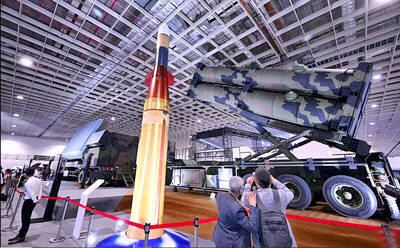
Taiwan is to commence mass production of the Tien Kung (天弓, “Sky Bow”) III, IV and V missiles by the second quarter of this year if the legislature approves the government’s NT$1.25 trillion (US$39.78 billion) special defense budget, an official said yesterday. Commenting on condition of anonymity, a defense official with knowledge of the matter said that the advanced systems are expected to provide crucial capabilities against ballistic and cruise missiles for the proposed “T-Dome,” an advanced, multi-layered air defense network. The Tien Kung III is an air defense missile with a maximum interception altitude of 35km. The Tien Kung IV and V
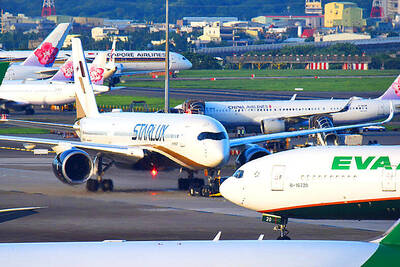
The disruption of 941 flights in and out of Taiwan due to China’s large-scale military exercises was no accident, but rather the result of a “quasi-blockade” used to simulate creating the air and sea routes needed for an amphibious landing, a military expert said. The disruptions occurred on Tuesday and lasted about 10 hours as China conducted live-fire drills in the Taiwan Strait. The Civil Aviation Administration (CAA) said the exercises affected 857 international flights and 84 domestic flights, affecting more than 100,000 travelers. Su Tzu-yun (蘇紫雲), a research fellow at the government-sponsored Institute for National Defense and Security Research, said the air
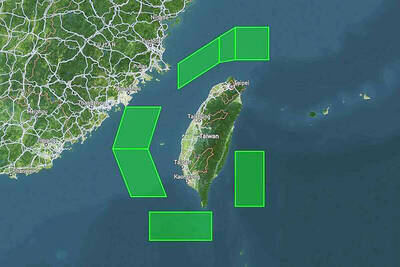
Trips for more than 100,000 international and domestic air travelers could be disrupted as China launches a military exercise around Taiwan today, Taiwan’s Civil Aviation Administration (CAA) said yesterday. The exercise could affect nearly 900 flights scheduled to enter the Taipei Flight Information Region (FIR) during the exercise window, it added. A notice issued by the Chinese Civil Aviation Administration showed there would be seven temporary zones around the Taiwan Strait which would be used for live-fire exercises, lasting from 8am to 6pm today. All aircraft are prohibited from entering during exercise, it says. Taipei FIR has 14 international air routes and
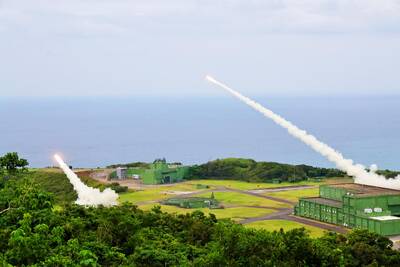
Taiwan lacks effective and cost-efficient armaments to intercept rockets, making the planned “T-Dome” interception system necessary, two experts said on Tuesday. The concerns were raised after China’s military fired two waves of rockets during live-fire drills around Taiwan on Tuesday, part of two-day exercises code-named “Justice Mission 2025.” The first wave involved 17 rockets launched at 9am from Pingtan in China’s Fujian Province, according to Lieutenant General Hsieh Jih-sheng (謝日升) of the Office of the Deputy Chief of the General Staff for Intelligence at the Ministry of National Defense. Those rockets landed 70 nautical miles (129.6km) northeast of Keelung without flying over Taiwan,


 RSS
RSS