


A strong continental cold air mass and radiative cooling sent temperatures plunging across Taiwan early yesterday, with the lowest recorded temperature in low-lying areas down to 4.8°C in Hsinchu County’s Guansi Township (關西), the Central Weather Administration (CWA) said.
The next-lowest temperature was 5.5°C recorded in Miaoli County’s Touwu Township (頭屋), it said.
The temperatures rebounded during the daytime, with highs of 21°C to 23°C in central and northern Taiwan as well as eastern regions, 24°C in the south, and lows of 10 to 12°C in central and northern Taiwan and the northeast, and 14°C to 16°C in southern Taiwan and eastern areas, it said.

Another strong continental cold air mass is forecast to move south from today into tomorrow, driving temperatures down.
Brief showers are expected in areas north of Taoyuan, as well as northeastern and eastern Taiwan, the CWA said.
Independent meteorologist Daniel Wu (吳德榮) said the cold air mass, expected to dominate Taiwan from Wednesday through Saturday, could bring even lower early-morning temperatures due to stable, clear conditions that aid radiative cooling.
Lows could be below 5°C, which would be the first officially classified cold surge of the winter.
The CWA defines a cold surge as conditions in which temperatures at the Taipei weather station fall to 10°C or lower.
Separately, doctors urged people to stay warm, especially elderly people.
According to statistics from the Changhua County Fire Department, between 8am on Friday and 8am yesterday, 88 people in the county were hospitalized due to suspected myocardial infarction or other illnesses. Among them, six elderly people were transported for out-of-hospital cardiac arrest, and all six cases occurred late at night or in the early morning.
Although cold weather cannot be confirmed as the cause of injury for all of them, doctors said people should pay attention to the health conditions of elderly family members and young children, and if they detect any discomfort, they should seek medical attention immediately.
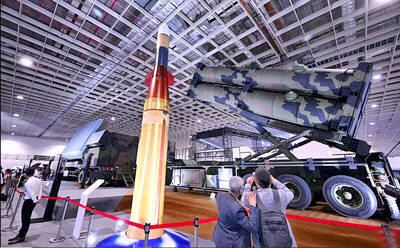
Taiwan is to commence mass production of the Tien Kung (天弓, “Sky Bow”) III, IV and V missiles by the second quarter of this year if the legislature approves the government’s NT$1.25 trillion (US$39.78 billion) special defense budget, an official said yesterday. Commenting on condition of anonymity, a defense official with knowledge of the matter said that the advanced systems are expected to provide crucial capabilities against ballistic and cruise missiles for the proposed “T-Dome,” an advanced, multi-layered air defense network. The Tien Kung III is an air defense missile with a maximum interception altitude of 35km. The Tien Kung IV and V
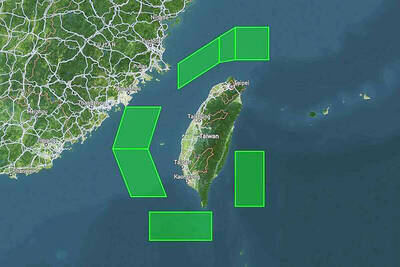
The disruption of 941 flights in and out of Taiwan due to China’s large-scale military exercises was no accident, but rather the result of a “quasi-blockade” used to simulate creating the air and sea routes needed for an amphibious landing, a military expert said. The disruptions occurred on Tuesday and lasted about 10 hours as China conducted live-fire drills in the Taiwan Strait. The Civil Aviation Administration (CAA) said the exercises affected 857 international flights and 84 domestic flights, affecting more than 100,000 travelers. Su Tzu-yun (蘇紫雲), a research fellow at the government-sponsored Institute for National Defense and Security Research, said the air
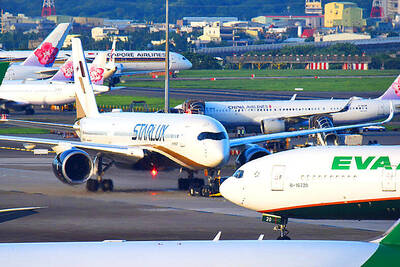
Trips for more than 100,000 international and domestic air travelers could be disrupted as China launches a military exercise around Taiwan today, Taiwan’s Civil Aviation Administration (CAA) said yesterday. The exercise could affect nearly 900 flights scheduled to enter the Taipei Flight Information Region (FIR) during the exercise window, it added. A notice issued by the Chinese Civil Aviation Administration showed there would be seven temporary zones around the Taiwan Strait which would be used for live-fire exercises, lasting from 8am to 6pm today. All aircraft are prohibited from entering during exercise, it says. Taipei FIR has 14 international air routes and
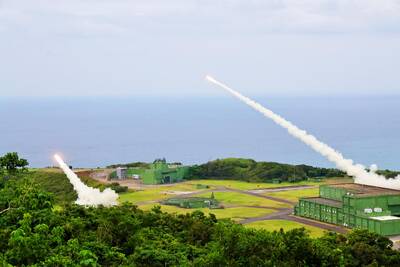
Taiwan lacks effective and cost-efficient armaments to intercept rockets, making the planned “T-Dome” interception system necessary, two experts said on Tuesday. The concerns were raised after China’s military fired two waves of rockets during live-fire drills around Taiwan on Tuesday, part of two-day exercises code-named “Justice Mission 2025.” The first wave involved 17 rockets launched at 9am from Pingtan in China’s Fujian Province, according to Lieutenant General Hsieh Jih-sheng (謝日升) of the Office of the Deputy Chief of the General Staff for Intelligence at the Ministry of National Defense. Those rockets landed 70 nautical miles (129.6km) northeast of Keelung without flying over Taiwan,


 RSS
RSS