


The government is taking a cautious response to a civic group’s call to raise the tobacco health and welfare surcharge.
The nation’s tobacco health and welfare surcharge has remained at NT$20 per pack since it was adjusted in 2009.
The Ministry of Health and Welfare (MOHW) and the Ministry of Finance convene experts from different fields every two years to review the tobacco health surcharge, taking into account factors such as tobacco consumption, smoking rates, national income and the consumer price index, according to Article 4 of the Tobacco Hazards Prevention Act (菸害防制法).

Photo: CNA
If an increase is deemed necessary, it must be submitted to the Executive Yuan for approval and then sent to the Legislative Yuan for review.
Imported or domestically produced cigarettes are subject to a tobacco health surcharge of NT$20 per pack. For the past five years, the surcharge has contributed about NT$13.7 billion (US$436 million) per year to the National Health Insurance reserve fund.
The John Tung Foundation said that cigarette prices in Taiwan are too low and that the tobacco surcharge or tax should be significantly and rapidly increased, aiming for a cigarette price of NT$400 by 2035, in order to restore the principle of “using price to control consumption” and achieve the goal of tobacco harm prevention.
Lin Ching-li (林清麗), director of the Tobacco Control Division at the John Tung Foundation, yesterday said that most countries primarily rely on tobacco taxes, while Taiwan uses both a tobacco tax and a tobacco health surcharge.
Ideally, this system should reach the WHO-recommended level, where tobacco taxes account for 75 percent of the retail cigarette price, she said, adding that since the tobacco surcharge was introduced in 2002, it was only raised by NT$5 in 2006 and NT$10 in 2009, while the tobacco tax was increased by NT$20 in 2017.
The combined tobacco tax and surcharge in Taiwan amounts to only NT$51.8 per pack, she said.
Discussions about the tobacco surcharge and tax in Taiwan have been distorted by tobacco companies into a “money-grabbing battle,” shifting the focus away from health promotion goals toward debates about the allocation of the surcharge, Lin said.
Other countries and regions adjust tobacco taxes more frequently than Taiwan, often by US$1–2 at a time, she said, pointing to Hong Kong, which had cigarette prices similar to Taiwan’s 40 years ago, and now has prices that are four times higher.
Lin said Taiwan’s tobacco tax and surcharge should be increased immediately when adjusted, without giving tobacco companies time to stockpile and profit.
She suggested implementing a NT$60 tax increase next year to raise cigarette prices to NT$200 per pack, followed by NT$30 increases every two years, taking cues from Australia and Hong Kong, with the goal of reaching NT$400 per pack by 2035.
Hsueh Kuang-chieh (薛光傑), director of the Tobacco Cessation Clinic at Kaohsiung Veterans General Hospital, said that the tobacco surcharge has long been left “unchanged when it should have been adjusted,” reflecting excessive government caution in policy.
He said that raising the surcharge and increasing cigarette prices to “control consumption through price” reduces the desire to smoke at the source, lowers health risks, and is most beneficial for National Health Insurance and public health.
When reached for comment, Health Promotion Administration Director-General Shen Ching-fen (沈靜芬) yesterday said that the tobacco health surcharge system has been evaluated on a regular basis, taking into account smoking rates, tobacco consumption, price levels and overall tobacco control strategies.
Shen said the core purpose of levying tobacco taxes and surcharges is to reduce tobacco consumption and protect public health.
Governmental data have shown that the adult smoking rate has dropped from 21.9 percent in 1997 to 12.8 percent in 2024, a decline of about 40 percent over 27 years, she said.
She said increasing tobacco taxes or surcharges is only one part of tobacco control policy.
It must be combined with regulatory measures, health education and cessation services to achieve the greatest impact, she said.
Additional reporting by Chiu Chih-jou
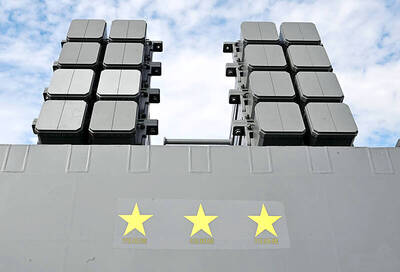
UPGRADE: The Kang Ding-class frigate is replacing its Chaparall missiles with Tien Chien II and Hua Yang VLS, which would provide it with long-range, 360° air defense Taiwan plans to produce 1,200 to 1,376 Hai Chien II missiles (海劍二, Sea Sword II) — also known as TC-2N — to serve as the standard air defense system of the navy’s surface combatant fleet, a source said yesterday. Last week, the Hai Chien II, the naval version of the Tien Kung II missile (天劍二, Sky Sword II), completed a live-fire test in waters off the National Chungshan Institute of Science and Technology’s Jiupeng facility (九鵬) in Pingtung County’s Manjhou Township (滿州). The MIM72 Chaparral and other dated air defense missiles that currently arm Taiwanese ships have inadequate range to combat Chinese

REASONS FOR TRAVEL: An assistant professor said that proposed amendments to penalize drivers if they used drugs overseas would not deter people from traveling People who operate a motor vehicle under the influence of marijuana would have their driver’s license revoked, even if they used the substance while overseas, the Ministry of Transportation and Communications said yesterday, citing proposed amendments to the Road Traffic Management and Penalty Act (道路交通管理處罰條例). The amendments would also authorize the government to revoke the licenses of people determined to have used Category 1 or Category 2 narcotics, even if they were not operating a vehicle while under the influence of drugs, as well as ban them from taking the license test for three years, the ministry said. People aged 18 or

HEAVY WEATHER: Typhoon Jangmi is due to crash straight into the Ryukyus as airlines look to shift flights to larger aircraft or cancel flights to Okinawa entirely Taiwan’s international air carriers announced flight adjustments over the weekend as Typhoon Jangmi is forecast to hit the Ryukyu Islands today and tomorrow. The Central Weather Administration (CWA) upgraded Jangmi from a tropical storm to a typhoon at 8am yesterday, with the eye located 580km south of Naha city. It was moving north at 19kph. Today, China Airlines’ CI-120, CI-121, CI-122 and CI-123 flights between Taoyuan and Naha, Okinawa, have been canceled as well as CI-132 and CI-133 between Kaohsiung and Naha. EVA Air’s BR-112, BR-113, BR-186 and BR-185 flights between Taoyuan and Naha are also canceled. Low-cost carrier Tigerair Taiwan canceled IT-230,
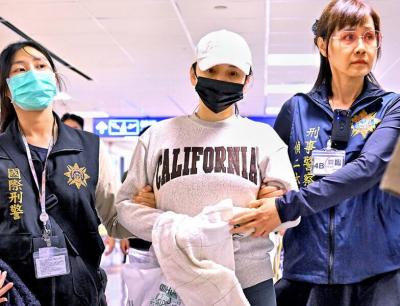
Johanne Liou (劉喬安), a Taiwanese woman who shot to unwanted fame during the Sunflower movement protests in 2014, returned to Taiwan last night after being deported from the US. She is to stand trial in Taiwan for charges involving embezzlement, fraud and drug crimes. The Criminal Investigation Bureau (CIB) said it took her into custody at Taiwan Taoyuan International Airport and would first question her before transferring her to the New Taipei District Prosecutors’ Office. She was arrested upon disembarking a flight from San Francisco that landed shortly before 7pm. Liou absconded to the US in 2019 after jumping bail


 RSS
RSS