


The Executive Yuan has proposed amendments to laws aimed at counteracting the Chinese Communist Party’s (CCP) “united front” operations, a government official said last week, adding that the changes are necessary, as China’s hostility toward Taiwan has intensified.
President William Lai (賴清德) in a high-level national security meeting in March introduced 17 response strategies to counter China’s infiltration, “united front” operations and sovereignty challenges toward Taiwan.
The Executive Yuan has conducted a cross-ministerial review and identified 20 rules that should be implemented — whether through new legislation or amendments — to address the issues.
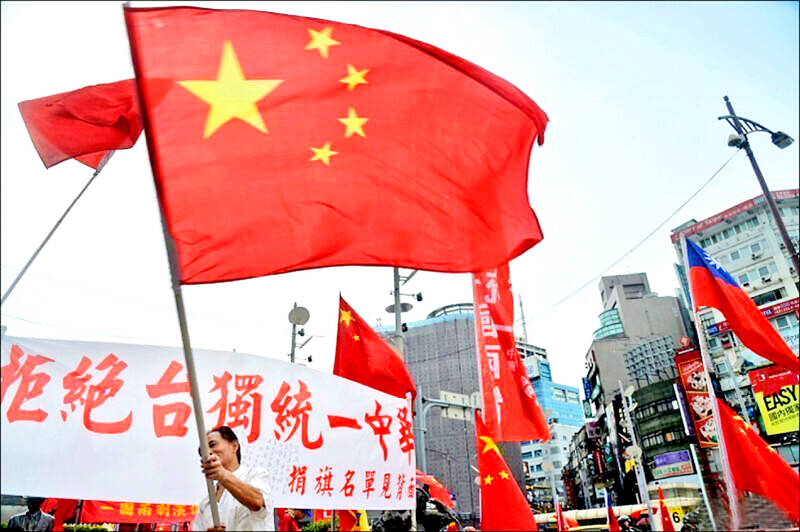
Photo: Taipei Times
The work is in progress, said the official, who asked to remain anonymous.
On Dec. 18, the Executive Yuan approved draft amendments to the National Security Act (國家安全法), Article 24 of the Criminal Code of the Armed Forces (陸海空軍刑法), articles 24, 25 and 41 of the Act of Military Service for Officers and Non-commissioned Officers of the Armed Forces (陸海空軍軍官士官服役條例), and Article 32 of the Veterans Assistance Act (國軍退除役官兵輔導條例).
Draft amendments to the National Security Act include expanding the definition of what constitutes unlawful involvement in organizations and adding administrative penalties for speech advocating war, the official said.
Publicly advocating, promoting or supporting the initiation of war against the Republic of China (ROC), or the use of non-peaceful means to eliminate ROC sovereignty by a foreign country, would be fined NT$100,000 to NT$1,000,000 (US$3,183 to US$31,828), they said.
Active or retired military personnel, civil servants or teachers who are found guilty of national security offenses would have their monthly pension halved upon a conviction warranting a prison term in a trial of first instance, the proposed amendments say, a change from where pension rights are revoked only after a final guilty verdict.
The draft amendments would increase criminal penalties by 50 percent for active-duty personnel or civil servants who deliberately contravene the National Security Act, the officials said.
Draft amendments to Article 24 of the Criminal Code of the Armed Forces stipulate that active-duty service members who express loyalty to the enemy through speech or other means would face imprisonment for one to seven years, the official said.
The changes would also increase penalties for active-duty service members who fail to fulfill their duties and surrender to the enemy, with sentences of three to 10 years, while new provisions would punish those convicted of involvement in the preparation of such offenses, they said.
The draft amendments to the Veterans Assistance Act stipulate that if a veteran is subject to suspension of all or part of their retirement payments according to provisions of the Act of Military Service for Officers and Non-commissioned Officers of the Armed Forces or other laws, their benefits would be “simultaneously suspended,” the official said.
The changes also introduce a new provision stipulating that veterans who “do not receive monthly retirement payments” and are fined according to provisions of the veteran’s act, their eligibility for benefits under the act would be suspended for one to five years, depending on the amount of the fine, they said.
Asked why the Cabinet is pushing the legislature to pass the amendments when it knows that opposition parties hold a majority, the official said that changes requiring lawmakers to obtain approval prior to travel to China, as well as disclosure requirements for such travel, are actually a guarantee from the government that trips to China by government officials would not prompt public anxiety.
The proposals seek to make people feel safer and advance democratic politics, as they provide mechanisms for people to scrutinize officials and hold them accountable, the official said.
The Cabinet maintains a positive outlook and is willing to explain the urgency and necessity of passing the amendments, they said.
China’s hostility toward Taiwan is intensifying and it is relentlessly trying to infiltrate Taiwan with its “united front” tactics, the official said.
Civil servants traveling to China are often approached, co-opted or lured by the CCP, the official said, adding that those who visit China several times might be asked to develop clandestine organizations and become “local collaborators.”
Meanwhile, the Executive Yuan on Dec. 26 approved draft amendments to the Act Governing Relations Between the People of the Taiwan Area and the Mainland Area (臺灣地區與大陸地區人民關係條例) and the Social Order Maintenance Act (社會秩序維護法).
The proposed changes would require that civil servants ranked below “grade 10” who do not work with classified material obtain approval from their agency before traveling to China.
Legislators and other government workers who are aware of or have state secrets would be required to obtain approval from a joint review committee.
The draft changes also stipulate that legislators and personnel who know, possess or store national security information due to their professional duties must obtain approval from the Ministry of the Interior’s joint review committee before traveling to China.
Proposed amendments to the Social Order Maintenance Act would penalize actions at public venues that use flags, banners, or similar items to affect public order by advocating, promoting or disseminating hate speech, terrorism or the agendas of foreign hostile forces, intended to exacerbate social divisions or the elimination of Taiwan’s national sovereignty.
Anyone who publicly advocates, promotes, spreads or broadcasts hateful speech, terrorism or claims that escalate social division or deny the sovereignty of the Republic of China on the Internet face having their account terminated, the official said.
The Legislature advanced the Executive Yuan’s proposal for stricter China travel rules for officials to committee review, but blocked its proposed amendments to the Social Order Maintenance Act on ground that they are akin to Internet martial law.

FUKUOKA SITUATION: Japanese media reported that the pathogen is expected to be identified by the summer, while the CDC downplayed the idea that it was hMPV A “mysterious cold-like illness” reported in Japan’s Fukuoka Prefecture does not seem to be a new disease, but Japanese authorities have been asked about the situation, the Centers for Disease Control (CDC) said yesterday. The Fukuoka Prefectural Medical Association on Wednesday told a news conference that a “mystery cold” that has become a hot topic on social media is “highly likely to be caused by some kind of viral infection,” Japan’s KBC News reported. “Many people are experiencing symptoms starting with a sore throat, followed by a runny nose, phlegm and a severe cough,” KBC News reported, citing association officials. Health authorities are

Nvidia Corp CEO Jensen Huang (黃仁勳) arrived in Taiwan yesterday ahead of upcoming AI and technology events, saying he plans to meet with clients and Taiwan Semiconductor Manufacturing Co Chairman C.C. Wei (魏哲家) during his visit. After landing at Taipei Songshan Airport, Huang posed for photos with fans and handed out Yakult drinks to reporters and supporters waiting at the scene, saying he has “a lot to do” during the trip. Asked about reports that Nvidia’s planned headquarters site in Taipei’s Beitou Shilin Technology Park could break ground on May 27, Huang said that if the company holds an event, he would

The Ministry of Finance this afternoon announced the winning numbers for the March-April uniform invoice lottery. The winning number for the NT$10 million (US$318,060) special prize is 19531471, and the winning number for the NT$2 million grand prize is 85941329. Three numbers were drawn for the NT$200,000 first prize: 07225810, 20231230 and 83518781. Those with receipts matching the last seven digits of any of the first-prize numbers will win the NT$40,000 second prize, while those matching the last six digits will win the NT$10,000 third prize. Those whose receipts match the last five digits of the first-prize numbers can claim the NT$4,000 fourth prize,
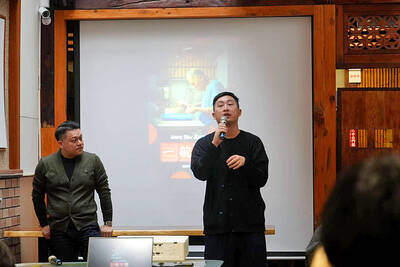
Taiwan Travelogue (臺灣漫遊錄), which earlier this week became the first Taiwanese novel to win the International Booker Prize, is to be adapted into a television series through a Taiwan-Japan coproduction, producer Chang Chen-yu (張辰漁) said yesterday. Chang, a producer at World Softest Production Film Co, wrote on Facebook that the company had been searching for projects with international appeal that retain a strong Taiwanese identity after colleagues and Japanese partners strongly recommended the novel. After reading the book, Chang said he immediately decided to pursue the screen rights. “A great story has the power to transcend time and borders, and connect countless people,”


 RSS
RSS