


The Ministry of National Defense yesterday stressed the importance of building a self-sufficient, non-China-reliant national defense industry, adding that this focus is a critical part of the ministry’s efforts to develop drone production supply chains.
Department of Strategic Planning Director Lieutenant General Huang Wen-chi (黃文?) made the remarks in an interview with the Chinese-language Liberty Times (the sister newspaper of the Taipei Times) yesterday, stating that, as an island, Taiwan is at high risk of being blockaded and cut off from external supplies.
Fostering a self-reliant national defense industry would mitigate the threats of such blockades, he said.
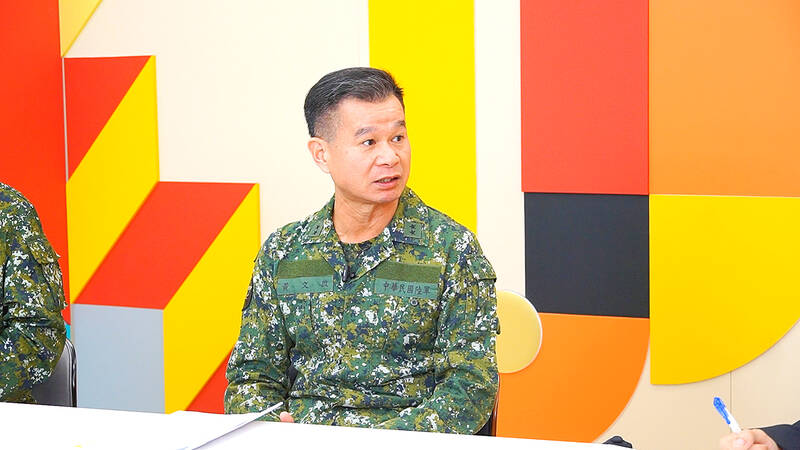
Photo: Chen Pin-yu, Taipei Times
The urgency, importance and speed of equipment delivery should determine whether it is manufactured domestically or purchased from abroad, he added.
The military should prioritize support for local industries if fostering a self-reliant, autonomous national defense industry means defense equipment could be acquired locally, Huang said, adding that foreign purchases should only be considered when domestic procurement is impossible due to technological barriers, long production times or if such an acquisition is not cost-effective.
The ministry’s plan to build local drone production supply chains is an essential step toward establishing a fully decoupled supply chain from Chinese suppliers, he said.
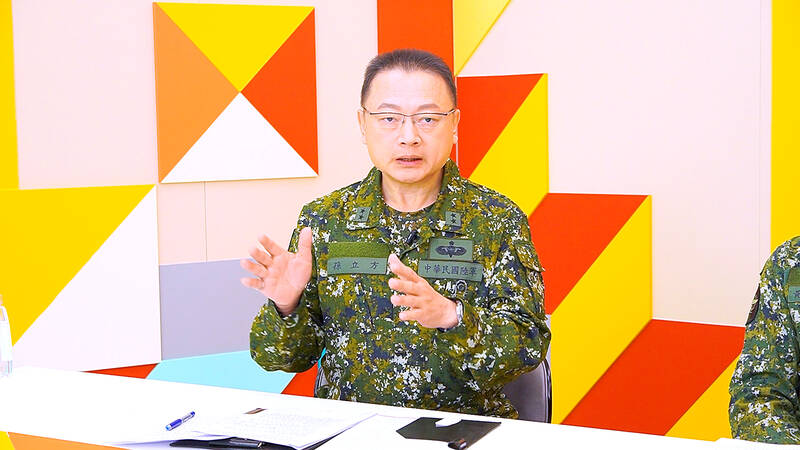
Photo: Chen Pin-yu, Taipei Times
The Armament Bureau also plans to increase munitions production for various weapons and is fostering the necessary local industries, he added.
Taiwan should no longer be content to simply increase production capacity for the Armaments Bureau or the Chungshan Institute of Science and Technology, but should instead leverage the nation’s advanced precision technology sector and strong production capacity to foster an autonomous national defense industry, Huang said.
The number of M109A7 Paladin self-propelled howitzers and High Mobility Artillery Rocket Systems (HIMARS) to be sold to Taiwan in the announcement made by US President Donald Trump’s administration on Dec. 17 last year was not less than before, but was the “most reliable estimate” that the US can provide, based on US manufacturer capability and in light of orders placed by other countries, he said.
The number of Paladin howitzers agreed for sale has fallen short of expectations, but it is the most reliable estimate of equipment that can be delivered on time, Huang said, adding that Taiwan has received all 29 sets of HIMARS previously purchased.
Acquisition of these systems would be key to the army’s transition upgrades for its units, he said, adding that the ministry would continue to maintain close contact with the US to adjust equipment purchases based on the enemy’s threat level.
Ministry spokesman Major General Sun Li-fang (孫立方) in the same interview said that if the special defense budget is not passed, the international community would begin to doubt Taiwan’s resolve to defend itself, which would have negative ramifications.
The number of Chinese jets spotted has increased by 7 percent in the past year, while the number of ships has increased by 23 percent, Sun said.
If narrowed down to Taiwan’s quick reaction zone, the number of Chinese jets has nearly doubled, he said, adding that this showed that the line between military exercise and actual invasive maneuver is increasingly blurred.
Only by increasing its capabilities quickly can Taiwan’s military show China that it should not act rashly and that such actions would come at a cost, Sun said, adding that such deterrence would pave the way for possible peace talks.

NATIONAL SECURITY: Authorities are working to confirm the identities of the military personnel involved and investigating possible illegal conduct and regulatory violations Authorities are probing possible national security implications after Kinmen police and immigration officers on Sunday found a Chinese woman allegedly posing as a tourist while engaging in prostitution involving more than 10 military personnel. The woman, surnamed Chen (陳), has since been deported, authorities said, adding that investigators are still working to confirm the identities of those implicated, as the records only listed code names and aliases. The case stemmed from a report received by the Kinmen District Prosecutors’ Office on Friday last week from the Jinhu Precinct of the Kinmen County Police Bureau. On Sunday, police, along with the National Immigration

GLOBALGIVING: ‘ Caving to external pressure is not acceptable for an organization that has cultivated justice reform and human rights for 30 years,’ one NGO said A slew of non-government organizations (NGOs) have withdrawn from the GlobalGiving fundraising platform after it announced it would use “Chinese Taipei” instead of “Taiwan” from next month. The Taiwan Good Rice Association wrote on Facebook on Friday that it was informed on April 28 via a teleconference call of the change, which was made because the platform wanted to operate in China. Taiwan Good Rice is to terminate all cooperative relationships with GlobalGiving in response to the platform’s “unilateral and non-negotiable” decision to remove references to Taiwan, the NGO said. “Taiwan is in the official name of Taiwan Good Rice Association and the

HEAVY WEATHER: Typhoon Jangmi is due to crash straight into the Ryukyus as airlines look to shift flights to larger aircraft or cancel flights to Okinawa entirely Taiwan’s international air carriers announced flight adjustments over the weekend as Typhoon Jangmi is forecast to hit the Ryukyu Islands today and tomorrow. The Central Weather Administration (CWA) upgraded Jangmi from a tropical storm to a typhoon at 8am yesterday, with the eye located 580km south of Naha city. It was moving north at 19kph. Today, China Airlines’ CI-120, CI-121, CI-122 and CI-123 flights between Taoyuan and Naha, Okinawa, have been canceled as well as CI-132 and CI-133 between Kaohsiung and Naha. EVA Air’s BR-112, BR-113, BR-186 and BR-185 flights between Taoyuan and Naha are also canceled. Low-cost carrier Tigerair Taiwan canceled IT-230,
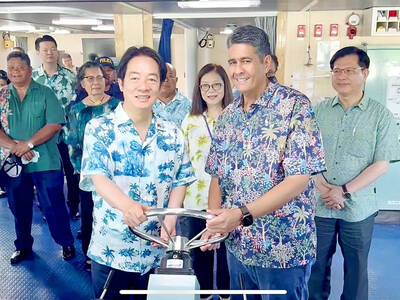
MULTIPRONGED APPROACH: China has sought to pressure Palau across a number of fronts, but the island nation has staunchly resisted overtures to ditch Taiwan Palau has been firm in backing Taiwan despite Chinese pressure that uses tourism economics, cyberattacks and criminal infiltration as tools to threaten the Pacific ally into renouncing its recognition of Taiwan as a sovereign state. The Presidential Office yesterday announced that Vice President Hsiao Bi-khim (蕭美琴) would visit Palau from Saturday to Wednesday next week at the invitation of Palauan President Surangel Whipps Jr. Whipps in April said in an interview that China had outspokenly asked Palau to “denounce Taiwan.” “And we have said: ‘We have no enemies, but nobody tells us who our friends are,’” he said. Whipps has told reporters multiple times


 RSS
RSS