


A temporary steel bridge over the Mataian River (馬太鞍溪) in Hualien County opened for traffic yesterday after the original bridge was destroyed by flooding on Sept. 23 last year.
The bridge is an important passage connecting Fonglin (鳳林) and Guangfu (光復) townships.
Torrential rain brought by the outer rainbands of Typhoon Ragasa led to the collapse of a barrier lake along the Mataian River, killing 18 people and causing massive infrastructure damage, including the bridge over the river.
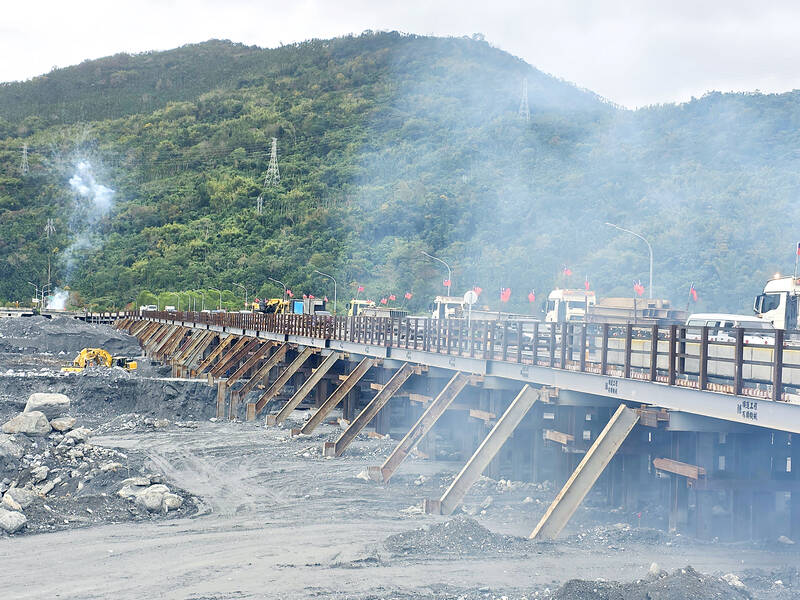
Photo: Hua Meng-ching, Taipei Times
The temporary bridge, which features one through lane and one slow lane in each direction, opened for traffic at 10am, one month earlier than initially scheduled.
Construction of a new permanent bridge also began on Wednesday.
The deck of the new bridge is to be 9m higher than the old bridge to enhance its disaster-resistant capabilities, the Highway Bureau said.
Northbound lanes of the new bridge are scheduled to be completed by the end of this year, while southbound lanes are scheduled to be completed next year, it said.
“I have never seen such a highly efficient construction team, which helped rebuild the Nanfangao Bridge. Their professionalism and experience enabled them to make an accurate judgement on the direction of the construction,” bureau Director-General Lin Fu-shan (林福山) told a news conference in Hualien.
By employing a hydrojet vibro hammer to install H-shaped steel piles, engineers were able to overcome the riverbed’s large boulders that had been hindering progress, Lin said.
The bureau’s Eastern Region Branch Office said in a briefing that the construction of the 560m-long and 12m-wide steel bridge would cost about NT$430 million (US$13.68 million), adding that the bridge would be closed when there is extremely heavy rainfall or the water level at the upper stream reaches a dangerous level.
The construction team was managed by engineers from Shun Yun Engineering Co.
Company president Hsieh Jin-ching (謝金清) said the team’s biggest challenge was the geological conditions in Hualien, which are very different from that on the west coast.
“We tried to use all the tools we have to install steel piles. The hydrojet vibro hammer technique was proven to be the most efficient. We started making progress in construction after a one-week adjustment period,” Hsieh said.
The technique uses a large amount of water to remove boulders on the riverbed to facilitate the installation of steel piles, which helps minimize wear and tear on the equipment, Hsieh said.
The team used three sets of machinery to speed up construction, which was slightly delayed by a newly formed barrier lake along the Mataian River and arrival of Typhoon Fung-wong, he said.
The riverbed access path, which was built before the temporary steel bridge, would be removed within one week for the Water Resources Agency to carry out dredging work, Lin said.
The new bridge is being built by the contractor that built the Danjiang Bridge in New Taipei City and should be completed on schedule, Lin added.

Trips for more than 100,000 international and domestic air travelers could be disrupted as China launches a military exercise around Taiwan today, Taiwan’s Civil Aviation Administration (CAA) said yesterday. The exercise could affect nearly 900 flights scheduled to enter the Taipei Flight Information Region (FIR) during the exercise window, it added. A notice issued by the Chinese Civil Aviation Administration showed there would be seven temporary zones around the Taiwan Strait which would be used for live-fire exercises, lasting from 8am to 6pm today. All aircraft are prohibited from entering during exercise, it says. Taipei FIR has 14 international air routes and
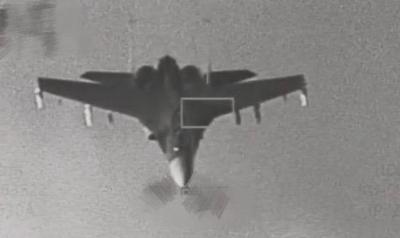
The Ministry of National Defense (MND) today released images of the military tracking China’s People's Liberation Army (PLA) movements during the latest round of Chinese drills around Taiwan. The PLA began "Justice Mission 2025" drills today, carrying out live-fire drills, simulated strikes on land and maritime targets, and exercises to blockade the nation's main ports. The exercises are to continue tomorrow, with the PLA announcing sea and air space restrictions for five zones around Taiwan for 10 hours starting from 8:30am. The ministry today released images showing a Chinese J-16 fighter jet tracked by a F-16V Block 20 jet and the

City buses in Taipei and New Taipei City, as well as the Taipei MRT, would on Saturday begin accepting QR code payments from five electronic payment providers, the Taipei Department of Transportation said yesterday. The new option would allow passengers to use the “transportation QR code” feature from EasyWallet, iPass Money, iCash Pay, Jkopay or PXPay Plus. Passengers should open their preferred electronic payment app, select the “transportation code” — not the regular payment code — unlock it, and scan the code at ticket readers or gates, General Planning Division Director-General Liu Kuo-chu (劉國著) said. People should move through the

Snow fell on Yushan (Jade Mountain, 玉山) yesterday morning as a continental cold air mass sent temperatures below freezing on Taiwan’s tallest peak, the Central Weather Administration (CWA) said. Snowflakes were seen on Yushan’s north peak from 6:28am to 6:38am, but they did not fully cover the ground and no accumulation was recorded, the CWA said. As of 7:42am, the lowest temperature recorded across Taiwan was minus-5.5°C at Yushan’s Fengkou observatory and minus-4.7°C at the Yushan observatory, CWA data showed. On Hehuanshan (合歡山) in Nantou County, a low of 1.3°C was recorded at 6:39pm, when ice pellets fell at Songsyue Lodge (松雪樓), a


 RSS
RSS