


The government is next year to offer new single-dose pneumococcal vaccines, as well as adjuvanted influenza vaccines for some elderly people, while increasing the administration fee for young children, the Centers for Disease Control (CDC) said yesterday.
The Executive Yuan on Thursday last week approved the policy, which includes offering new single-dose pneumococcal conjugate vaccines, CDC Director-General Philip Lo (羅一鈞) said.
The single-dose 20-valent pneumococcal conjugate vaccine has already obtained a drug permit license and is marketed in Taiwan, while the license for the single-dose 21-valent vaccine is still in the application phase, but is likely to be approved in April, he said.
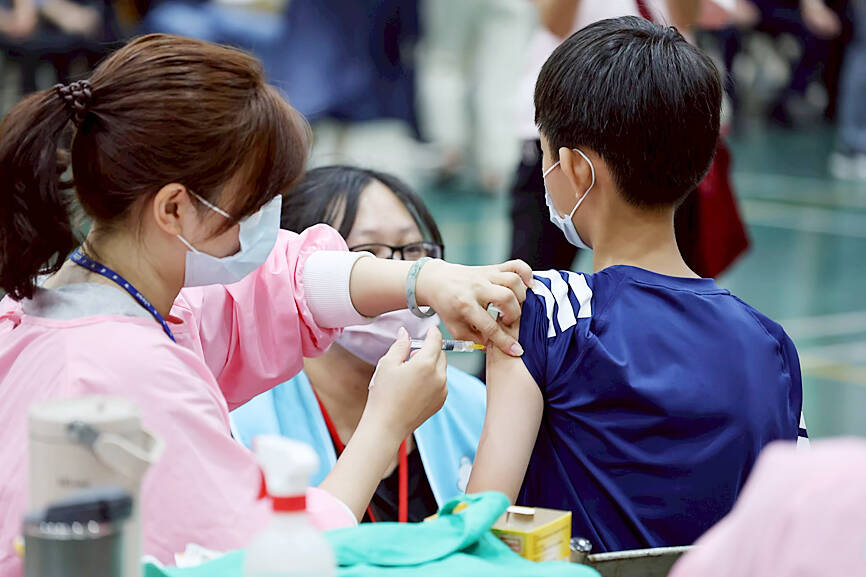
Photo: Tsai Shu-yuan, Taipei Times
The Advisory Committee on Immunization Practices has agreed that the single-dose vaccines can replace the current two-dose regimens, he said.
“For recipients, [the new vaccines] provide better protection and are more convenient,” Lo said.
He said that 150,000 doses of the new single-dose vaccine have been purchased, and would be ready for administering from Jan. 15 in two phases.
People aged 65 years or older, indigenous people aged 50 to 64, and people aged 19 to 64 with high risk of invasive pneumococcal disease (IPD) are eligible for the government-funded single-dose pneumococcal conjugate vaccines, the CDC said.
People at high risk of IPD include those with spleen dysfunction, immunodeficiency, cochlear implants, cerebrospinal fluid rhinorrhea, or those who have undergone radiotherapy, taken immunosuppressive agents or have had an organ transplant in the past year, it said.
In the first phase, eligible recipients would be those who have never received a pneumococcal vaccine, only received the pneumococcal 23-valent vaccine for over a year, or those at high risk of IPD who have received a 13-valent vaccine before age 65 or received both a 15-valent and a 23-valent vaccine, or are aged 65 or older and received the last dose more than five years ago, Lo said.
The second phase would begin later in the year for those who have received a 13-valent or a 15-valent vaccine for more than a year, he added.
The CDC would also purchase 200,000 doses of adjuvanted flu vaccines for elderly people in long-term care centers or nursing homes to boost their protection against the flu next year, he said.
The agency would only increase the vaccine administration fee, as many healthcare workers have expressed concern that the NT$100 per shot fee no longer covers the rising costs of administering vaccines, Lo said.
The fee is to be increased from NT$100 to NT$200 for each shot given to young children aged six and younger, and from NT$100 to NT$150 for each shot given to people of other ages, he said, adding that the new payment standard is to take effect on March 1.
A plan to include rotavirus vaccines in the government-funded vaccination program for young children has also been approved, but would be added in 2027, he said.

Considering that most countries issue more than five denominations of banknotes, the central bank has decided to redesign all five denominations, the bank said as it prepares for the first major overhaul of the banknotes in more than 24 years. Central bank Governor Yang Chin-lung (楊金龍) is expected to report to the Legislative Yuan today on the bank’s operations and the redesign’s progress. The bank in a report sent to the legislature ahead of today’s meeting said it had commissioned a survey on the public’s preferences. Survey results showed that NT$100 and NT$1,000 banknotes are the most commonly used, while NT$200 and NT$2,000

The Centers for Disease Control (CDC) yesterday reported the first case of a new COVID-19 subvariant — BA.3.2 — in a 10-year-old Singaporean girl who had a fever upon arrival in Taiwan and tested positive for the disease. The girl left Taiwan on March 20 and the case did not have a direct impact on the local community, it said. The WHO added the BA.3.2 strain to its list of Variants Under Monitoring in December last year, but this was the first imported case of the COVID-19 variant in Taiwan, CDC Deputy Director-General Lin Ming-cheng (林明誠) said. The girl arrived in Taiwan on

ANNUAL EVENT: Two massive Pokemon balloons are to be set up in Daan Park, with an event zone operating from 10am to 6pm This year’s Taipei Floral Picnic is to be held at Daan Park today and tomorrow, featuring an exclusive Pokemon Go event, a themed food market, a coffee rave picnic area and stage performances, the Taipei Department of Information and Tourism said yesterday. Two massive Pokemon balloons are to be set up in the park as attractions, with an exclusive event zone operating from 10am to 6pm, it said. Participants who complete designated tasks on-site would have a chance to receive limited-edition souvenirs, it added. People could also try the newly launched game Pokemon Pokopia in the trial area, the department said. Three PokeStops are

South Korea is planning to revise its controversial electronic arrival card, a step Taiwanese officials said prompted them to hold off on planned retaliatory measures, a South Korean media report said yesterday. A Yonhap News Agency report said that the South Korean Ministry of Foreign Affairs is planning to remove the “previous departure place” and “next destination” fields from its e-arrival card system. The plan, reached after interagency consultations, is under review and aims to simplify entry procedures and align the electronic form with the paper version, a South Korean ministry official said. The fields — which appeared only on the electronic form


 RSS
RSS