


The sulcata tortoise pictured recently with its belly up at the Taipei Zoo was overturned by its opponent in a fight for territory, the zoo said in a statement last week after the photograph went viral online.
The photo showed a zookeeper trying to stop a fight between two tortoises and help the overturned “loser” roll over.
Sulcata tortoises would engage in physical fights to obtain or defend territory, which often involves ramming each other and flipping opponents onto their back, the zoo said.
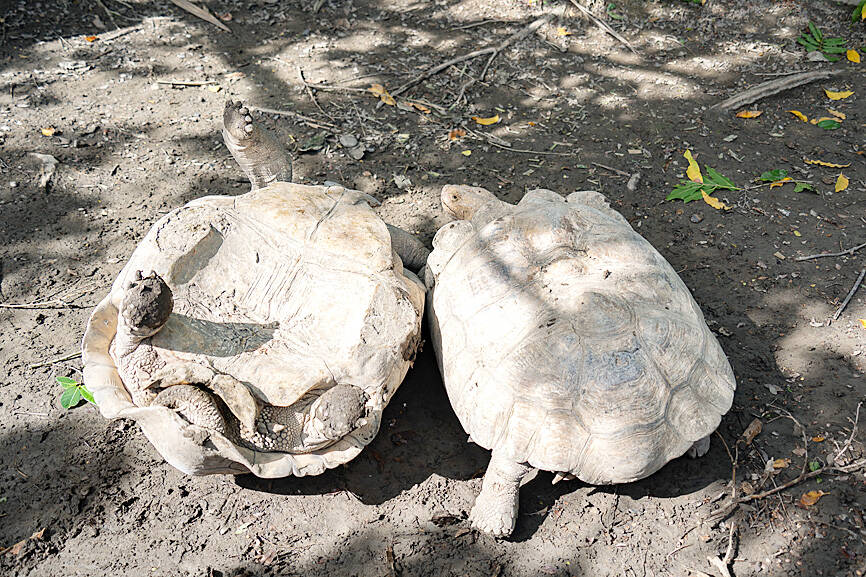
Photo courtesy of the Taipei Zoo
The zoo said its tortoises tend to fight during warm season from May to July.
However, the photo was taken this month, and the fight occurred probably because temperatures were above normal and the zoo adopted heat lamps to help animals keep warm, it said.
Such warmth might have tricked the tortoises into believing that the warm season begins and triggered fights over territory, it said.
While fighting, sulcata tortoises would pull their head into their shell, and push their four legs off the ground to hit and ram their opponent with their lower shell, it said.
They would not stop when their opponent is overturned, so one could often see a tortoise continuing to attack its overturned opponent, it said.
Some misunderstand the attacking tortoise’s intent as being helpful while it is actually aggression, it added.
The tortoise getting the upper hand in the photograph also targeted the zookeeper, perhaps because it regarded them to be on the opponent’s side, the zoo said.
The tortoise could also be targeting the zookeeper simply because they were on its way, the zoo said.
That is why the zookeeper pulled it away from its defeated opponent, to divert its attention, the zoo said.
It said it has placed floating balls at sulcata tortoises’ outdoor playground, adding that they are expected to distract tortoises’ attention from chasing their peers.
Zookeepers observe whether tortoises are wounded while mediating their fights, it added.
They would also occasionally monitor tortoises’ body weight, the zoo said, adding that they would not interfere with tortoises’ life as long as no health issues occur due to fierce fights.

Yangmingshan National Park authorities yesterday urged visitors to respect public spaces and obey the law after a couple was caught on a camera livestream having sex at the park’s Qingtiangang (擎天崗) earlier in the day. The Shilin Police Precinct in Taipei said it has identified a suspect and his vehicle registration number, and would summon him for questioning. The case would be handled in accordance with public indecency charges, it added. The couple entered the park at about 11pm on Thursday and began fooling around by 1am yesterday, the police said, adding that the two were unaware of the park’s all-day live

Fast food chain McDonald's is to raise prices by up to NT$5 on some products at its restaurants across Taiwan, starting on Wednesday next week, the company announced today. The prices of all extra value meals and sharing boxes are to increase by NT$5, while breakfast combos and creamy corn soup would go up by NT$3, the company said in a statement. The price of the main items of those meals, if ordered individually, would remain the same. Meanwhile, the price of a medium-sized lemon iced tea and hot cappuccino would rise by NT$3, extra dipping sauces for chicken nuggets would go up

Yangmingshan National Park’s Qingtiangang (擎天崗) nature area has gone viral after a park livestream camera observed a couple in the throes of intimate congress, which was broadcast live on YouTube, drawing large late-night crowds and sparking a backlash over noise, bright lights and disruption to wildlife habitat. The area’s livestream footage appeared to show a couple engaging in sexual activity on a picnic table in the park on Friday last week, with the uncensored footage streamed publicly online. The footage quickly spread across social media, prompting a tide of visitors to travel to the site to “check in” and recreate the

Minister of Digital Affairs Lin Yi-ching (林宜敬) yesterday cited regulatory issues and national security concerns as an expert said that Taiwan is among the few Asian regions without Starlink. Lin made the remarks on Facebook after funP Innovation Group chief executive officer Nathan Chiu (邱繼弘) on Friday said Taiwan and four other countries in Asia — China, North Korea, Afghanistan and Syria — have no access to Starlink. Starlink has become available in 166 countries worldwide, including Ukraine, Malaysia, the Philippines and Vietnam, in the six years since it became commercial, he said. While China and North Korea block Starlink, Syria is not


 RSS
RSS