


Taiwan’s Puyuma Tu’Tu wood carpentry has been listed by the Ministry of Culture as an "Important Traditional Craft" of indigenous cultural heritage, with Puyuma tribal chief Haku designated as the technique’s preserver and recognized as a national living treasure.
On Wednesday, the ministry convened this year's Traditional Craft Review Committee, which unanimously approved the registration of Puyuma Tu’Tu wood carpentry as one of the nation’s "Important Traditional Crafts."
According to the Bureau of Cultural Heritage, 30 cultural practices have been registered nationally as Important Traditional Crafts, including the Paiwan tribe’s tjemenun and the Puyuma tribe’s tenun.

Photo courtesy of the Ministry of Culture
The ministry said in a news release that Puyuma Tu’Tu wood carpentry reflects the tribe’s rich historical memory and aesthetics, playing an irreplaceable role in tribal ceremonies, daily artifacts, and culture.
Registration as an Important Traditional Craft is expected to boost the craft’s visibility and support its conservation in the Kasavakan tribe in Taitung County.
The designated preserver, Haku, born in 1943 in the Kasavakan tribe, is the 69th tribal chief.
He began practicing traditional carpentry at the age of 42, focusing on figures in the Puyuma hierarchy and the evolution of tribal culture.
Unlike earlier Puyuma bas-relief carvings on flat surfaces, Haku’s sculptures are more modern, with individual rustic yet expressive strokes.
Wang Yu-hsin (王昱心), a member of the review committee, said Haku has devoted more than four decades to traditional carpentry.
He incorporates ancestral legends, tribal rituals and daily life into his works, using a chisel and wood to tell stories.
Wang added that Haku embraces his role as tribal chief to raise the visibility of Puyuma traditional religion and values through his art.
The ministry said it would follow the Cultural Heritage Preservation Act (文化資產保存法) to assist the preserver in maintaining the craft.
The ministry would also collaborate with local authorities and the tribe to develop Puyuma wood carving culture and preserve and pass down this invaluable indigenous heritage.

The military has spotted two Chinese warships operating in waters near Penghu County in the Taiwan Strait and sent its own naval and air forces to monitor the vessels, the Ministry of National Defense (MND) said. Beijing sends warships and warplanes into the waters and skies around Taiwan on an almost daily basis, drawing condemnation from Taipei. While the ministry offers daily updates on the locations of Chinese military aircraft, it only rarely gives details of where Chinese warships are operating, generally only when it detects aircraft carriers, as happened last week. A Chinese destroyer and a frigate entered waters to the southwest
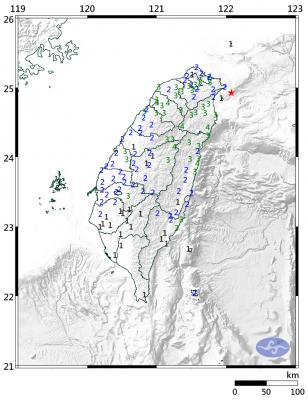
A magnitude 6.1 earthquake struck off the coast of Yilan County at 8:39pm tonight, the Central Weather Administration (CWA) said, with no immediate reports of damage or injuries. The epicenter was 38.7km east-northeast of Yilan County Hall at a focal depth of 98.3km, the CWA’s Seismological Center said. The quake’s maximum intensity, which gauges the actual physical effect of a seismic event, was a level 4 on Taiwan’s 7-tier intensity scale, the center said. That intensity level was recorded in Yilan County’s Nanao Township (南澳), Hsinchu County’s Guansi Township (關西), Nantou County’s Hehuanshan (合歡山) and Hualien County’s Yanliao (鹽寮). An intensity of 3 was

Japanese Prime Minister Sanae Takaichi’s comment last year on Tokyo’s potential reaction to a Taiwan-China conflict has forced Beijing to rewrite its invasion plans, a retired Japanese general said. Takaichi told the Diet on Nov. 7 last year that a Chinese naval blockade or military attack on Taiwan could constitute a “survival-threatening situation” for Japan, potentially allowing Tokyo to exercise its right to collective self-defense. Former Japan Ground Self-Defense Force general Kiyofumi Ogawa said in a recent speech that the remark has been interpreted as meaning Japan could intervene in the early stages of a Taiwan Strait conflict, undermining China’s previous assumptions
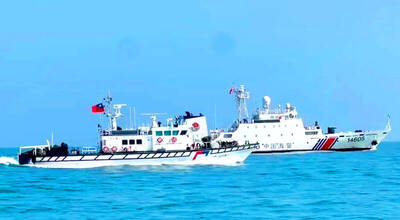
Instead of focusing solely on the threat of a full-scale military invasion, the US and its allies must prepare for a potential Chinese “quarantine” of Taiwan enforced through customs inspections, Stanford University Hoover fellow Eyck Freymann said in a Foreign Affairs article published on Wednesday. China could use various “gray zone” tactics in “reconfiguring the regional and ultimately the global economic order without a war,” said Freymann, who is also a nonresident research fellow at the US Naval War College. China might seize control of Taiwan’s links to the outside world by requiring all flights and ships entering or leaving Taiwan


 RSS
RSS