


Amendments to the Criminal Code, the Prison Act (監獄行刑法) and Enforcement Law of the Criminal Code of the Republic of China (中華民國刑法施行法) that would allow a system of “life imprisonment without parole” contravene the International Covenant on Civil and Political Rights and should be withdrawn for further review, Covenants Watch (人權公約施行監督聯盟) and other civic groups said yesterday.
The groups urged the Executive Yuan to retract its amendments and called on all political parties to halt the related legislative procedures.
If the Executive Yuan were to push forward with the amendments, they would set a poor example for legislation, as the Constitutional Court is currently unable to sit with an insufficient number of members and therefore cannot review them.
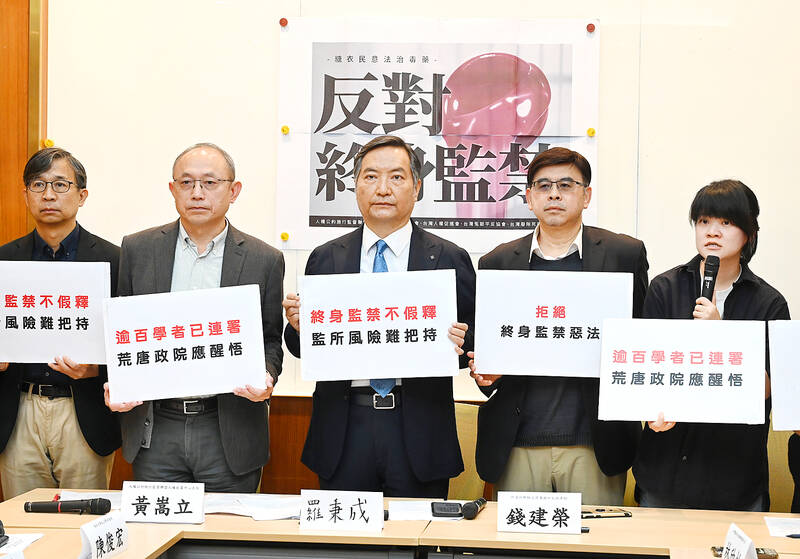
Photo: Tien Yu-hua, Taipei Times
The Cabinet issued previews of the amendments, which said that life imprisonment or prison sentences longer than 10 years would not be eligible for parole.
The amendments contravene the ex post facto, proportionality and equality principles, making them unconstitutional, the groups said.
The amendments have drawn strong backlash from the legal community, they said.
The ruling and opposition parties are ramming through problematic amendments that would have lasting effects on the nation’s correctional system, without consulting experts or investigating problems at correctional facilities, they said.
The Cabinet had not conducted any factual research to support its amendments, nor had it assessed how such a policy would affect human rights, they said.
The groups said they would launch a petition led by 17 experts to express public opposition to the amendments, adding that, to date, more than 100 academics in law and sociology have shown support.
The groups said the petition has also received support from lawyers, correctional facility personnel, juvenile court judges, social workers and psychiatrists.
Life sentences without parole are cruel and infringe human dignity, the groups said, adding that they also contravene the international covenant.
The Chinese Correctional Association said that the parole system is not meant to pardon a large group of people, but it is a safety valve and a source of hope for inmates.

Considering that most countries issue more than five denominations of banknotes, the central bank has decided to redesign all five denominations, the bank said as it prepares for the first major overhaul of the banknotes in more than 24 years. Central bank Governor Yang Chin-lung (楊金龍) is expected to report to the Legislative Yuan today on the bank’s operations and the redesign’s progress. The bank in a report sent to the legislature ahead of today’s meeting said it had commissioned a survey on the public’s preferences. Survey results showed that NT$100 and NT$1,000 banknotes are the most commonly used, while NT$200 and NT$2,000

The Centers for Disease Control (CDC) yesterday reported the first case of a new COVID-19 subvariant — BA.3.2 — in a 10-year-old Singaporean girl who had a fever upon arrival in Taiwan and tested positive for the disease. The girl left Taiwan on March 20 and the case did not have a direct impact on the local community, it said. The WHO added the BA.3.2 strain to its list of Variants Under Monitoring in December last year, but this was the first imported case of the COVID-19 variant in Taiwan, CDC Deputy Director-General Lin Ming-cheng (林明誠) said. The girl arrived in Taiwan on

ANNUAL EVENT: Two massive Pokemon balloons are to be set up in Daan Park, with an event zone operating from 10am to 6pm This year’s Taipei Floral Picnic is to be held at Daan Park today and tomorrow, featuring an exclusive Pokemon Go event, a themed food market, a coffee rave picnic area and stage performances, the Taipei Department of Information and Tourism said yesterday. Two massive Pokemon balloons are to be set up in the park as attractions, with an exclusive event zone operating from 10am to 6pm, it said. Participants who complete designated tasks on-site would have a chance to receive limited-edition souvenirs, it added. People could also try the newly launched game Pokemon Pokopia in the trial area, the department said. Three PokeStops are

South Korea is planning to revise its controversial electronic arrival card, a step Taiwanese officials said prompted them to hold off on planned retaliatory measures, a South Korean media report said yesterday. A Yonhap News Agency report said that the South Korean Ministry of Foreign Affairs is planning to remove the “previous departure place” and “next destination” fields from its e-arrival card system. The plan, reached after interagency consultations, is under review and aims to simplify entry procedures and align the electronic form with the paper version, a South Korean ministry official said. The fields — which appeared only on the electronic form


 RSS
RSS