


Premier Cho Jung-tai (卓榮泰) today said he would not countersign the Legislative Yuan’s fiscal planning bill, as it would harm national development, infringes on executive authority and was passed in an undemocratic manner.
The Legislative Yuan’s version of the Act Governing the Allocation of Government Revenues and Expenditures (財政收支劃分法) that passed on Nov. 14 was required to be promulgated by today.
Cho this afternoon convened a news conference entitled “Defending the Constitutional Order” to announce that he would not countersign the bill.
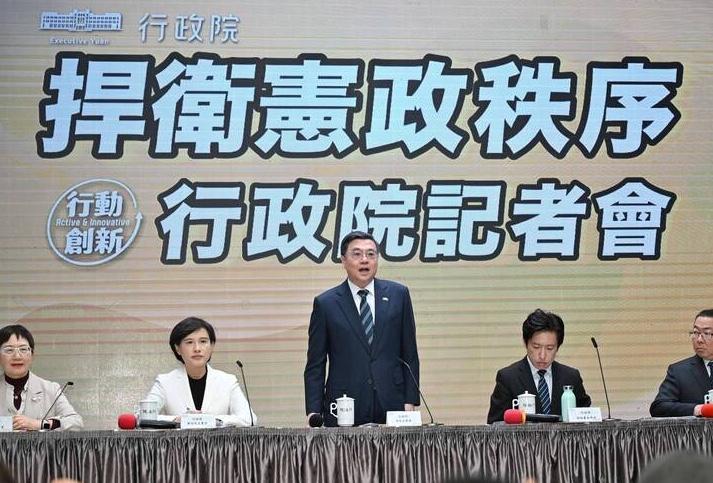
Photo: Chen Yi-kuan, Taipei Times
This marks the first time in the nation’s history that a premier has refused to countersign a bill.
Former premier Hau Pei-tsun (郝柏村) previously refused to countersign personnel appointments, but not a bill.
The ruling and opposition parties have been wrangling over the fiscal planning act for more than a year.
The Legislative Yuan amended the act at the end of last year to shift a greater proportion of national revenues to local governments and passed another amendment last month aiming to ensure that local government subsidies are not adjusted by the central government.
The Executive Yuan considered the amendments highly flawed and challenging to implement, but the legislature rejected its requests to reconsider the bills.
The premier has the right to refuse to countersign according to Article 37 of the Constitution, which states that the president shall promulgate laws and issue mandates according to the law, with the countersignature of the premier or the premier and relevant ministers.
If the Legislative Yuan disagrees with his decision, Cho said it can exercise its constitutional right to hold a vote of no confidence against him.
Cho told reporters that the bill infringes on the separation of powers, breaches democratic principles and would harm national development.
Under the Constitution, the Executive Yuan has the right to propose the budget, while the legislature approves it, he said.
However, the amendments would force the government to borrow an additional NT$264.6 billion (US$8.45 billion) next fiscal year to fund project-based subsidies for local governments, significantly increasing government spending and crowding out other policy expenditures, he said.
Total borrowing would reach NT$560 billion, accounting for 17.1 percent of the total budget in excess of the statutory debt ceiling of 15 percent, he said.
This is tantamount to the legislature both compiling and approving the budget, thus infringing on the separation of power, he said, adding that it would also force the executive to compile an illegal budget.
In addition, the bill was sent to a second reading without holding a line-by-line review by legislative committees, and was sent to a vote without the party caucuses reaching a consensus, he said.
“This completely violates democratic principles and infringes upon national sovereignty,” he said.
Furthermore, the executive has a responsibility to ensure “national development and fiscal stability,” Cho said.
The bill would cut funding for national defense, infrastructure, foreign affairs, social welfare, labor and health insurance, and other important federal work, he said.
It would also place a greater burden on local governments to implement things such as disaster relief, as well as exacerbate the urban-rural wealth cap, he added.
“Can the Legislative Yuan take responsibility for this?” he asked.
Earlier this morning, President William Lai (賴清德) hosted a tea gathering with the heads of the Executive Yuan and Examination Yuan to discuss next year’s budget, amendments to the fiscal planning act and civil servant pension reform.
All ministries and agencies should implement legislation on a constitutionally sound basis to ensure the integrity of the constitutional system, Lai said after the meeting.
He pointed out that amendments to the Act Governing the Legislative Yuan's Power (立法院職權行使法) passed last year were ruled unconstitutional.
However, the Legislative Yuan afterward passed amendments to the Constitutional Court Procedure Act (憲法訴訟法), effectively paralyzing the functioning of the court, Lai said.
Since then, the Legislative Yuan has pushed through several bills with which the Executive Yuan and Examination Yuan disagree, including the fiscal planning bill and the cancelation of pension cuts, he said.
The Constitutional Court, which currently has only eight sitting judges, has been unable to operate since January, when a legal revision took effect requiring a quorum 10 grand justices to participate in deliberations and nine to rule on the constitutionality of cases.
Additional reporting by Chen Yun

SPACE VETERAN: Kjell N. Lindgren, who helps lead NASA’s human spaceflight missions, has been on two expeditions on the ISS and has spent 311 days in space Taiwan-born US astronaut Kjell N. Lindgren is to visit Taiwan to promote technological partnerships through one of the programs organized by the US for its 250th national anniversary. Lindgren would be in Taiwan from Tuesday to Saturday next week as part of the US Bureau of Educational and Cultural Affairs’ US Speaker Program, organized to celebrate the 250th anniversary of the signing of the Declaration of Independence, the American Institute in Taiwan (AIT) said in a statement yesterday. Lindgren plans to engage with key leaders across the nation “to advance cutting-edge technological partnerships and inspire the next generation of scientists and engineers,”

UNREASONABLE SURVEILLANCE: A camera targeted on an road by a neighbor captured a man’s habitual unsignaled turn into home, netting him dozens of tickets The Taichung High Administrative Court has canceled all 45 tickets given to a man for failing to use a turn signal while driving, as it considered long-term surveillance of his privacy more problematic than the traffic violations. The man, surnamed Tseng (曾), lives in Changhua County and was reported 45 times within a month for failing to signal while driving when he turned into the alley where his residence is. The reports were filed by his neighbor, who set up security cameras that constantly monitored not only the alley but also the door and yard of Tseng’s house. The surveillance occurred from July

A Japan Self-Defense Forces vessel entered the Taiwan Strait yesterday, Japanese media reported. After passing through the Taiwan Strait, the Ikazuchi was to proceed to the South China Sea to take part in a joint military exercise with the US and the Philippines, the reports said. Japan Self-Defense Force vessels were first reported to have passed through the strait in September, 2024, with two further transits taking place in February and June last year, the Asahi Shimbun reported. Yesterday’s transit also marked the first time since Japanese Prime Minister Sanae Takaichi took office that a Japanese warship has been sent through the Taiwan
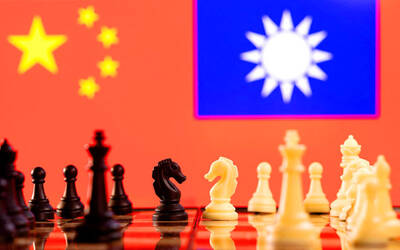
‘SAME OLD TRICK’: Even if Beijing resumes individual travel to Taiwan, it would only benefit Chinese tourism companies, the Economic Democracy Union convener said China’s 10 new “incentives” are “sugar-coated poison,” an official said yesterday, adding that Taiwanese businesses see them clearly for what they are, but that Beijing would inevitably find some local collaborators to try to drums up support. The official, speaking on condition of anonymity, made the remark ahead of a news conference the General Chamber of Commerce is to hold today. The event, titled “Industry Perspectives on China’s Recent Pro-Taiwan Policies,” is expected to include representatives from industry associations — such as those in travel, hotels, food and agriculture — to request the government cooperate with China’s new measures, people familiar with


 RSS
RSS