


The Control Yuan yesterday said insufficient driver training, weak law enforcement and lenient penalties are among the factors contributing to a rise in traffic-related incidents involving foreign residents in Taiwan.
In May, a six-language survey was conducted to investigate the causes of the increase in such incidents, Control Yuan member Yeh Ta-hua (葉大華) said.
The survey identified multiple contributing factors, including inadequate driver training, weak enforcement, light penalties, poor road design and infrastructure, low traffic safety awareness, and difficulties adapting to local traffic rules due to language barriers and limited information, Yeh said.
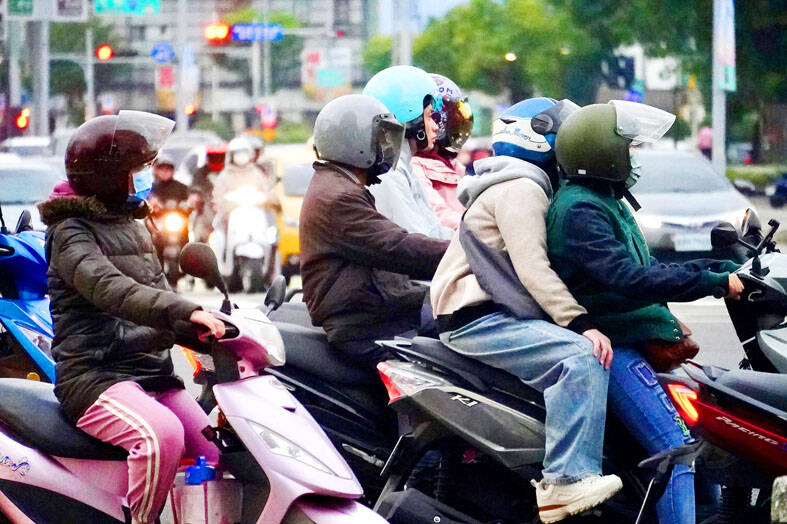
Photo: CNA
Citing National Audit Office figures, she said more than 13,000 foreign residents were involved in traffic incidents last year, up from 6,213 in 2019.
The highest numbers were reported in Taichung, Taoyuan, New Taipei City and Tainan, the National Audit Office report said.
Foreign residents riding heavy scooters and small electric two-wheelers accounted for the largest share of those involved in incidents, the report said.
Only 10 percent of foreign residents attended a driving school to learn to drive and obtain a license, while 90 percent were unaware that a government subsidy is available for driving courses, Yeh said.
Although Taiwan has signed the UN Convention on Road Signs and Signals, traffic signs in the country do not fully comply with its standards, she added.
In addition to language barriers, some symbols and colors differ from international norms, creating further difficulties for foreign residents, Yeh said.
While small electric two-wheel vehicles remain popular among foreign residents in Taiwan, no riding permit is required for such vehicles, making enforcement difficult for police, particularly when it comes to educating riders about traffic rules amid language barriers.
The 35-page report released yesterday also included feedback from foreign residents, who urged the government to improve road safety by making driving tests more rigorous, enforcing traffic laws and penalties more strictly, and strengthening traffic safety education.
The Control Yuan said that traffic safety issues affecting foreign residents cannot be addressed by a single agency.
It called on the Executive Yuan to coordinate central and local government agencies to review policies, enforcement, education and infrastructure, and to introduce measures to protect vulnerable road users, reduce accident risks and safeguard their basic rights.

Yangmingshan National Park authorities yesterday urged visitors to respect public spaces and obey the law after a couple was caught on a camera livestream having sex at the park’s Qingtiangang (擎天崗) earlier in the day. The Shilin Police Precinct in Taipei said it has identified a suspect and his vehicle registration number, and would summon him for questioning. The case would be handled in accordance with public indecency charges, it added. The couple entered the park at about 11pm on Thursday and began fooling around by 1am yesterday, the police said, adding that the two were unaware of the park’s all-day live

Fast food chain McDonald's is to raise prices by up to NT$5 on some products at its restaurants across Taiwan, starting on Wednesday next week, the company announced today. The prices of all extra value meals and sharing boxes are to increase by NT$5, while breakfast combos and creamy corn soup would go up by NT$3, the company said in a statement. The price of the main items of those meals, if ordered individually, would remain the same. Meanwhile, the price of a medium-sized lemon iced tea and hot cappuccino would rise by NT$3, extra dipping sauces for chicken nuggets would go up

Yangmingshan National Park’s Qingtiangang (擎天崗) nature area has gone viral after a park livestream camera observed a couple in the throes of intimate congress, which was broadcast live on YouTube, drawing large late-night crowds and sparking a backlash over noise, bright lights and disruption to wildlife habitat. The area’s livestream footage appeared to show a couple engaging in sexual activity on a picnic table in the park on Friday last week, with the uncensored footage streamed publicly online. The footage quickly spread across social media, prompting a tide of visitors to travel to the site to “check in” and recreate the

Minister of Digital Affairs Lin Yi-ching (林宜敬) yesterday cited regulatory issues and national security concerns as an expert said that Taiwan is among the few Asian regions without Starlink. Lin made the remarks on Facebook after funP Innovation Group chief executive officer Nathan Chiu (邱繼弘) on Friday said Taiwan and four other countries in Asia — China, North Korea, Afghanistan and Syria — have no access to Starlink. Starlink has become available in 166 countries worldwide, including Ukraine, Malaysia, the Philippines and Vietnam, in the six years since it became commercial, he said. While China and North Korea block Starlink, Syria is not


 RSS
RSS