


Opposition motions requiring President William Lai (賴清德) to take questions from the legislature on his proposed NT$1.25 trillion (US$39.97 billion) special defense budget were sent directly to a second reading and cross-party negotiations yesterday.
The move comes after Chinese Nationalist Party (KMT) and Taiwan People’s Party (TPP) lawmakers, who together hold a majority in the 113-seat legislature, twice voted to reject the Cabinet’s 2026-2033 spending proposals for major US-linked weapons purchases and joint development programs.
In its motion, the KMT pointed to Lai’s remarks on possible Chinese military readiness in 2027 and argued that the eight-year plan could total NT$4.5 trillion with sustainment, squeezing out social and economic spending.
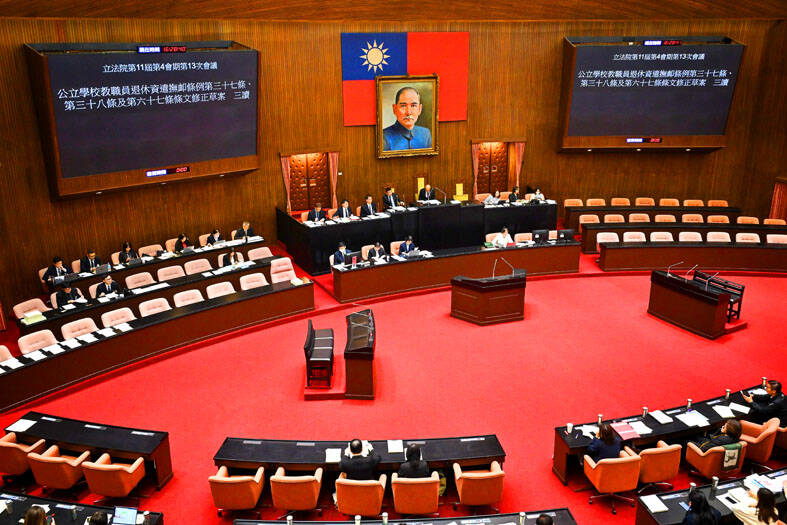
Photo: Chen Yi-kuan, Taipei Times
While it supports strengthening national defense, the KMT said that the Cabinet’s plan lacks transparency, includes unproven weapons systems and items without strategic validation and risks wasteful spending.
The KMT added that the Constitution and the Act on Exercising Legislative Yuan Powers (立法院職權行使法) allow lawmakers to invite the president to brief the chamber and take lawmakers’ questions.
The TPP’s motion said that Lai has already budgeted NT$949.5 billion for defense in fiscal 2026 and pledged to raise defense spending to 5 percent of GDP, calling the scale unprecedented and a major shift in fiscal priorities.
It said Lai should honor his campaign pledge to brief lawmakers on national security, cross-strait developments, US arms purchases and defense budget planning before any review of the special budget.
During floor debate, KMT Legislator Hsu Chiao-hsin (徐巧芯) said the president must take lawmakers’ questions, adding that a one-way speech would be meaningless.
Democratic Progressive Party Legislator Puma Shen (沈伯洋) said the opposition motions were politically driven, and asserted that the Constitutional Court had ruled on-the-spot questioning of the president unconstitutional.
Shen said that if the opposition is concerned about waste or budgetary pressure, it should allow the special act to enter committee review so details can be examined.
As party caucuses reached a consensus before yesterday’s sitting, Legislative Speaker Han Kuo-yu (韓國瑜) ruled that both motions would bypass a vote and go straight to a second reading and cross-party negotiations.

Yangmingshan National Park authorities yesterday urged visitors to respect public spaces and obey the law after a couple was caught on a camera livestream having sex at the park’s Qingtiangang (擎天崗) earlier in the day. The Shilin Police Precinct in Taipei said it has identified a suspect and his vehicle registration number, and would summon him for questioning. The case would be handled in accordance with public indecency charges, it added. The couple entered the park at about 11pm on Thursday and began fooling around by 1am yesterday, the police said, adding that the two were unaware of the park’s all-day live
Fast food chain McDonald's is to raise prices by up to NT$5 on some products at its restaurants across Taiwan, starting on Wednesday next week, the company announced today. The prices of all extra value meals and sharing boxes are to increase by NT$5, while breakfast combos and creamy corn soup would go up by NT$3, the company said in a statement. The price of the main items of those meals, if ordered individually, would remain the same. Meanwhile, the price of a medium-sized lemon iced tea and hot cappuccino would rise by NT$3, extra dipping sauces for chicken nuggets would go up
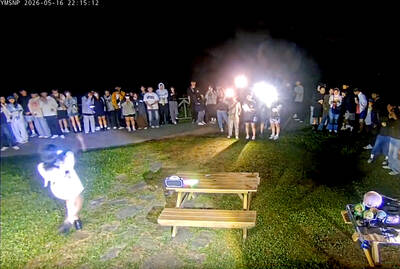
Yangmingshan National Park’s Qingtiangang (擎天崗) nature area has gone viral after a park livestream camera observed a couple in the throes of intimate congress, which was broadcast live on YouTube, drawing large late-night crowds and sparking a backlash over noise, bright lights and disruption to wildlife habitat. The area’s livestream footage appeared to show a couple engaging in sexual activity on a picnic table in the park on Friday last week, with the uncensored footage streamed publicly online. The footage quickly spread across social media, prompting a tide of visitors to travel to the site to “check in” and recreate the

Minister of Digital Affairs Lin Yi-ching (林宜敬) yesterday cited regulatory issues and national security concerns as an expert said that Taiwan is among the few Asian regions without Starlink. Lin made the remarks on Facebook after funP Innovation Group chief executive officer Nathan Chiu (邱繼弘) on Friday said Taiwan and four other countries in Asia — China, North Korea, Afghanistan and Syria — have no access to Starlink. Starlink has become available in 166 countries worldwide, including Ukraine, Malaysia, the Philippines and Vietnam, in the six years since it became commercial, he said. While China and North Korea block Starlink, Syria is not


 RSS
RSS