


The US House of Representatives on Wednesday passed a compromise National Defense Authorization Act (NDAA), which includes authorization of up to US$1 billion for Taiwan-related security cooperation and a joint drone program.
The latest version of the NDAA for Fiscal 2026, released on Sunday, passed the House in a 312-112 vote.
In a news release, US Representative Mike Rogers, chairman of the House Armed Services Committee, said the bill advances US President Donald Trump’s “peace through strength” agenda, and keeps US forces ready and lethal amid an increasingly complex security environment.
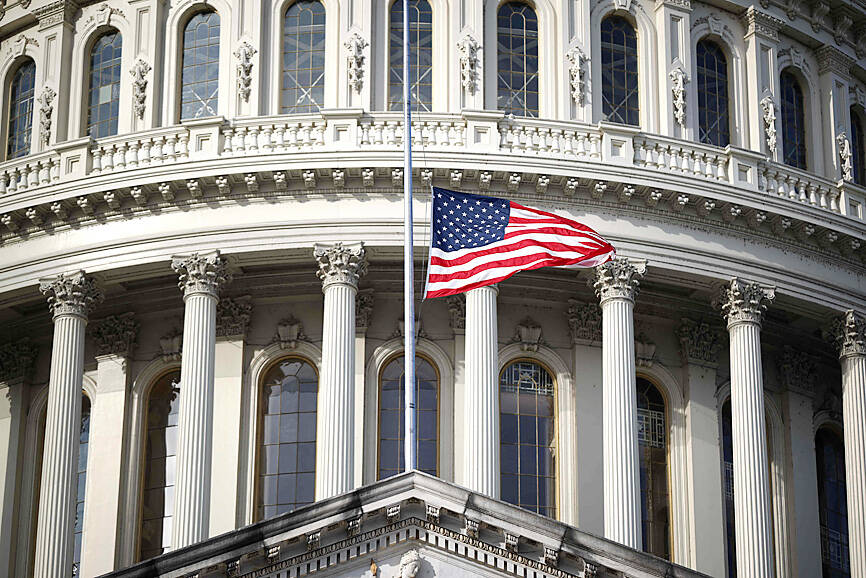
Photo: AFP
According to the committee, the 2026 NDAA focuses on countering China’s threats, ensuring mission success in the Indo-Pacific region, and supporting regional allies and partners.
The bill authorizes up to US$1 billion for the Taiwan Security Cooperation Initiative and directs the Pentagon to collaborate with Taiwan on a joint drone program, including codevelopment and coproduction, in line with the Taiwan Relations Act.
It further authorizes US forces to maintain training programs with Taiwan and other partners to counter “malign influence operations” by Beijing.
The bill also calls for a plan to expand joint Taiwan-US coast guard training and to deploy US personnel in Taiwan to bolster maritime security, law enforcement and deterrence.
The NDAA includes the Taiwan Non-Discrimination Act, which supports Taiwan’s bid to join the IMF.
The US Senate and House had earlier passed their own versions of the NDAA. The two chambers would now have to produce a single reconciled version of the bill, which would then require passage by both chambers of the US Congress before it could be signed into law by the president.
In other news, American Institute in Taiwan (AIT) Director Raymond Greene said that the international community might find it hard to understand the domestic criticisms of Taiwan’s efforts to increase its defense budget.
Washington supports President William Lai’s (賴清德) proposal for a supplementary defense budget of NT$1.25 trillion (US$40 billion) to be spent over the next eight years in the face of a growing Chinese threat, Greene said in podcast interview published on Wednesday.
Greene said he understands the proposed budget has to go through a democratic process, including approval by lawmakers.
“But I remain very confident that at the end of the day, all of the parties in Taiwan will come together on behalf of increased defense spending,” Greene said.
Following Lai’s announcement of the proposal last month, the Cabinet put forth a bill to allocate NT$1.25 trillion for the purchase of weapons and joint development programs with the US from next year to 2033.
However, the draft bill has been blocked in the opposition-controlled legislature, with lawmakers of the main opposition Chinese Nationalist Party (KMT) and smaller Taiwan People’s Party arguing that it lacks details, and that the funds could only be secured through debt financing and would likely force cuts to other spending.
On Wednesday, Greene said that all the Taiwanese lawmakers he and visiting US Congress members had met with in Taipei supported the idea of boosting Taiwan’s self-defense capabilities, and he was “quite optimistic” the bill would be passed.
The US side is also looking forward to “answering questions from our Taiwan friends in the legislature once they get into the detailed review of the budget,” he added.
However, the international community might not understand domestic pushback against the proposal, Greene said.
“I would say I think it’s important for Taiwanese citizens to understand, though, that some of the criticism of increasing Taiwan’s defense spending will unlikely receive support or understanding from the international community,” he said.
The international community is more concerned about Taiwan’s under-investment in defense, which has “actually increased the risk of a conflict,” he said.

FUKUOKA SITUATION: Japanese media reported that the pathogen is expected to be identified by the summer, while the CDC downplayed the idea that it was hMPV A “mysterious cold-like illness” reported in Japan’s Fukuoka Prefecture does not seem to be a new disease, but Japanese authorities have been asked about the situation, the Centers for Disease Control (CDC) said yesterday. The Fukuoka Prefectural Medical Association on Wednesday told a news conference that a “mystery cold” that has become a hot topic on social media is “highly likely to be caused by some kind of viral infection,” Japan’s KBC News reported. “Many people are experiencing symptoms starting with a sore throat, followed by a runny nose, phlegm and a severe cough,” KBC News reported, citing association officials. Health authorities are

Nvidia Corp CEO Jensen Huang (黃仁勳) arrived in Taiwan yesterday ahead of upcoming AI and technology events, saying he plans to meet with clients and Taiwan Semiconductor Manufacturing Co Chairman C.C. Wei (魏哲家) during his visit. After landing at Taipei Songshan Airport, Huang posed for photos with fans and handed out Yakult drinks to reporters and supporters waiting at the scene, saying he has “a lot to do” during the trip. Asked about reports that Nvidia’s planned headquarters site in Taipei’s Beitou Shilin Technology Park could break ground on May 27, Huang said that if the company holds an event, he would

The Ministry of Finance this afternoon announced the winning numbers for the March-April uniform invoice lottery. The winning number for the NT$10 million (US$318,060) special prize is 19531471, and the winning number for the NT$2 million grand prize is 85941329. Three numbers were drawn for the NT$200,000 first prize: 07225810, 20231230 and 83518781. Those with receipts matching the last seven digits of any of the first-prize numbers will win the NT$40,000 second prize, while those matching the last six digits will win the NT$10,000 third prize. Those whose receipts match the last five digits of the first-prize numbers can claim the NT$4,000 fourth prize,

Taiwan Travelogue (臺灣漫遊錄), which earlier this week became the first Taiwanese novel to win the International Booker Prize, is to be adapted into a television series through a Taiwan-Japan coproduction, producer Chang Chen-yu (張辰漁) said yesterday. Chang, a producer at World Softest Production Film Co, wrote on Facebook that the company had been searching for projects with international appeal that retain a strong Taiwanese identity after colleagues and Japanese partners strongly recommended the novel. After reading the book, Chang said he immediately decided to pursue the screen rights. “A great story has the power to transcend time and borders, and connect countless people,”


 RSS
RSS