

Minister of National Defense Wellington Koo (顧立雄) today defended his ministry's decision to award a contract to import military-grade explosives to a company better known for selling furniture, after a lawmaker questioned the public procurement process.
A day earlier, Chinese Nationalist Party (KMT) Legislator Wang Hung-wei (王鴻薇) said Tainan-based Home-Max Furniture Trading Ltd won a tender on Tuesday last week to import a batch of RDX for less than NT$590 million (US$18.87 million).
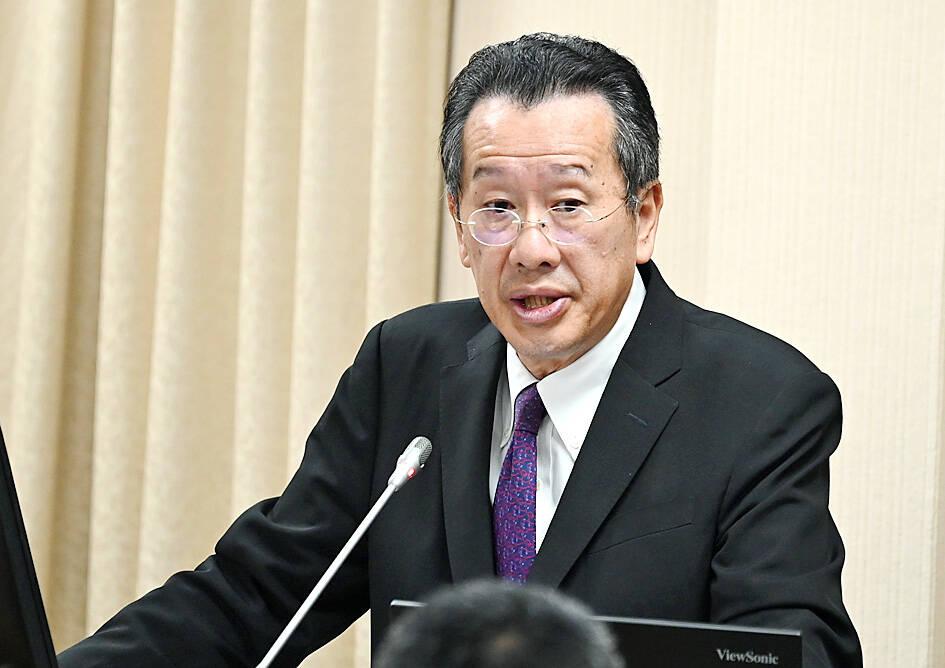
Photo: Wang Yi-sung, Taipei Times
Wang questioned whether a relatively small furniture trading company should have been eligible to bid for a contract involving explosive materials, let alone secure it.
RDX, also known as hexogen, is a powerful explosive with strong detonation characteristics and is widely used in military applications, including in C-4.
Koo said no companies in Taiwan are capable of producing RDX, which is why the ministry must rely on imports.
Any qualified international trading company can submit a bid, he said.
In a separate statement yesterday, the Ministry of National Defense said Home-Max was the sole bidder.
Although registered as a furniture trading company, it also engages in international trade and the wholesale of chemical materials, the ministry said.
To ensure the company can fulfill the contract, the ministry said it has asked Home-Max to present an export permit for the explosives and documentation identifying the original manufacturer by a set deadline.
The ministry vowed to inspect the RDX shipment upon arrival to verify its origin and ensure it meets required standards.
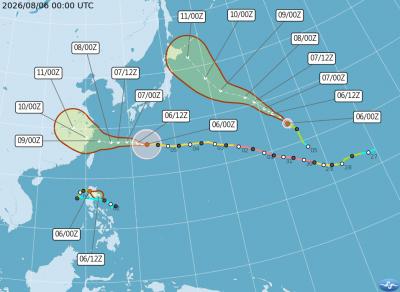
Typhoon Dolphin is expected to enter the East China Sea on Saturday and intensify rainfall in western regions over the weekend as the typhoon’s outer circulation sweeps across the sea north of Taiwan, independent meteorologist Daniel Wu (吳德榮) said today. The eastern coast should prepare for extreme heat caused by downslope winds over the weekend, while southwesterly winds from Monday would bring localized heavy rain to the southwest, he said. As Typhoon Dolphin’s outer bands move past northern Taiwan over the next couple of days, northern, central and southern areas would experience showers tomorrow, he said. Rainfall over the weekend would lead to
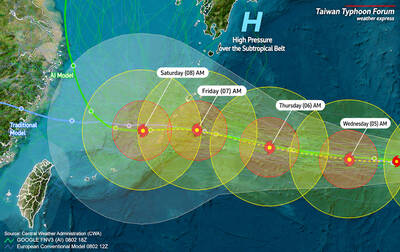
Taiwan could issue a sea warning for Typhoon Dolphin as early as Friday afternoon if the storm maintains its current westward track, the Central Weather Administration (CWA) said yesterday. As of 2pm yesterday, the center of the typhoon was about 2,590km east of Taipei and moving west at 21kph, potentially bringing hazardous conditions to waters surrounding Taiwan by Saturday. Dolphin is expected to reach waters south of the Ryukyu Islands around Saturday, but its track beyond that remains highly uncertain, CWA forecaster Lin Ping-yu (林秉煜) said. The typhoon could either continue moving westward or veer northward, Lin said. A westward track would bring
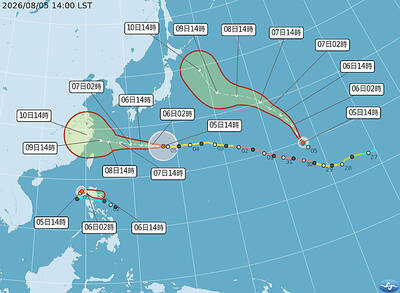
STORM SEASON: A typhoon and two tropical storms currently forming are certainly making life exciting for those living the western Pacific, the CWA said One typhoon and two tropical storms are in the west Pacific, and a sea warning for Typhoon Dolphin could be issued as early as tomorrow afternoon as the storm closes on Taiwan, the Central Weather Administration (CWA) said yesterday. As of 8am yesterday, the center of the typhoon was about 1,680km east of Taipei and moving west at 20kph, the CWA said. Meanwhile, Tropical Storm Kujia formed west of Luzon at 2am yesterday and is forecast to move east of the island before weakening and being absorbed by Typhoon Dolphin, the agency said. Steered by the Pacific high-pressure system, Dolphin is forecast to

EXPANSIONISM: Taiwan has established a cross-agency mechanism to share its experience with other nations to help build a united front against China, Joseph Wu said National Security Council Secretary-General Joseph Wu (吳釗燮) has accused China of using its coast guard and other official vessels to threaten not only Taiwan, but the broader Indo-Pacific region. “The threat posed by China is toward the whole region,” Wu said in an English-language interview with Nikkei Asia published yesterday. The entire First Island Chain, stretching from Japan southward through Taiwan to the Philippines and Malaysia, is facing increasing maritime aggression, he said. Taiwan’s intelligence, surveillance and reconnaissance systems have detected a significant increase in Chinese official vessel activity in the East China Sea, the Taiwan Strait, the western Pacific and the South


 RSS
RSS