


China’s Taiwan Affairs Office (TAO) yesterday struggled to provide a convincing explanation as to why Chinese still need to circumvent firewall to access Facebook, YouTube and Google, after it criticized the Democratic Progressive Party (DPP) government’s decision to restrict access to Chinese platform Xiaohongshu (小紅書, also known as RedNote in English) for one year as “undemocratic.”
TAO spokesman Chen Binhua (陳斌華) in a news conference in Beijing said that Xiaohongshu is a popular social platform among Taiwanese youth, who use it to understand Chinese society.
The existence of such a platform is a thorn in the side of the DPP administration, as it exposed DPP’s “echo chamber” and disinformation campaign against Beijing, Chen said.
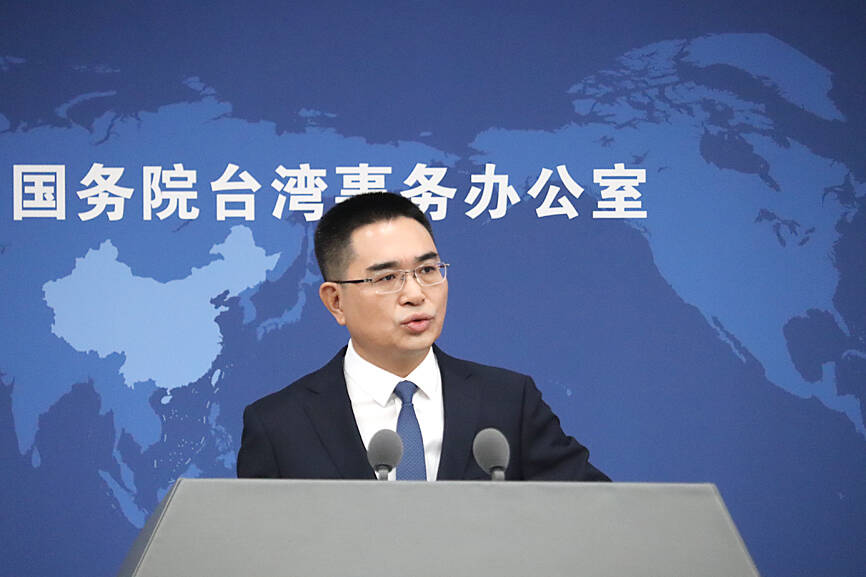
Photo: CNA
About 60,000 fraudulent schemes were identified on Facebook last year, and more than 30,000 were found this year, far exceeding the number on Xiaohongshu that DPP claimed, he said.
“The ban on Xiaohongshu is really an antidemocratic move, even though the DPP administration called it a move to crack down scams. It deprives Taiwanese, particularly Taiwanese youth, of their right to know and their freedom to access the social platform. It also hurts the Taiwanese who try to make a living by building a business on Xiaohongshu,” Chen said.
A Central News Agency (CNA) journalist asked Chen whether Chinese Internet users, who must bypass China’s “great firewall” to access Facebook, Google and YouTube, would in the future be able to use Facebook to interact with their Taiwanese counterparts.
The journalist also asked the TAO’s position on Chinese using the US platforms, given that the office and other Chinese agencies have accounts on Facebook and X.
Chen paused for about five seconds before saying that the ban imposed by the Taiwanese government on Xiaohongshu — which he said has sparked strong opposition in Taiwanese society — would be very difficult to implement.
The DPP might have other motives for specifically targeting the Chinese social platform, he added.
“We support the use of all kinds of social media in accordance with laws and regulations. We would also consistently prioritize the people, lawfully combat telecom fraud and criminal activities, and actively safeguard the safety of people’s lives and properties, and their legal rights,” he said.
The CNA reporter also said that the Straits Exchange Foundation (SEF) has notified Xiaohongshu about the government’s new policy, but has yet to receive an official response. The journalist asked whether China’s Association for Relations Across the Taiwan Straits (ARATS) would help in this matter.
Chen said that communication between the SEF and the ARATS has been suspended, as the DPP government does not acknowledge the so-called “1992 consensus.”
The “1992 consensus,” a term former Mainland Affairs Council (MAC) chairman Su Chi (蘇起) in 2006 admitted making up in 2000, refers to a tacit understanding between KMT and Beijing that there is “one China,” with each side having its own interpretation.
The MAC said that the temporary ban on Xiaohongshu targets fraud and is unrelated to cross-strait issues, adding that the measure is aimed at preventing scams and protecting the public.
Minister of the Interior Liu Shyh-fang (劉世芳) said that Xiaohongshu has no presence in Taiwan and lacks contacts for law enforcement to reach.
After the platform ignored official requests, the government followed administrative procedures, issuing notices through the SEF to Xiaohongshu’s parent company in Shanghai, and subsequently ordered the app’s access to be blocked and its Internet resolution to be stopped, Liu said.
The Criminal Investigation Bureau said that it analyzed fraud patterns and data on Xiaohongshu, and found that 756 fraud cases were linked to it from January to last month.
The most common types were “installment cancelation scams targeting sellers,” “fake online shopping,” and “fake investment schemes,” with “fake online shopping” leading at 283 cases. By comparison, last year saw 950 fraud cases, with “installment cancelation scams targeting sellers” accounting for the highest number at 477 cases, it said.

UPGRADE: The Kang Ding-class frigate is replacing its Chaparall missiles with Tien Chien II and Hua Yang VLS, which would provide it with long-range, 360° air defense Taiwan plans to produce 1,200 to 1,376 Hai Chien II missiles (海劍二, Sea Sword II) — also known as TC-2N — to serve as the standard air defense system of the navy’s surface combatant fleet, a source said yesterday. Last week, the Hai Chien II, the naval version of the Tien Kung II missile (天劍二, Sky Sword II), completed a live-fire test in waters off the National Chungshan Institute of Science and Technology’s Jiupeng facility (九鵬) in Pingtung County’s Manjhou Township (滿州). The MIM72 Chaparral and other dated air defense missiles that currently arm Taiwanese ships have inadequate range to combat Chinese

REASONS FOR TRAVEL: An assistant professor said that proposed amendments to penalize drivers if they used drugs overseas would not deter people from traveling People who operate a motor vehicle under the influence of marijuana would have their driver’s license revoked, even if they used the substance while overseas, the Ministry of Transportation and Communications said yesterday, citing proposed amendments to the Road Traffic Management and Penalty Act (道路交通管理處罰條例). The amendments would also authorize the government to revoke the licenses of people determined to have used Category 1 or Category 2 narcotics, even if they were not operating a vehicle while under the influence of drugs, as well as ban them from taking the license test for three years, the ministry said. People aged 18 or

Shih Hsin University President Chen Ching-he (陳清河) yesterday issued a public apology for comments made in his commencement speech last week, stating that he has asked the school to suspend his duties and halt his wages for two months as a show of contrition. At the commencement ceremony on May 30, Chen said, “If you don’t manage your time well, or your own emotions, or your health, then I am telling every one of you — put a quick end to ‘you,’ because the world has no need for ‘you.’” The comments have sparked significant controversy online, and Chen through an open
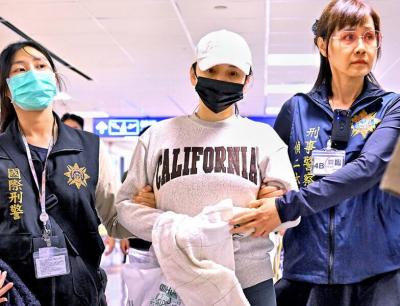
Johanne Liou (劉喬安), a Taiwanese woman who shot to unwanted fame during the Sunflower movement protests in 2014, returned to Taiwan last night after being deported from the US. She is to stand trial in Taiwan for charges involving embezzlement, fraud and drug crimes. The Criminal Investigation Bureau (CIB) said it took her into custody at Taiwan Taoyuan International Airport and would first question her before transferring her to the New Taipei District Prosecutors’ Office. She was arrested upon disembarking a flight from San Francisco that landed shortly before 7pm. Liou absconded to the US in 2019 after jumping bail


 RSS
RSS