


A surge in Chinese maritime military activity across East Asia might be evidence that “hardliners” are gaining ascendancy in Beijing’s leadership, an expert said on Friday.
Shu Hsiao-huang (舒孝煌), a research fellow at the state-run Institute for National Defense and Security Research, said that deployments of Chinese People’s Liberation Army (PLA) Navy and China Coast Guard vessels — with more than 100 ships reported at sea last week — appear to be Beijing’s response to Japanese Prime Minister Sanae Takaichi’s public opposition to any use of force by China against Taiwan.
Beijing appears to be using ships and other military assets already taking part in military exercises to intimidate the US, Japan and the Philippines, Shu said.
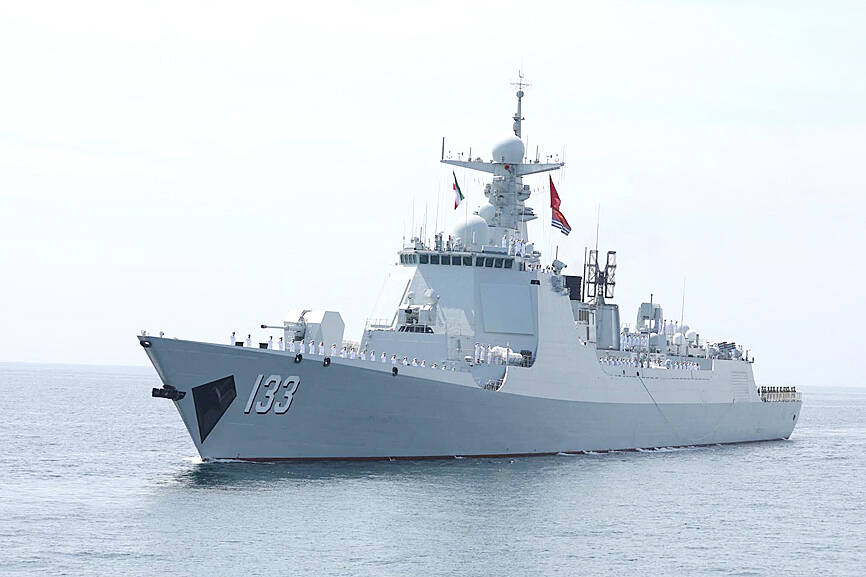
Photo: Reuters
The three governments in the past few months have showed an unfavorable inclination toward China’s aims in the region, he said.
China signaling its displeasure with warships rather than diplomatic protests, as expected of nations that follow international norms, suggests that “hardliners” have seized the reins in Beijing, he said.
The showy and bombastic threats emanating from Beijing are concerning, as they highlight an increasingly dysfunctional decisionmaking process that deliberately pursues counterproductive courses of action, Shu said.
The Chinese government’s rude and extreme reaction to Takaichi’s Taiwan remarks might alienate neighboring countries and give an inadvertent boost to the credibility of political factions opposed to Beijing, he said.
However, it is possible that the show of force is intended for China’s domestic audience, he added.
The Chinese naval activities appear to be a test of logistics, and command and control capabilities during a large deployment, said Lin Ying-yu (林穎佑), an associate professor of international affairs and strategic studies at Tamkang University.
The absence of the Chinese military’s air and rocket forces made the activity distinct from the Joint Sword and Strait Thunderbolt exercises of previous years, Lin said.
The PLA for the moment is content with a display of its numerical strength at sea and waving the Chinese flag in the Pacific by penetrating the first island chain, he said.
That means the chances of China announcing another Joint Sword-type exercise are not high, as naval demonstrations are a sufficient flex of Beijing’s muscles directed at Japan and the Philippines, he said.
Observers are seeking signs that China’s Liaoning, Shandong and Fujian aircraft carriers are conducting simultaneous exercise in the South China Sea, the East China Sea and the western Pacific, he said.
More attention should be paid to the type of drills China conducts and modernization of its armed forces, rather than focusing on the number of aircraft and ships involved in excursions crossing the median line of the Taiwan Strait, Lin said.
Beijing would continue to use its “salami slice” strategy to pressure Taiwan, with military exercises aimed to compressing the buffer space around Taiwan proper, he added.

FUKUOKA SITUATION: Japanese media reported that the pathogen is expected to be identified by the summer, while the CDC downplayed the idea that it was hMPV A “mysterious cold-like illness” reported in Japan’s Fukuoka Prefecture does not seem to be a new disease, but Japanese authorities have been asked about the situation, the Centers for Disease Control (CDC) said yesterday. The Fukuoka Prefectural Medical Association on Wednesday told a news conference that a “mystery cold” that has become a hot topic on social media is “highly likely to be caused by some kind of viral infection,” Japan’s KBC News reported. “Many people are experiencing symptoms starting with a sore throat, followed by a runny nose, phlegm and a severe cough,” KBC News reported, citing association officials. Health authorities are

Nvidia Corp CEO Jensen Huang (黃仁勳) arrived in Taiwan yesterday ahead of upcoming AI and technology events, saying he plans to meet with clients and Taiwan Semiconductor Manufacturing Co Chairman C.C. Wei (魏哲家) during his visit. After landing at Taipei Songshan Airport, Huang posed for photos with fans and handed out Yakult drinks to reporters and supporters waiting at the scene, saying he has “a lot to do” during the trip. Asked about reports that Nvidia’s planned headquarters site in Taipei’s Beitou Shilin Technology Park could break ground on May 27, Huang said that if the company holds an event, he would

The Ministry of Finance this afternoon announced the winning numbers for the March-April uniform invoice lottery. The winning number for the NT$10 million (US$318,060) special prize is 19531471, and the winning number for the NT$2 million grand prize is 85941329. Three numbers were drawn for the NT$200,000 first prize: 07225810, 20231230 and 83518781. Those with receipts matching the last seven digits of any of the first-prize numbers will win the NT$40,000 second prize, while those matching the last six digits will win the NT$10,000 third prize. Those whose receipts match the last five digits of the first-prize numbers can claim the NT$4,000 fourth prize,
Taiwan Travelogue (臺灣漫遊錄), which earlier this week became the first Taiwanese novel to win the International Booker Prize, is to be adapted into a television series through a Taiwan-Japan coproduction, producer Chang Chen-yu (張辰漁) said yesterday. Chang, a producer at World Softest Production Film Co, wrote on Facebook that the company had been searching for projects with international appeal that retain a strong Taiwanese identity after colleagues and Japanese partners strongly recommended the novel. After reading the book, Chang said he immediately decided to pursue the screen rights. “A great story has the power to transcend time and borders, and connect countless people,”


 RSS
RSS