


The Ministry of Transportation and Communications has previewed proposed changes to the Railway Act (鐵路法) that would fine people for playing on or crossing safety lines on railway platforms.
The amendments are due to the frequency of people falling onto the tracks at railway stations, the ministry said.
Currently, there are penalties for trespassing on the tracks, but there are none for crossing the yellow safety lines on platforms.
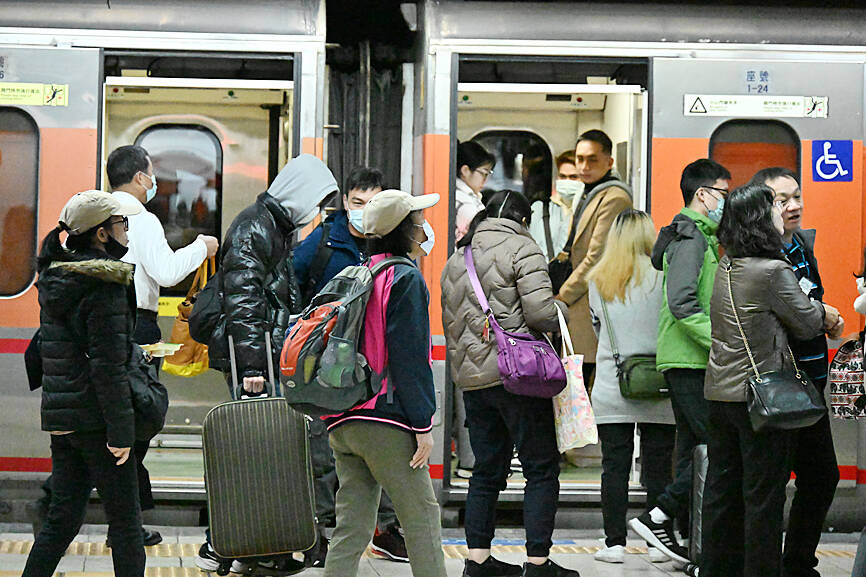
Photo: Tien Yu-hua, Taipei Times
The proposed amendments say that crossing a platform safety line, playing on a platform, walking or running against the designated direction on escalators, refusing to heed warnings or other behaviors announced by the railway authorities could result in fines ranging from NT$1,500 to NT$7,500.
The proposed amendments introduce penalties for people on high-speed or regular railway trains obstructing the closing of train or platform doors, opening doors without authorization or entering or exiting the station or boarding or disembarking without a valid ticket.
According to the draft amendments, fines could be levied for loitering in a station’s passenger hall, mezzanine or platform areas without the intention of boarding, causing obstruction to passenger movement or other activities.
To maintain the safety and order of railway stations and trains, the draft stipulates that if people engage in certain behaviors and refuse to comply after being advised, they could face doubled penalties.
This includes climbing onto or jumping off a moving train, obstructing the closing of train or platform doors or opening them without authorization and not following the prescribed procedures when entering or exiting the station or boarding or alighting from the train.
Other behaviors subject to penalties include soliciting donations, selling goods, distributing advertisements, setting up stalls, building scaffolding, or arranging banquets inside the train or station area without permission; refusing ticket checks by railway staff; spitting betel nut juice or spit in the train or station area; bringing animals into the station or train without permission or unlawfully occupying or damaging railway property or facilities.
The draft amendments state that if train operators are found to be using drugs, the Railway Bureau is required to revoke their driver’s license and prohibit them from operating trains.
A 60-day public announcement period for the preview of the proposed changes began on Friday and after gathering feedback from various sectors, a proposal would be submitted to the Executive Yuan for approval before forwarding it to the Legislative Yuan.
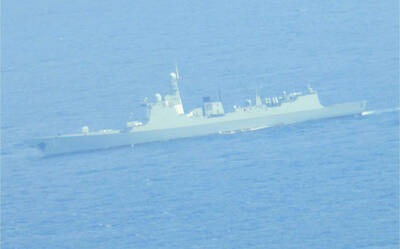
The military has spotted two Chinese warships operating in waters near Penghu County in the Taiwan Strait and sent its own naval and air forces to monitor the vessels, the Ministry of National Defense (MND) said. Beijing sends warships and warplanes into the waters and skies around Taiwan on an almost daily basis, drawing condemnation from Taipei. While the ministry offers daily updates on the locations of Chinese military aircraft, it only rarely gives details of where Chinese warships are operating, generally only when it detects aircraft carriers, as happened last week. A Chinese destroyer and a frigate entered waters to the southwest
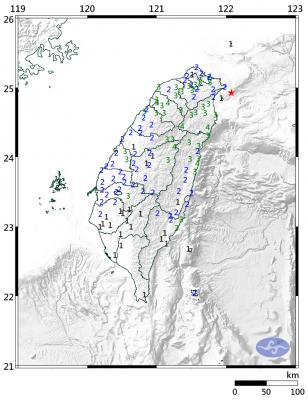
A magnitude 6.1 earthquake struck off the coast of Yilan County at 8:39pm tonight, the Central Weather Administration (CWA) said, with no immediate reports of damage or injuries. The epicenter was 38.7km east-northeast of Yilan County Hall at a focal depth of 98.3km, the CWA’s Seismological Center said. The quake’s maximum intensity, which gauges the actual physical effect of a seismic event, was a level 4 on Taiwan’s 7-tier intensity scale, the center said. That intensity level was recorded in Yilan County’s Nanao Township (南澳), Hsinchu County’s Guansi Township (關西), Nantou County’s Hehuanshan (合歡山) and Hualien County’s Yanliao (鹽寮). An intensity of 3 was

Japanese Prime Minister Sanae Takaichi’s comment last year on Tokyo’s potential reaction to a Taiwan-China conflict has forced Beijing to rewrite its invasion plans, a retired Japanese general said. Takaichi told the Diet on Nov. 7 last year that a Chinese naval blockade or military attack on Taiwan could constitute a “survival-threatening situation” for Japan, potentially allowing Tokyo to exercise its right to collective self-defense. Former Japan Ground Self-Defense Force general Kiyofumi Ogawa said in a recent speech that the remark has been interpreted as meaning Japan could intervene in the early stages of a Taiwan Strait conflict, undermining China’s previous assumptions
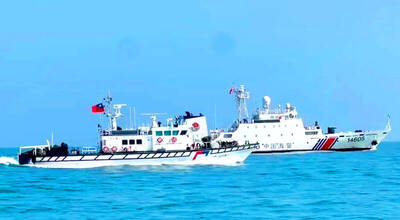
Instead of focusing solely on the threat of a full-scale military invasion, the US and its allies must prepare for a potential Chinese “quarantine” of Taiwan enforced through customs inspections, Stanford University Hoover fellow Eyck Freymann said in a Foreign Affairs article published on Wednesday. China could use various “gray zone” tactics in “reconfiguring the regional and ultimately the global economic order without a war,” said Freymann, who is also a nonresident research fellow at the US Naval War College. China might seize control of Taiwan’s links to the outside world by requiring all flights and ships entering or leaving Taiwan


 RSS
RSS