


Taiwan has been "very moved" by Japanese Prime Minister Sanae Takaichi's comments last month on peace and stability, even in the face of strong pressure, Premier Cho Jung-tai (卓榮泰) said today.
China and Japan are in their worst diplomatic crisis in years, after Takaichi said in parliament that a hypothetical Chinese attack on Taiwan could trigger a military response from Tokyo.
Meeting Japan-Taiwan Exchange Association Chairman Shuzo Sumi in Taipei, Cho said that the government was grateful to Takaichi.
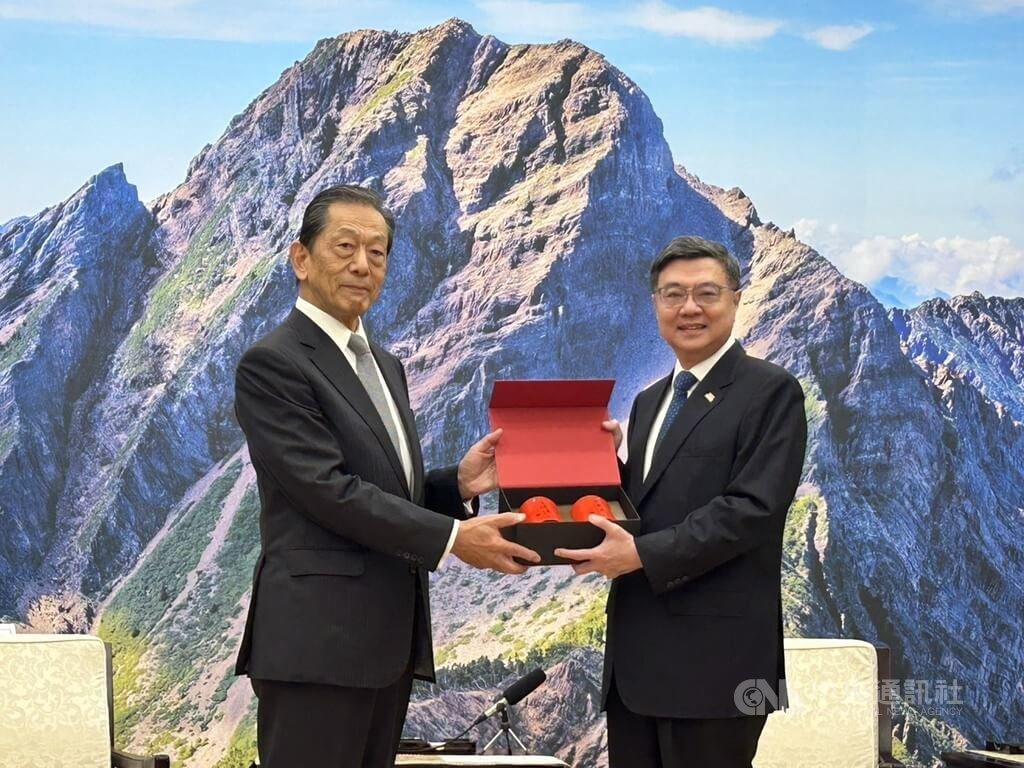
Photo: CNA
"Recently, Prime Minister Takaichi's remarks about stability and peace in the Taiwan Strait moved us all very, very much. They represent justice and peace," Cho said.
"We are also extremely grateful to Prime Minister Takaichi and to the Japanese government and people for continuing to uphold this justice and peace under such strong pressure."
Beijing has responded to Takaichi's comments with anger, accusing her of taking Japan back down the path of militarism, while Chinese airlines have mass canceled flights to the country and Japanese artists have been stopped from performing in China.
Cho said that in response to Chinese pressure on Japan, many Taiwanese have been changing their travel plans and choosing to visit the country.
"At the same time, we especially welcome Japanese performance groups and pop idols to come perform in Taiwan. We will definitely give them a full house and a very warm welcome," he added.
President William Lai (賴清德) on Wednesday last week announced an extra NT$1.25 trillion (US$40 billion) in defense spending to better counter China's threats.
Cho said peace depends on strength.
"I sincerely hope that Taiwan is safe, Japan is safe and the world is at peace," he said.
Japan has also been boosting its defenses.
On Nov. 23, Japanese Minister of Defense Shinjiro Koizumi said that plans were "steadily moving forward" to deploy a medium-range surface-to-air missile unit at a military base on Yonaguni, an island about 110km off Taiwan's east coast.
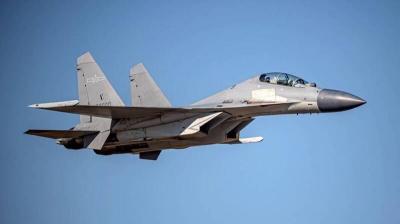
Eight Chinese naval vessels and 24 military aircraft were detected crossing the median line of the Taiwan Strait between 6am yesterday and 6am today, the Ministry of National Defense said this morning. The aircraft entered Taiwan’s northern, central, southwestern and eastern air defense identification zones, the ministry said. The armed forces responded with mission aircraft, naval vessels and shore-based missile systems to closely monitor the situation, it added. Eight naval vessels, one official ship and 36 aircraft sorties were spotted in total, the ministry said.
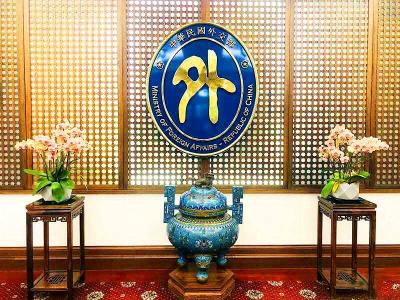
The Ministry of Foreign Affairs (MOFA) today said that if South Korea does not reply appropriately to its request to correct Taiwan’s name on its e-Arrival card system before March 31, it would take corresponding measures to alter how South Korea is labeled on the online Taiwan Arrival Card system. South Korea’s e-Arrival card system lists Taiwan as “China (Taiwan)” in the “point of departure” and “next destination” fields. The ministry said that it changed the nationality for South Koreans on Taiwan’s Alien Resident Certificates from “Korea” to “South Korea” on March 1, in a gesture of goodwill and based on the
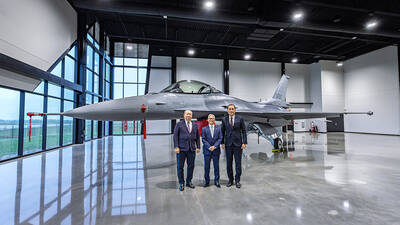
Taiwanese officials were shown the first of 66 F-16V fighter jets purchased by Taiwan from the United States, the Ministry of National Defense said yesterday, adding the aircraft has completed an initial flight test and is expected to be delivered later this year. A delegation led by Deputy Minister of National Defense Hsu Szu-chien (徐斯儉) visited Lockheed Martin’s F-16 C/D Block 70 (also known as F-16V) assembly line in South Carolina on March 16 to view the aircraft. The jet will undergo a final acceptance flight in the US before being delivered to Taiwan, the
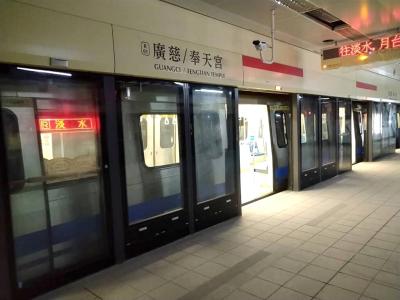
The New Taipei Metro's Sanyin Line and the eastern extension of the Taipei Metro's Tamsui-Xinyi Line (Red Line) are scheduled to begin operations in June, the National Development Council said today. The Red Line, which terminates at Xiangshan Station, would be connected by the 1.4km extension to a new eastern terminal, Guangci/Fengtian Temple Station, while the Sanyin Line would link New Taipei City's Tucheng and Yingge stations via Sanxia District (三峽). The council gave the updates at a council meeting reviewing progress on public construction projects for this year. Taiwan's annual public infrastructure budget would remain at NT$800 billion (US$25.08 billion), with NT$97.3


 RSS
RSS