


A new cross-national study led by researchers from National Chung Hsing University (NCHU) found that regular physical activity benefits can be reduced when people exercise while exposed to highly polluted air, the university said yesterday.
The international research, led by Ku Po-wen (古博文), a professor in NCHU’s Graduate Institute of Sports and Health Management, assessed whether air pollution could have an impact on the health benefits of regular exercise.
Researchers conducted a meta-analysis on seven cohort studies, involving more than 1.52 million adults in places including Taiwan, the UK, the US, Denmark and China, with all of the subjects tracked for more than a decade.
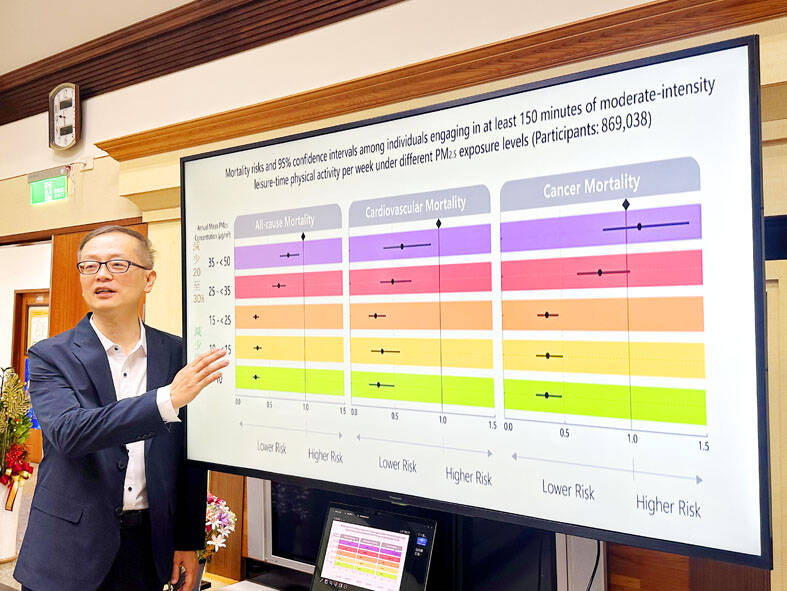
Photo: CNA
For assessing the levels of air pollution, the researchers focused on PM2.5 — tiny particles measuring 2.5 micrometers or less that are small enough to penetrate deep in people’s lungs and enter the bloodstream.
The research found that the benefits of regular exercise on people’s health — such as reducing risk of death from illnesses such as cancer and heart disease — are reduced for those living in high pollution areas.
Researchers found that people who did at least 2.5 hours of moderate or vigorous exercise a week had a 30 percent lower risk of dying during the study period than those who did not, Ku said.
However, if people in the physically active group lived in an area with high fine particle pollution — a yearly average PM2.5 concentration level of 25 micrograms per cubic meter (mg/m3) or higher — then this reduction in mortality risk halved to about 12 to 15 percent, he said.
Moreover, at higher levels of fine particle pollution — a yearly average PM2.5 concentration level of 35mg/m3 or higher — the benefits of regular exercise weakened further, particularly for risk of death from cancer, to a point where the benefits were no longer robust, he said.
Approximately 46 percent of the global population live in areas exceeding the 25mg/m3 or higher threshold, and about 36 percent live in areas exceeding the 35mg/m3 or higher threshold, he said.
“Our findings emphasize that exercise remains beneficial even in polluted environments. However, improving air quality can greatly enhance these health gains,” he said.
In Taiwan, the overall air quality has improved in the past few years, and the nationwide yearly average PM2.5 level is below 25mg/m3 but air quality differs across the country, Ku said.
Air pollution levels can increase due to changes in weather, traffic flow, topography and other factors, he said.
In addition, many people in Taiwan like to participate in outdoor physical activities, such as marathons or other road running events, he said, suggesting people to develop a habit of checking the real-time air quality before exercising outdoors.
The study was published in the journal BMC Medicine last month.
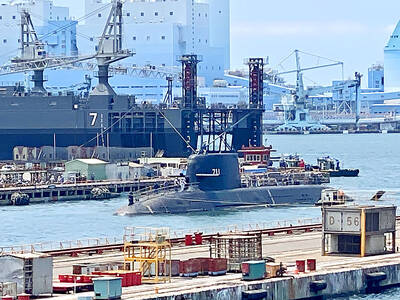
AGING: While Japan has 22 submarines, Taiwan only operates four, two of which were commissioned by the US in 1945 and 1946, and transferred to Taiwan in 1973 Taiwan would need at least 12 submarines to reach modern fleet capabilities, CSBC Corp, Taiwan chairman Chen Cheng-hung (陳政宏) said in an interview broadcast on Friday, citing a US assessment. CSBC is testing the nation’s first indigenous defense submarine, the Hai Kun (海鯤, Narwhal), which is scheduled to be delivered to the navy next month or in July. The Hai Kun has completed torpedo-firing tests and is scheduled to undergo overnight sea trials, Chen said on an SET TV military affairs program. Taiwan would require at least 12 submarines to establish a modern submarine force after assessing the nation’s operational environment and defense

A white king snake that frightened passengers and caused a stir on a Taipei MRT train on Friday evening has been claimed by its owner, who would be fined, Taipei Rapid Transit Corp (TRTC) said yesterday. A person on Threads posted that he thought he was lucky to find an empty row of seats on Friday after boarding a train on the Bannan (Blue) Line, only to spot a white snake with black stripes after sitting down. Startled, he jumped up, he wrote, describing the encounter as “terrifying.” “Taipei’s rat control plan: Release snakes on the metro,” one person wrote in reply, referring
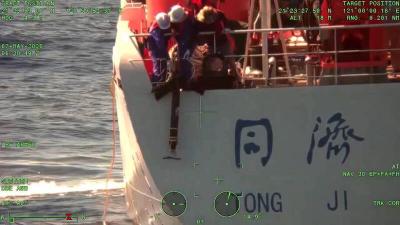
The coast guard today said that it had disrupted "illegal" operations by a Chinese research ship in waters close to the nation and driven it away, part of what Taipei sees a provocative pattern of China's stepped up maritime activities. The coast guard said that it on Thursday last week detected the Chinese ship Tongji (同濟號), which was commissioned only last year, 29 nautical miles (54km) southeast of the southern tip of Taiwan, although just outside restricted waters. The ship was observed lowering ropes into the water, suspected to be the deployment of scientific instruments for "illegal" survey operations, and the coast

Yangmingshan National Park authorities yesterday urged visitors to respect public spaces and obey the law after a couple was caught on a camera livestream having sex at the park’s Qingtiangang (擎天崗) earlier in the day. The Shilin Police Precinct in Taipei said it has identified a suspect and his vehicle registration number, and would summon him for questioning. The case would be handled in accordance with public indecency charges, it added. The couple entered the park at about 11pm on Thursday and began fooling around by 1am yesterday, the police said, adding that the two were unaware of the park’s all-day live


 RSS
RSS