

The Legislative Yuan yesterday passed the third reading of a proposed the National Health Insurance Data Management Act (全民健康保險資料管理條例), which would establish a mechanism to manage the use of NHI data and grant people the right to opt out of sharing.
In August 2022, the Constitutional Court ruled that provisions of the Personal Data Protection Act (個人資料保護法) allow the government and academic institutions to use NHI data for statistical or research purposes, but also said that the lack of personal data oversight mechanisms and provisions for individuals to opt out were unconstitutional.
The court ordered that amendments to the data protection act be made within three years.
Photo: Chung Li-hua, Taipei Times
The Executive Yuan in May advanced the draft NHI data bill — which specifies regulations such as the right to opt out — and forwarded it to the Legislative Yuan for approval.
The bill passed yesterday stipulates that when the Ministry of Health and Welfare or the National Health Insurance Administration (NHIA) collect NHI data, people may request that all or part of their data be kept out of public studies.
Within 30 days of the new law taking effect, the ministry and NHIA must cease processing requests to use NHI data by government agencies, hospitals and academic institutions, the bill says.
People can opt out of allowing use of their NHI data within the 30-day period, it says, adding that if no request is made within that period, it would be considered consent that their NHI data be used.
However, members of the public can opt out after the 30-day period, it says.
Given the sensitive nature of NHI data, the bill stipulates that those who steal, destroy, or use other illegal methods to harm the NHI database or its facilities would face imprisonment of one to seven years, and a fine of up to NT$10 million (US$318,117), the bill says.
If the offense is committed with the intent to harm national security or social stability, the offender would face a sentence of three to 10 years, and a fine of up to NT$50 million, it says.
People who are convicted of the offenses having leveraged their authority to steal or destroy data would face sentences 1.5 times harsher, while attempted misuse of the data would also be penalized, it says.
The Legislative Yuan also passed amendments to the Occupational Safety and Health Act (職業安全衛生法) that for the first time define workplace bullying and require employers to take steps to prevent it.
Workplace bullying is defined as repeated harassment, threats, isolation, insults or other inappropriate conduct carried out by someone using their position or authority and causing physical or psychological harm to a worker, the amendments say.
In severe cases, it does not need to be repeated to constitute bullying, they say.
Workplaces with more than 30 employees must establish and publish prevention guidelines, while those with more than 10 employees must provide a publicly accessible reporting channel, they say.
Employers are also required to support workers who file complaints, and report cases and outcomes to a government-designated Web site, it says. Larger workplaces must form investigation committees in which external members make up at least half of the panel.
The person in charge of a firm would be fined NT$10,000 to NT$1 million if they engage in workplace bullying, the amendments say.
Failure to provide support or conduct an investigation would result in a fine of NT$30,000 to NT$75,000, they say.
If company decisionmakers are accused of bullying, complainants can appeal directly to local labor authorities, they say. Labor agencies can order reinvestigations if they find procedural violations, and employers are not permitted to object.
The amendments would improve construction site safety by increasing penalties for employers who fail to comply with safety protocols.

‘FRIENDSHIP FLEET’: A CGA official is scheduled to meet with the president of the Pacific nation, while one of the ships is to host a banquet and National Day event Two Coast Guard Administration (CGA) patrol vessels have docked at Malakal Harbor in Palau as part of an expedition exercise and diplomatic visit, during which a senior official is expected to meet with Palauan President Surangel Whipps Jr, the agency said yesterday. The two vessels, the 4,000-tonne-class Chiayi and the 1,000-tonne-class Penghu, set sail for Palau from Taiwan last week and arrived on Tuesday at Malakal Harbor, the CGA’s Fleet Branch said in a statement. The journey marks the second time the CGA has dispatched a “friendship fleet” to another country, after it sent its first-ever goodwill fleet, comprising the Hualien and

Two executives of drone supplier Jiin Ming Industry Co (錦明實業) have been detained and held incommunicado over the company's alleged use of prohibited China-made chips and camera lenses in drones supplied under recent military contracts, the Taoyuan District Prosecutors' Office said today. In a statement, prosecutors said they raided the offices of Jiin Ming — headquartered in Taoyuan — as well as those of its subsidiaries and its suppliers on Thursday last week. The raids followed a report that the company had breached its procurement contracts by putting the prohibited components into drones delivered to the military. During the raids, prosecutors summoned

The Coast Guard Administration (CGA) today said that two of its patrol vessels have docked at Palau's Malakal Harbor as part of an expedition exercise and diplomatic visit, during which a senior official is expected to meet with the Palauan president. The two vessels, the 4,000-tonne-class Chiayi (嘉義) and the 1,000-tonne-class Penghu (澎湖), set sail for Palau from Taiwan last week and arrived at Malakal Harbor yesterday, the CGA's Fleet Branch said in a statement. The journey marked the second time the CGA has dispatched a "Friendship Fleet" to another country, after it sent its first-ever goodwill fleet, comprising the Hualien (花蓮)
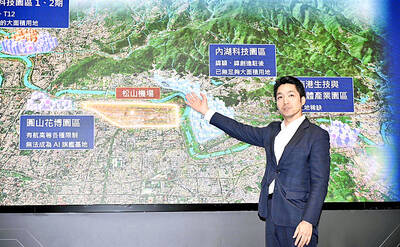
DETAILED PLAN NEEDED: Relocating the airport would affect not just travelers, but also undermine national defense and emergency medical services, a legislator said Taipei Mayor Chiang Wan-an (蔣萬安) yesterday proposed relocating Taipei International Airport (Songshan airport) and turning the site into an artificial intelligence (AI) park, drawing opposition from politicians across party lines. Chiang’s plan would turn the 300 hectares into an AI park featuring tech clusters, residential communities and green space. The industrial cluster would host 200 domestic enterprises, generate NT$12 trillion (US$376.47 billion) in output, and accommodate 65,000 jobs and 35,000 residents, he said. Cabinet spokeswoman Michelle Lee (李慧芝) said the Executive Yuan was surprised by the announcement, as the Taipei City Government did not discuss the proposal with the central government before making


 RSS
RSS