


Flight testing of US F-16V jets built for Taiwan begins this month, an air force official said yesterday, but warned of “very serious delays” in delivery.
The US$8 billion deal for 66 warplanes was approved during US President Donald Trump’s first term in the White House, with delivery scheduled for 2026.
Speaking at a meeting of the legislature’s Foreign Affairs and National Defense Committee, Air Force Chief of Staff Lieutenant General Lee Ching-jan (李慶然) said flight tests of the new fighters would be carried out “earlier” than planned this month.
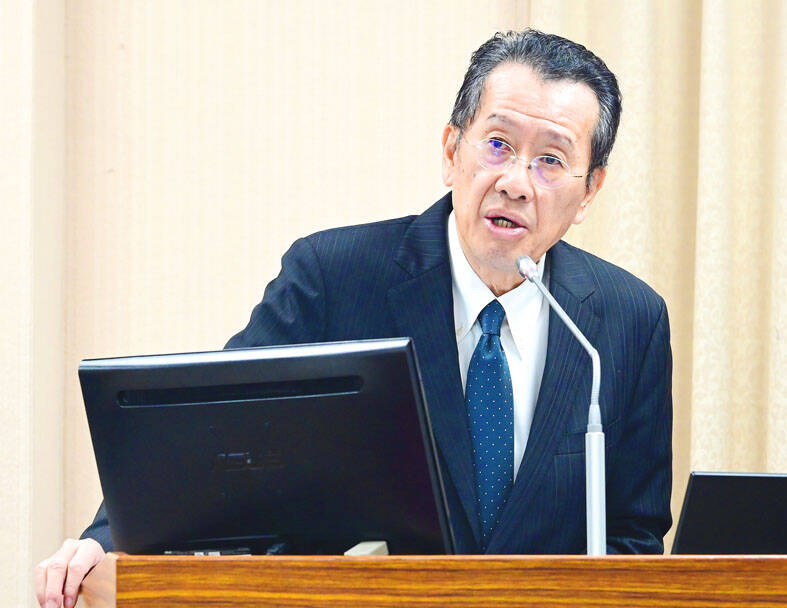
Photo: Wang Yi-sung, Taipei Times
“For now, 54 aircraft have entered the assembly line, compared with 50 in October. The progress is being accelerated,” Lee said.
Minister of National Defense Wellington Koo (顧立雄) last month said that Lockheed Martin, the US defense contractor building the jets, had accelerated production, running two shifts every weekday. “There are 50 aircraft on the assembly line at the same time, and some airframes have already completed structural assembly,” Koo said.
Koo said it would be “challenging” for all the aircraft to be delivered in next year.
The F-16V — a fourth-generation multi-role fighter — is a significantly upgraded version of Taiwan’s aging F-16A/B jets. Taiwan finished upgrading 141 older F-16s to the V standard in late 2023.
In other news, Thunder Tiger Group, a Taiwanese drone manufacturer, said it simultaneously operated six SeaShark unmanned surface vessels from a single control station during a sea trial late last month, calling the operation a major milestone in Taiwan’s uncrewed vessel development.
The Taichung-based company said in a statement yesterday that the sea trial at Dapeng Bay in Pingtung County on Nov. 28 showcased its advanced control and artificial intelligence systems, and successfully carried out multiple tactical formations and rapid, second-level maneuvers.
The 6m-long drone boats, named SeaShark, maintained 100 percent connection stability under electromagnetic interference by using a UK-made military anti-interference frequency-hopping communications system, the company said.
The vessels also feature a low-radar-cross-section hull design that reduces its chance of detection, it said.
Thunder Tiger said its SeaShark range carries precision sensors, swarm-control technology, and a stable communications network capable of real-time information exchange and dynamic adjustments.
“The SeaShark series of suicide uncrewed vessels will become the sharpest asymmetric vehicular weapon for defending the Taiwan Strait,” it said.
The company hopes to expand cooperative testing with the Chungshan Institute of Science and Technology and the Ministry of National Defense to meet operational needs.
The company said it aims to secure a defense contract next year, citing its high localization rate, completed military-specification verification and production readiness.

FUKUOKA SITUATION: Japanese media reported that the pathogen is expected to be identified by the summer, while the CDC downplayed the idea that it was hMPV A “mysterious cold-like illness” reported in Japan’s Fukuoka Prefecture does not seem to be a new disease, but Japanese authorities have been asked about the situation, the Centers for Disease Control (CDC) said yesterday. The Fukuoka Prefectural Medical Association on Wednesday told a news conference that a “mystery cold” that has become a hot topic on social media is “highly likely to be caused by some kind of viral infection,” Japan’s KBC News reported. “Many people are experiencing symptoms starting with a sore throat, followed by a runny nose, phlegm and a severe cough,” KBC News reported, citing association officials. Health authorities are

Nvidia Corp CEO Jensen Huang (黃仁勳) arrived in Taiwan yesterday ahead of upcoming AI and technology events, saying he plans to meet with clients and Taiwan Semiconductor Manufacturing Co Chairman C.C. Wei (魏哲家) during his visit. After landing at Taipei Songshan Airport, Huang posed for photos with fans and handed out Yakult drinks to reporters and supporters waiting at the scene, saying he has “a lot to do” during the trip. Asked about reports that Nvidia’s planned headquarters site in Taipei’s Beitou Shilin Technology Park could break ground on May 27, Huang said that if the company holds an event, he would

The Ministry of Finance this afternoon announced the winning numbers for the March-April uniform invoice lottery. The winning number for the NT$10 million (US$318,060) special prize is 19531471, and the winning number for the NT$2 million grand prize is 85941329. Three numbers were drawn for the NT$200,000 first prize: 07225810, 20231230 and 83518781. Those with receipts matching the last seven digits of any of the first-prize numbers will win the NT$40,000 second prize, while those matching the last six digits will win the NT$10,000 third prize. Those whose receipts match the last five digits of the first-prize numbers can claim the NT$4,000 fourth prize,
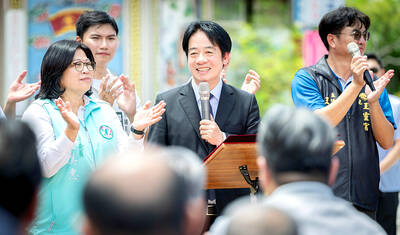
SIX SUBSIDIES: The monthly allowance for older farmers is to increase to NT$10,000, and NT$5,000 is to be given to homemakers under the national pension system, Lai said The government is to implement major welfare policies for disadvantaged groups, including raising the monthly allowance for older farmers to NT$10,000 and providing homemakers with NT$5,000 per month, President William Lai (賴清德) said yesterday. Lai made the remarks during a visit to Wangling Temple in Chiayi County, saying that the planned increases were being introduced amid economic growth and an increase in tax revenue. Touting a policy, in which the government plans to provide a monthly allowance of NT$5,000 for every child under the age of 18 in a bid to address Taiwan’s low birthrate, Lai said that if received for the


 RSS
RSS