

Chinese President Xi Jinping (習近平) used his latest phone call with US President Donald Trump to raise the Taiwan issue and make clear its stance on the matter, two US experts on cross-Taiwan Strait issues told a Taiwan media outlet yesterday.
Trump and Xi spoke on the phone yesterday, though neither side disclosed who initiated the call, according to separate announcements made by both governments.
In describing the call on Truth Social, Trump did not mention that the Taiwan issue was touched on during the call, and White House Press Secretary Karoline Leavitt told reporters the call with Xi was focused on trade.
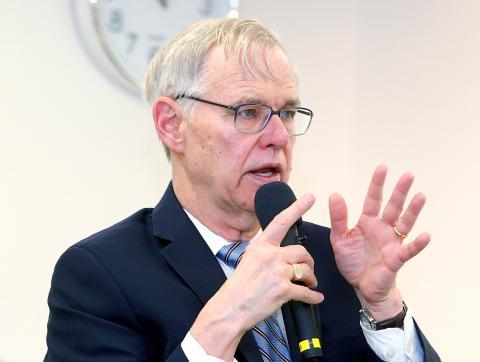
Photo: CNA
Xi, however, was cited in a state-run Xinhua New Agency article yesterday as saying that he highlighted "China's principled position on the Taiwan question, underscoring that Taiwan's return to China is an integral part of the post-war international order" during the call.
"Noting that China and the United States fought shoulder to shoulder against fascism and militarism, Xi said that given what is going on, it is even more important for the two sides to jointly safeguard the victory of World War II (WWII)," the Xinhua report said.
The same Xinhua article quoted Trump praising Xi as "a great leader" and saying that China was "a big part of the victory of WWII."
Trump also stressed that the US "understands how important the Taiwan question is to China," the Xinhua article said.
Asked about Taiwan's role in the latest Trump-Xi conversation, Richard Bush, a former American Institute in Taiwan chair and now a non-resident senior fellow at the Brookings Institution, told CNA that this was likely a follow-up call after the two did not discuss Taiwan when they last met at the Busan Summit on Oct. 30 in South Korea.
"It may be that there was an understanding at the time of the Busan summit, when Taiwan apparently was not discussed, that there would be a follow-up phone call that would include attention to Taiwan," Bush told CNA in an email.
Bush said Xi's focus on WWII cooperation in the call was a key element of China's narrative on Taiwan, though historically flawed.
"The linkage of U.S.-China cooperation in WWII with the Taiwan issue was a key theme of the PRC commemoration of the restoration of Chinese jurisdiction over Taiwan," Bush said.
"Of course, it was the ROC [Republic of China] with which the US was allied and which assumed jurisdiction on Oct. 25, 1945."
The ROC government led by Kuomintang leader Chiang Kai-shek (蔣介石) assumed control of Taiwan in October 1945 but did not cede governance of mainland China until 1949 after losing a civil war to Mao Zedong's (毛澤東) Communists.
The PRC was then established in October 1949.
Meanwhile, Bonnie Glaser, managing director of the Indo-Pacific Program at the U.S.-based German Marshall Fund, told CNA yesterday's call may have been initiated by Trump because the US leader may have wanted to "solicit Xi's help" given the recent attention focused on a proposed Russia-Ukraine peace plan.
"It is likely that Xi opted to use the opportunity to make a statement about Taiwan," Glaser said in an email to CNA.
She said Trump understands that Taiwan "is a third rail issue in U.S.-China relations" and has been "very cautious when talking about Taiwan, including when he has been asked whether the US would defend Taiwan if attacked."
Since taking office in January this year, Trump has not made any clear statements on what he would do in the event of an invasion by China.
The US's longstanding position on the issue has been one of "strategic ambiguity," which is aimed at deterring Beijing from an attempted invasion without committing to involvement in such a war.
Trump's predecessor, Joe Biden, said publicly on several occasions, however, that the US would defend Taiwan if China attacked.
Each time, Biden administration officials later walked back his statements, signaling that the US policy on Taiwan had not changed.
Given the differing accounts of the call related to the Taiwan issue by the US and China, Taiwan's Ministry of Foreign Affairs was still trying to establish what happened.
Asked about the call, Ministry of Foreign Affairs spokesman spokesman Hsiao Kuang-wei (蕭光偉) would not comment directly, saying only that "Taiwan and the US have always maintained close communications regarding all high-level interactions between Beijing and Washington."
Hsiao also blasted China for again belittling Taiwan's sovereignty status in Beijing's description of the phone call.

Taiwan’s growing defense preparations might be sending a stronger signal to the US than to Beijing, highlighting the need for Taipei to tailor its deterrence efforts to different audiences, a US security academic said yesterday. Stanford University Freeman Spogli Institute for International Studies fellow Oriana Skylar Mastro made the comment during a Taipei Security Dialogue panel examining lessons Taiwan could draw from the wars in Ukraine and the Middle East. Mastro said she was impressed by Taiwan’s increased defense spending, emphasis on asymmetric capabilities and efforts to prepare society for conflict, but questioned whom those initiatives were influencing. She said when she asked
A total of 400 foreign “high- level” professionals have been naturalized as Republic of China (Taiwan) citizens over the past decade as the government has eased nationality rules to attract talent from a wider range of fields, the Ministry of the Interior said yesterday. The 400th high-level professional, who works in the electronics industry, was approved for ROC citizenship on Aug. 26, the MOI said. The MOI quoted the newly naturalized citizen as saying that Taiwan is a leader in fields such as semiconductors, electronics manufacturing, artificial intelligence development and energy technology. He also said
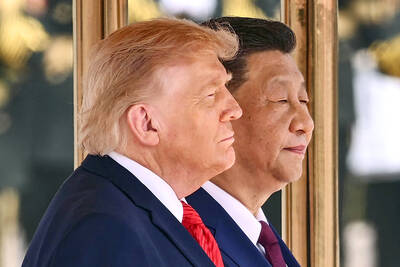
China has warned that it could cancel a planned US-China leaders’ summit if Washington approves new arms sales to Taiwan, a Japanese media outlet quoted sources as saying yesterday. US President Donald Trump, “apparently eager to showcase some diplomatic achievements ahead of November’s midterm congressional elections, places great importance on holding the summit with Chinese President Xi Jinping (習近平),” Japan’s Kyodo News reported. “While preparing for Xi’s upcoming trip, China has restated its position that the Taiwan issue is a ‘red line’ in bilateral relations,” the report said. The report said that when Xi met with Trump in Beijing in May, Xi said
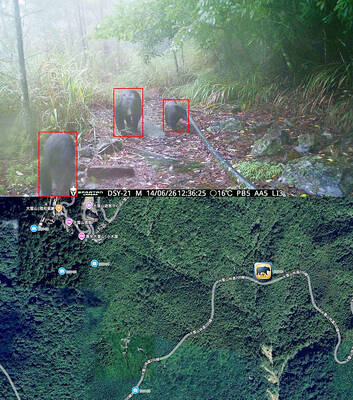
RARE PEEK: The footage released showed one of the bears staying in a cave for as long as 70 days, providing the first record of Formosan black bear’s overwintering The Forestry and Nature Conservation Agency yesterday released tracking records of released Formosan black bears for the first time, showing that they get much closer to human settlements than previously thought. The agency said it had captured two bears, Da Qu-ali (達古阿里) and Aziman (阿里曼), in indigenous villages in Hualien County and began to track them with a camera-mounted satellite collar after releasing them back into the wild. The results confirmed that the bears have moved from deep mountain areas into lowland hills closer to human communities, leading to an increase in human-bear conflicts, it said. The agency has introduced artificial intelligence-assisted early


 RSS
RSS