


Premier Cho Jung-tai (卓榮泰) said today that a "return" to China is not an option for Taiwan's 23 million people, after Chinese President Xi Jinping (習近平) pressed his country's sovereignty claims in a call with US President Donald Trump.
Xi told Trump yesterday that Taiwan's "return to China" at the end of World War II was a key part of Beijing's vision for the world order.
"We must once again emphasize that the Republic of China, Taiwan, is a fully sovereign and independent country," Cho told reporters outside parliament, referring to Taiwan's formal name.
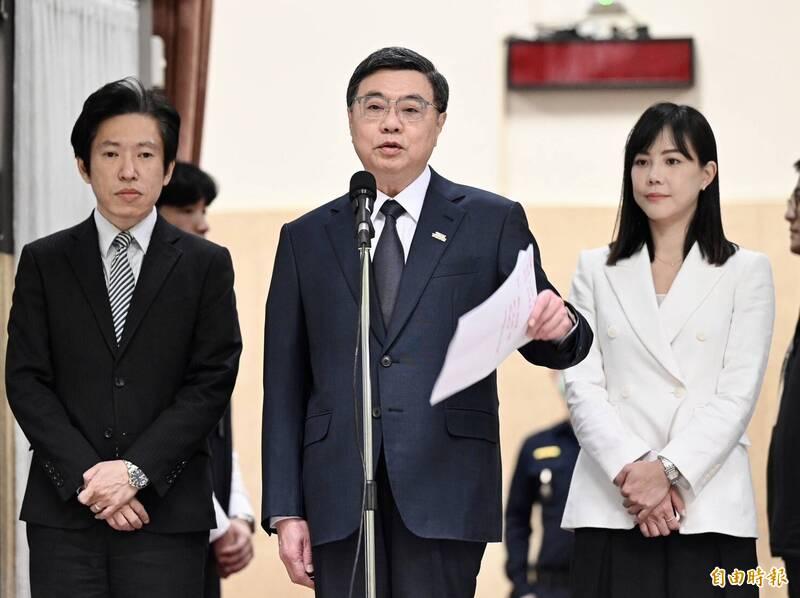
Photo: Lo Pei-te, Taipei Times
"For the 23 million people of our nation, 'return' is not an option — this is very clear," he added.
In Taiwan's system, the premier is in charge of day-to-day government operations while defense and foreign relations are generally the president's purview.
China has offered Taiwan a "one country, two systems" model, which enjoys no support from any mainstream Taiwanese political party and has been rejected by President William Lai (賴清德).
Relations between Beijing and Tokyo have plunged after Japanese Prime Minister Sanae Takaichi said this month that a hypothetical Chinese attack on Taiwan could trigger a military response from Japan.
China says Taiwan is its most important and sensitive diplomatic issue.
Taipei has repeatedly denounced Beijing for trying to distort the legacy of World War II, which ended 80 years ago, especially as Taiwan was handed to the Republic of China government at the end of the conflict.
The People's Republic of China did not come into existence until 1949, when it defeated the Republic of China forces, which then fled to Taiwan.
Ministry of Foreign Affairs spokesman Hsiao Kuang-wei (蕭光偉) told a separate briefing in Taipei today that Beijing's narrative on World War Two was "completely false and untrue".
"Its real intention is simply to isolate Taiwan from the international community and, as part of a broader set of actions, to try to restrict other countries' sovereign choices in how they engage with Taiwan," he added.
Beijing has never renounced the use of force to bring Taipei under its control and has stepped up its military pressure.
The Ministry of National Defense said today it had spotted a single balloon coming from China flying over the sensitive Taiwan Strait the day before.
Taiwan has complained that these balloon flights, which typically occur in the winter months, are part of a pattern of Chinese harassment activities.
Beijing's defense ministry did not immediately respond to a request for comment.
China has previously dismissed Taiwan's complaints about the balloons, saying they were for meteorological purposes and should not be hyped up for political reasons.
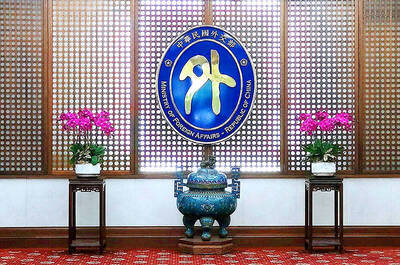
The Ministry of Foreign Affairs (MOFA) yesterday voiced dissatisfaction with the Comprehensive and Progressive Agreement for Trans- Pacific Partnership (CPTPP), whose latest meeting, concluded earlier the same day, appeared not to address the country’s application. In a statement, MOFA said the CPTPP commission had "once again failed to fairly process Taiwan’s application," attributing the inaction to the bloc’s "succumbing to political pressure," without elaborating. Taiwan submitted its CPTPP application under the name "Separate Customs Territory of Taiwan, Penghu, Kinmen and Matsu" on Sept. 22, 2021 -- less than a week after China

THE GOOD WORD: More than 100 colleges on both sides of the Pacific will work together to bring students to Taiwan so they can learn Mandarin where it is spoken A total of 102 universities from Taiwan and the US are collaborating in a push to promote Taiwan as the first-choice place to learn Mandarin, with seven Mandarin learning centers stood up in the US to train and support teachers, the Foundation for International Cooperation in Higher Education of Taiwan (FICHET) said. At the annual convention of the American Council on the Teaching of Foreign Languages held over the weekend in New Orleans, Louisiana, a Taiwan Pavilion was jointly run by 17 representative teams from the FICHET, the Overseas Community Affairs Council, the Steering Committee for the Test of Proficiency-Huayu, the
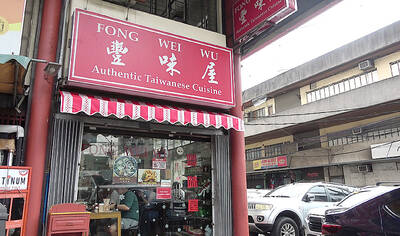
A home-style restaurant opened by a Taiwanese woman in Quezon City in Metro Manila has been featured in the first-ever Michelin Guide honoring exceptional restaurants in the Philippines. The restaurant, Fong Wei Wu (豐味屋), was one of 74 eateries to receive a “Michelin Selected” honor in the guide, while one restaurant received two Michelin stars, eight received one star and 25 were awarded a “Bib Gourmand.” The guide, which was limited to restaurants in Metro Manila and Cebu, was published on Oct. 30. In an interview, Feng Wei Wu’s owner and chef, Linda, said that as a restaurateur in her 60s, receiving an

Kaohsiung Mayor Chen Chi-mai (陳其邁) on Monday announced light shows and themed traffic lights to welcome fans of South Korean pop group Twice to the port city. The group is to play Kaohsiung on Saturday as part of its “This Is For” world tour. It would be the group’s first performance in Taiwan since its debut 10 years ago. The all-female group consists of five South Koreans, three Japanese and Tainan’s Chou Tzu-yu (周子瑜), the first Taiwan-born and raised member of a South Korean girl group. To promote the group’s arrival, the city has been holding a series of events, including a pop-up


 RSS
RSS