


A former juvenile court judge with a lengthy record of misconduct, including forcing a defendant to slap themselves and kneel to apologize to their parents, has been banned from the bench for three years, a Disciplinary Court ruling said yesterday.
Chou Ching-ni (周靜妮), who was suspended from her position by the Judicial Yuan in 2022 and later resigned, was formally removed from office and banned from the bench for three years, said the court, which is responsible for the disciplining of civil servants in Taiwan.
The ruling can be appealed.
The Disciplinary Court’s decision followed investigations by a judicial evaluation committee and the Control Yuan.
The investigations found Chou, a former prosecutor, guilty of misconduct after being transferred to the Miaoli District Court in 2009, where she served as a judge in the criminal and civil divisions before being assigned to juvenile court.
During her tenure, Chou amassed a record of unexplained absences, inconsistent rulings, unauthorized cancelations of hearings and use of court documents, and improper reliance on subordinates, the investigations found.
She also frequently showed a lack of discipline and self-control, they said.
The investigations cited one example in 2015, in which Chou received a request from prosecutors to hold a detention hearing for a defendant while she was on call.
To avoid a late-night court hearing, Chou instructed a bailiff to tell the defendant that if they refused to sit for questioning at night, she would offer them bail.
Meanwhile, in a 2019 trial involving a defendant charged with beating up their father, Chou forced the young defendant to slap themselves in the face 23 times to understand how it felt, and then kneel to apologize to their parents, the investigations found.
The probes also uncovered a 2021 case in which one party applied to withdraw from mediation. Upon receiving the request, Chou called the person on the phone, and warned that if they did not retract their application, she “might” grant the other party custody of their child.
While facing her own disciplinary proceedings in 2021, Chou also improperly accessed and photocopied related documents, and threatened the person assigned to facilitate the handover following her suspension, the investigations found.
According to the Public Functionary Discipline Act (公務員懲戒法), the Disciplinary Court’s ruling means that Chou would be banned from serving as a judge for a period of three years.
If she is reappointed after that period, she would also be barred from holding a supervisory position for an additional two years.
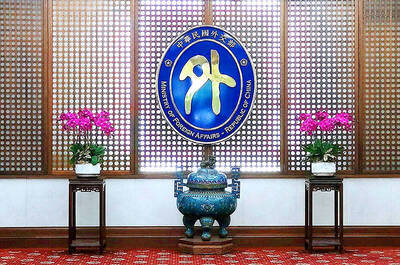
The Ministry of Foreign Affairs (MOFA) yesterday voiced dissatisfaction with the Comprehensive and Progressive Agreement for Trans- Pacific Partnership (CPTPP), whose latest meeting, concluded earlier the same day, appeared not to address the country’s application. In a statement, MOFA said the CPTPP commission had "once again failed to fairly process Taiwan’s application," attributing the inaction to the bloc’s "succumbing to political pressure," without elaborating. Taiwan submitted its CPTPP application under the name "Separate Customs Territory of Taiwan, Penghu, Kinmen and Matsu" on Sept. 22, 2021 -- less than a week after China

THE GOOD WORD: More than 100 colleges on both sides of the Pacific will work together to bring students to Taiwan so they can learn Mandarin where it is spoken A total of 102 universities from Taiwan and the US are collaborating in a push to promote Taiwan as the first-choice place to learn Mandarin, with seven Mandarin learning centers stood up in the US to train and support teachers, the Foundation for International Cooperation in Higher Education of Taiwan (FICHET) said. At the annual convention of the American Council on the Teaching of Foreign Languages held over the weekend in New Orleans, Louisiana, a Taiwan Pavilion was jointly run by 17 representative teams from the FICHET, the Overseas Community Affairs Council, the Steering Committee for the Test of Proficiency-Huayu, the

A home-style restaurant opened by a Taiwanese woman in Quezon City in Metro Manila has been featured in the first-ever Michelin Guide honoring exceptional restaurants in the Philippines. The restaurant, Fong Wei Wu (豐味屋), was one of 74 eateries to receive a “Michelin Selected” honor in the guide, while one restaurant received two Michelin stars, eight received one star and 25 were awarded a “Bib Gourmand.” The guide, which was limited to restaurants in Metro Manila and Cebu, was published on Oct. 30. In an interview, Feng Wei Wu’s owner and chef, Linda, said that as a restaurateur in her 60s, receiving an

Kaohsiung Mayor Chen Chi-mai (陳其邁) on Monday announced light shows and themed traffic lights to welcome fans of South Korean pop group Twice to the port city. The group is to play Kaohsiung on Saturday as part of its “This Is For” world tour. It would be the group’s first performance in Taiwan since its debut 10 years ago. The all-female group consists of five South Koreans, three Japanese and Tainan’s Chou Tzu-yu (周子瑜), the first Taiwan-born and raised member of a South Korean girl group. To promote the group’s arrival, the city has been holding a series of events, including a pop-up


 RSS
RSS