


Taiwan’s accession to the Comprehensive and Progressive Agreement for Trans-Pacific Partnership (CPTPP) has been hindered by China, Deputy Minister of Foreign Affairs Francois Wu (吳志中) said yesterday.
The ninth CPTPP Commission meeting was held in Melbourne on Friday, as Australia serves as the chair for the year.
The joint statement from the meeting said that four aspirants have been deemed in-line with the Auckland Principles — Uruguay, the United Arab Emirates, the Philippines and Indonesia — while member states agreed to start Uruguay’s accession process. Taiwan was not mentioned.
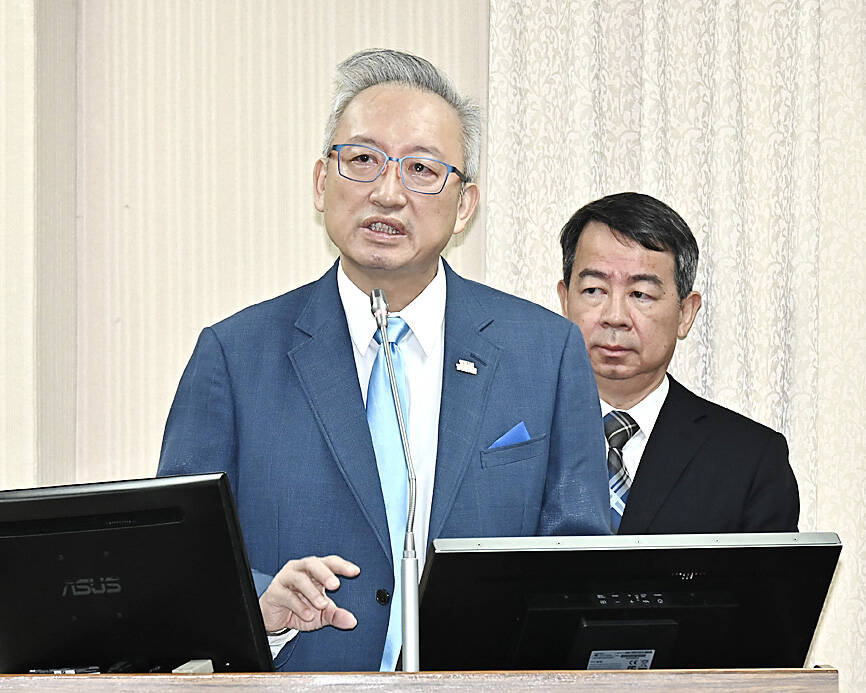
Photo: Tu Chien-jung, Taipei Times
The Auckland Principles are criteria to evaluate potential new members, which include readiness to meet the agreement’s standards, a good track record of upholding trade obligations and consensus among members
Taiwan submitted its CPTPP application on Sept. 22, 2021, about a week after China.
At the legislature’s Foreign Affairs and National Defense Committee meeting, Chinese Nationalist Party (KMT) Legislator Hsu Chiao-hsin (徐巧芯) asked Wu about the progress of Taiwan’s accession to the CPTPP.
Wu said Taiwan already meets the criteria of the Auckland Principles, but in the diplomatic arena, a country does not necessarily get what it wants by meeting the criteria, just as Taiwan meets the requirements of a sovereign state, but not all countries recognize it.
Taiwan has indeed encountered obstacles in its bid to join the CPTPP, Wu said.
“The obstacles come from China,” he added.
Taiwan is not being treated fairly because of China’s suppression, he said.
When Hsu asked whether China was involved in Australia’s decision not to establish a task force for Taiwan’s accession, Wu said that is likely.
The Ministry of Foreign Affairs’ Department of International Cooperation and Economic Affairs Director-General Vivian Lien (連玉蘋) said the ministry has constantly called on member countries to apply fair and effective methods to review Taiwan’s application.
It is an internal meeting among member countries, so the ministry is uncertain if any country proposed to establish Taiwan’s accession task force, Lien said.
Wu said Japan and the UK have expressed support for Taiwan’s accession, and the ministry has asked Japan to make the proposal.
Japan has explicitly expressed its continual support for Taiwan, speaking out for Taipei in several international events, and Wu said he believes Japan might have made the proposal in the meeting.
Earlier this month, Lien said at a ministry news conference that last year, then-CPTPP chair Canada had mentioned that individual member countries can hold pre-accession meetings with aspirants.
A CPTPP ministerial meeting in May reaffirmed their commitment to advancing discussions on remaining accession requests in a timely manner, in line with the Auckland Principles, and that they continue to welcome accession applications by economies that can satisfy the Auckland Principles, she said.
The ministry has continued to push for establishing institutional cooperation and demonstrating the contributions Taiwan can make in the CPTPP through multiple channels, Lien said.
Taiwan has urged next year’s CPTPP chair Vietnam to “fairly and effectively” process its application to join the major 12-member regional economic bloc, she added.

Yangmingshan National Park authorities yesterday urged visitors to respect public spaces and obey the law after a couple was caught on a camera livestream having sex at the park’s Qingtiangang (擎天崗) earlier in the day. The Shilin Police Precinct in Taipei said it has identified a suspect and his vehicle registration number, and would summon him for questioning. The case would be handled in accordance with public indecency charges, it added. The couple entered the park at about 11pm on Thursday and began fooling around by 1am yesterday, the police said, adding that the two were unaware of the park’s all-day live

Yangmingshan National Park’s Qingtiangang (擎天崗) nature area has gone viral after a park livestream camera observed a couple in the throes of intimate congress, which was broadcast live on YouTube, drawing large late-night crowds and sparking a backlash over noise, bright lights and disruption to wildlife habitat. The area’s livestream footage appeared to show a couple engaging in sexual activity on a picnic table in the park on Friday last week, with the uncensored footage streamed publicly online. The footage quickly spread across social media, prompting a tide of visitors to travel to the site to “check in” and recreate the

A former soldier and an active-duty army officer were yesterday indicted for allegedly selling classified military training materials to a Chinese intelligence operative for a total of NT$79,440. The Taipei District Prosecutors’ Office indicted Chen Tai-yin (陳泰尹) and Lee Chun-ta (李俊達) for contravening the National Security Act (國家安全法) and the Anti-Corruption Act (貪污治罪條例). Chen left the military in September 2013 after serving alongside then-staff sergeant Lee, now an army lieutenant, at the 21st Artillery Command of the army’s Sixth Corps from 2011 to 2013, according to the indictment. Chen met a Chinese intelligence operative identified as “Wang” (王) through a friend in November

Minister of Digital Affairs Lin Yi-ching (林宜敬) yesterday cited regulatory issues and national security concerns as an expert said that Taiwan is among the few Asian regions without Starlink. Lin made the remarks on Facebook after funP Innovation Group chief executive officer Nathan Chiu (邱繼弘) on Friday said Taiwan and four other countries in Asia — China, North Korea, Afghanistan and Syria — have no access to Starlink. Starlink has become available in 166 countries worldwide, including Ukraine, Malaysia, the Philippines and Vietnam, in the six years since it became commercial, he said. While China and North Korea block Starlink, Syria is not


 RSS
RSS