


EVA Air flight attendants are reluctant to request sick leave, as their attendance records affect their work schedules, bonuses and performance reviews, an investigation from the Ministry of Labor showed yesterday.
The ministry began investigating the nation’s second-largest airline after a 34-year-old flight attendant surnamed Sun (孫) died soon after returning from a round trip to Milan, Italy.
Sun reportedly felt unwell before the trip and had asked for assistance multiple times from coworkers and the cabin chief during the flight to Milan.
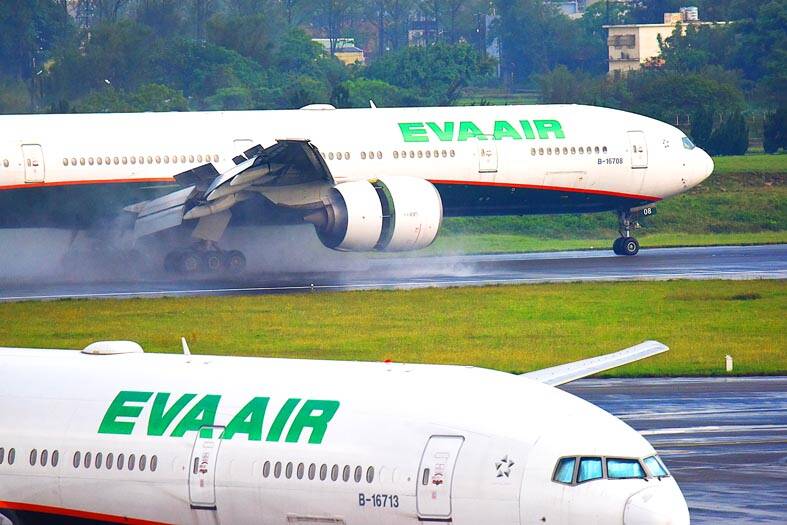
Photo: Wu Liang-yi, Taipei Times
Her request for MediLink service during the return flight was allegedly ignored by the cabin crew chief.
The incident triggered a nationwide discussion of whether the worker’s performance should factor in the number of sick leave days requested, as local media reported that Sun did not dare request sick leave for fear that doing so would hurt her performance review.
The Occupational Safety and Health Administration spent nearly one month interviewing cabin crew members working with Sun, Sun’s family members, and representatives of the Taoyuan Flight Attendant Union and EVA Airways.
The investigation found that EVA created a high-pressure corporate culture in which any sick leave request would affect a flight attendant’s work schedule, day-off arrangements and shift-swap requests.
“If a flight attendant requests more than three days of sick leave in three months, they lose the right to arrange their workdays and off days in the next months. Their work schedules would be completely arranged by the airline instead,” agency Director-General Lin Yu-tang (林毓堂) told a news conference in Taipei, adding that most flight attendants cited this as the main reason why they were reluctant to request sick leave.
A flight attendant would be deducted points from attendance records for requesting sick leave and not be granted additional points in the category of “special contributions” to the airline, Lin said.
Points would be deducted three times more if an attendant requests sick leave during Lunar New Year or other national holidays, Lin said, adding that it would affect the attendant’s year-end bonus as well as promotions.
The agency found that Sun had told her coworkers that she once requested more than three days of sick leave in three months after a traffic accident.
She said she then received a “very tiring” fight schedule after returning for work.
Sun’s experience of exhausting other types of leave before requesting sick leave was shared by other flight attendants, who said they would take menstrual leave or family care leave instead of sick leave, or simply go to work while feeling unwell to avoid punishment, Lin said.
The cabin chief told the work safety inspectors that she knew that Sun was physically unwell, but she did not ask Sun to stop working or take sick leave as “it would hurt her attendance record.”
The airline’s operational manual for cabin crew stipulates that emergency response procedures must be activated when a cabin crew member is unconscious or is unable to accurately convey their health.
Other crew members are supposed to contact MediLink service, a real-time, ground-based medical support system for airlines to assist flight crews during medical emergencies on a plane, Lin said.
However, the cabin crew chief did not activate MediLink as Sun said she did not need to consult a doctor and could take her own medication.
Nor did the cabin crew chief contact EVA’s ground personnel to take Sun to the hospital once the flight landed, Lin said.
Instead, the cabin crew chief gave Sun a hot towel, told her to seek medical attention after the flight landed and adjusted her duties.
“EVA is responsible for leaving the cabin crew to react to emergency situations and bear risks themselves, and failing to list explicit emergency operating procedures for them to follow,” Lin said, adding that most cabin crew reported that they thought MediLink was for passenger use only.
The investigation found that Sun was told she needed to pay for herself if they called an ambulance, and her request to be picked up by her roommate after landing was also denied.
When disembarking, Sun was also asked to remove the blanket she used to cover herself.
Work safety inspectors also found that Sun was supposed to receive a compensatory off day for working on Children’s Day, a national holiday, but the airline could not name the exact date of the off day, Lin said, adding that the airline could contravene Article 37 of the Labor Standards Act (勞動基準法) in this regard.
The Civil Aviation Administration has been asked to investigate if the airline contravened the Civil Aviation Act (民用航空法) and Aircraft Flight Operation Regulations (航空器飛航作業管理規則), while EVA has been ordered to complete an investigation within two months to determine whether Sun was being bullied.
The Taoyuan City government would investigate whether the airline breached Article 37 of the Labor Standards Act.
With permission from Sun’s family, the ministry would request her medical records from the Ministry of Health and Welfare and consult medical specialists to determine if Sun died of occupation-induced illness.
EVA said that since the incident occurred, it has investigated the matter and promptly implemented improvements, and would continue to work with the Ministry of Labor to review and adjust its systems.

Considering that most countries issue more than five denominations of banknotes, the central bank has decided to redesign all five denominations, the bank said as it prepares for the first major overhaul of the banknotes in more than 24 years. Central bank Governor Yang Chin-lung (楊金龍) is expected to report to the Legislative Yuan today on the bank’s operations and the redesign’s progress. The bank in a report sent to the legislature ahead of today’s meeting said it had commissioned a survey on the public’s preferences. Survey results showed that NT$100 and NT$1,000 banknotes are the most commonly used, while NT$200 and NT$2,000
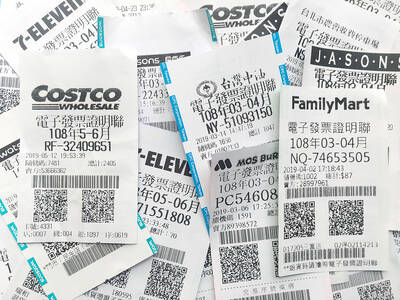
A NT$39 receipt for two bottles of tea at a FamilyMart was among the NT$10 million (US $312,969) special prize winners in the January-February uniform invoice lottery. FamilyMart said that two NT$10 million-winning receipts were issued at its stores, as well as two NT$2 million grand prizes and three NT$200,000 first prizes. The two NT$10 million receipts were issued at stores in Pingtung County and Yilan County’s Dongshan Township (冬山). One winner spent just NT$39 on two bottles of tea, while another spent NT$80 on water, tea and coffee, the company said. Meanwhile, 7-Eleven reported three NT$10 million winners — in New Taipei

The Centers for Disease Control (CDC) yesterday reported the first case of a new COVID-19 subvariant — BA.3.2 — in a 10-year-old Singaporean girl who had a fever upon arrival in Taiwan and tested positive for the disease. The girl left Taiwan on March 20 and the case did not have a direct impact on the local community, it said. The WHO added the BA.3.2 strain to its list of Variants Under Monitoring in December last year, but this was the first imported case of the COVID-19 variant in Taiwan, CDC Deputy Director-General Lin Ming-cheng (林明誠) said. The girl arrived in Taiwan on

ANNUAL EVENT: Two massive Pokemon balloons are to be set up in Daan Park, with an event zone operating from 10am to 6pm This year’s Taipei Floral Picnic is to be held at Daan Park today and tomorrow, featuring an exclusive Pokemon Go event, a themed food market, a coffee rave picnic area and stage performances, the Taipei Department of Information and Tourism said yesterday. Two massive Pokemon balloons are to be set up in the park as attractions, with an exclusive event zone operating from 10am to 6pm, it said. Participants who complete designated tasks on-site would have a chance to receive limited-edition souvenirs, it added. People could also try the newly launched game Pokemon Pokopia in the trial area, the department said. Three PokeStops are


 RSS
RSS