


The High Court last night granted prosecutors' request to detain six retired and active Taiwanese military personnel and a Chinese man indicted for leaking military secrets to China.
The ruling can be appealed.
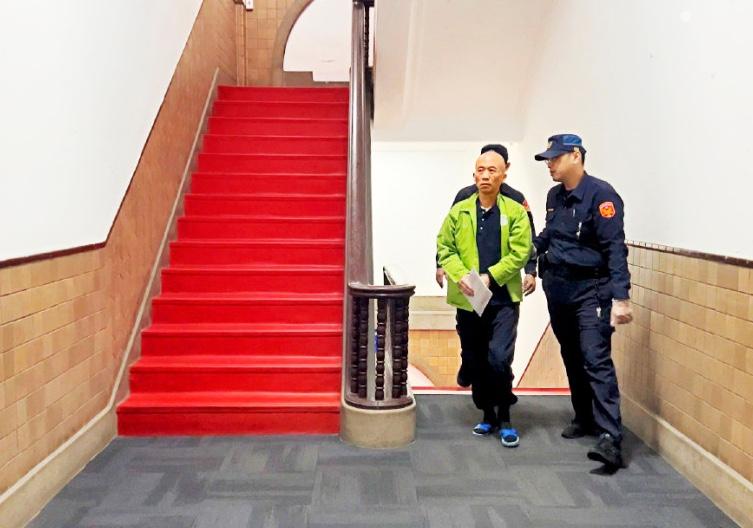
Photo: Chang Wen-chuan, Taipei Times
In a summary of the ruling read by a court spokesperson, the court said the seven people were indicted on charges related to contraventions of the National Security Act (國家安全法), which carry a minimum sentence of five years in prison.
It decided that given the seriousness of their alleged crimes and their potential flight risk, they were ordered to be detained for three months, the maximum allowed for defendants during a trial.
One of the defendants, Yang Chien-hui (楊千慧), admitted to all charges and was deemed unlikely to collude, so she would not be held incommunicado.
The remaining six suspects would be detained incommunicado, the court said.
Earlier yesterday, the High Prosecutors' Office indicted the seven for contravening the National Security Act, the Classified National Security Information Protection Act (國家機密保護法) and the Criminal Code of the Armed Forces (陸海空軍刑法).
The defendants include a Chinese man named Ding Xiaohu (丁小琥), or Ting Siu-fu in Cantonese, who holds a Hong Kong passport, as well as six military personnel, identified as Wang Wen-hao (王文豪), Tan Chun-ming (譚俊明), Lu Fang-chi (呂芳契), Chiu Han-lin (邱翰林), Yang Chien-hui and Yang Po-chih (楊博智).
Prosecutors allege that Ding recruited retired officers Wang, Tan and two others surnamed Chang (張) and Ho (何) who have since died as members of a network that developed contacts and gathered classified information.
The four then took advantage of their connections in the military to recruit active and retired personnel, including Lu, Chiu, Yang Chien-hui and Yang Po-chih, prosecutors said.
More than NT$11.12 million (US$356,444) was transferred to Taiwan to fund the criminal operations by an associate named Chen Chun-an (陳俊安), according to information provided by prosecutors, the Investigation Bureau and the Ministry of National Defense.
Official descriptions of the case have not pinpointed when these actions took place, but according to local media, Ding began recruiting people for his network in 2018 and began actual spy activities in 2023.
The case was discovered by judicial authorities last year.
Also yesterday, the Taipei District Prosecutors' Office indicted Ding, Wang and Chen for money laundering and contraventions of the Banking Act (銀行法).
Charges against Chang and Ho, both deceased, were dropped.

FUKUOKA SITUATION: Japanese media reported that the pathogen is expected to be identified by the summer, while the CDC downplayed the idea that it was hMPV A “mysterious cold-like illness” reported in Japan’s Fukuoka Prefecture does not seem to be a new disease, but Japanese authorities have been asked about the situation, the Centers for Disease Control (CDC) said yesterday. The Fukuoka Prefectural Medical Association on Wednesday told a news conference that a “mystery cold” that has become a hot topic on social media is “highly likely to be caused by some kind of viral infection,” Japan’s KBC News reported. “Many people are experiencing symptoms starting with a sore throat, followed by a runny nose, phlegm and a severe cough,” KBC News reported, citing association officials. Health authorities are

Nvidia Corp CEO Jensen Huang (黃仁勳) arrived in Taiwan yesterday ahead of upcoming AI and technology events, saying he plans to meet with clients and Taiwan Semiconductor Manufacturing Co Chairman C.C. Wei (魏哲家) during his visit. After landing at Taipei Songshan Airport, Huang posed for photos with fans and handed out Yakult drinks to reporters and supporters waiting at the scene, saying he has “a lot to do” during the trip. Asked about reports that Nvidia’s planned headquarters site in Taipei’s Beitou Shilin Technology Park could break ground on May 27, Huang said that if the company holds an event, he would

The Ministry of Finance this afternoon announced the winning numbers for the March-April uniform invoice lottery. The winning number for the NT$10 million (US$318,060) special prize is 19531471, and the winning number for the NT$2 million grand prize is 85941329. Three numbers were drawn for the NT$200,000 first prize: 07225810, 20231230 and 83518781. Those with receipts matching the last seven digits of any of the first-prize numbers will win the NT$40,000 second prize, while those matching the last six digits will win the NT$10,000 third prize. Those whose receipts match the last five digits of the first-prize numbers can claim the NT$4,000 fourth prize,
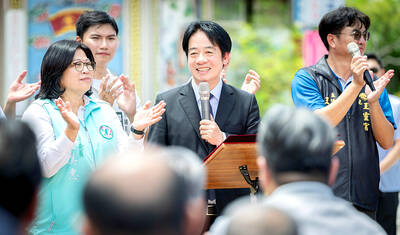
SIX SUBSIDIES: The monthly allowance for older farmers is to increase to NT$10,000, and NT$5,000 is to be given to homemakers under the national pension system, Lai said The government is to implement major welfare policies for disadvantaged groups, including raising the monthly allowance for older farmers to NT$10,000 and providing homemakers with NT$5,000 per month, President William Lai (賴清德) said yesterday. Lai made the remarks during a visit to Wangling Temple in Chiayi County, saying that the planned increases were being introduced amid economic growth and an increase in tax revenue. Touting a policy, in which the government plans to provide a monthly allowance of NT$5,000 for every child under the age of 18 in a bid to address Taiwan’s low birthrate, Lai said that if received for the


 RSS
RSS