


Beijing’s advisory urging Chinese citizens to avoid traveling to Japan would significantly improve the tourism experience for visitors from other countries, travel bloggers said.
The Chinese Ministry of Foreign Affairs on Friday issued a travel warning after Japanese Prime Minister Sanae Takaichi earlier this month said that a Chinese attack on Taiwan could constitute “a survival-threatening situation” that could trigger a military response.
The advisory said that the crime rate in Japan has been rising, with many cases of Chinese being attacked.
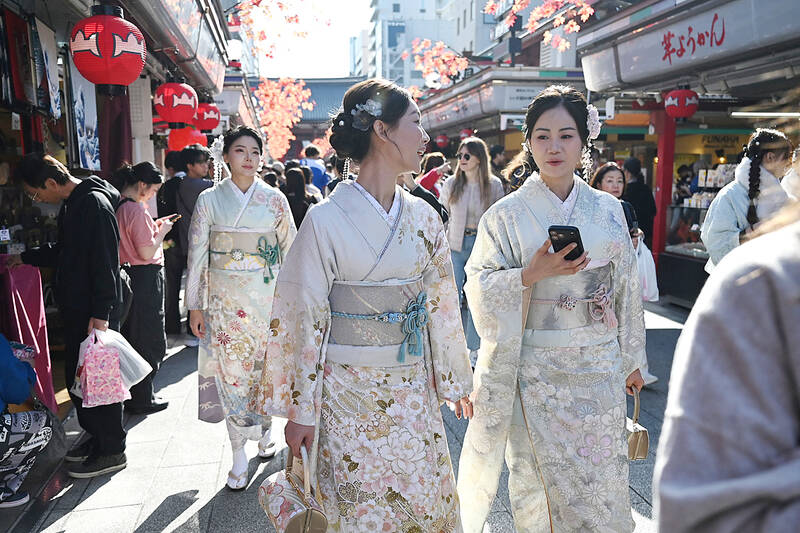
Photo: AFP
“Recently, the Japanese leader made explicit and provocative remarks related to Taiwan, severely worsening the atmosphere of the exchange between Chinese and Japanese nationals, and putting life and safety of Chinese nationals residing in Japan under enormous risks,” the Chinese ministry said.
Chinese citizens should avoid visiting Japan in the near term, while those residing in Japan should closely monitor the security situation and enhance their safety awareness, it said.
Taiwanese travel writer “943” said that fewer Chinese tourists in Japan would make it easier for Taiwanese to book quality hotels and restaurants.
They would have more space to move around when shopping in Japanese stores and might no longer face long lines at checkouts, she said.
Their travel in Japan would be more relaxed and of higher quality as well, she said.
“Taiwanese travelers are actually pleased with the latest development of Japan-China relations, because they are now less likely to encounter loud group travelers, like going to Japan before it was inundated by travelers,” she said.
Taiwanese travel blogger Linshibi (林氏壁), who specializes in independent travel in Japan, joked that Japan is indeed a dangerous country.
“Seriously, Japan has seen a rise in bear attacks on humans, as well as a major flu outbreak. With the yen’s depreciation, one could easily spend a fortune without realizing it. Such a dangerous country is perfect for Taiwanese visitors,” he said.
It is worth monitoring to see if political factors actually lead to a substantial fall in Chinese tourists in Japan, he added.
“Takaichi can be assured that the tourism revenue that Japan has lost due to its dispute with China would be made up by a dramatic increase of Taiwanese visitors,” he said.
However, some Chinese in Shanghai and Beijing said they would still travel to Japan despite the warning, although they are concerned about discrimination in Japan and retribution from fellow citizens.
A man surnamed Yang (楊), who offers technical support services for Japanese corporations in China, frequently travels between the countries for work.
He said that he has become accustomed to shifts in China-Japan relations over the years.
However, it was the COVID-19 pandemic, rather than political factors, that most affected his work, Yang said.
Having permanent residency in Japan, Yang said he is surrounded by mostly Japan-friendly people and has already booked tickets for a sea-fishing trip in Nagasaki next year.
“My position on this issue would not be swayed, and I do not have friends who are populists,” he said.
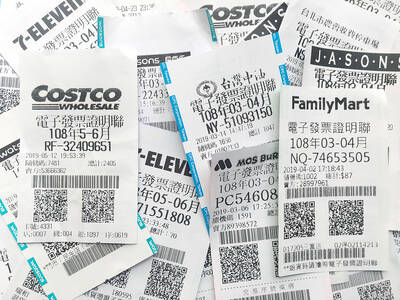
A NT$39 receipt for two bottles of tea at a FamilyMart was among the NT$10 million (US $312,969) special prize winners in the January-February uniform invoice lottery. FamilyMart said that two NT$10 million-winning receipts were issued at its stores, as well as two NT$2 million grand prizes and three NT$200,000 first prizes. The two NT$10 million receipts were issued at stores in Pingtung County and Yilan County’s Dongshan Township (冬山). One winner spent just NT$39 on two bottles of tea, while another spent NT$80 on water, tea and coffee, the company said. Meanwhile, 7-Eleven reported three NT$10 million winners — in New Taipei

Considering that most countries issue more than five denominations of banknotes, the central bank has decided to redesign all five denominations, the bank said as it prepares for the first major overhaul of the banknotes in more than 24 years. Central bank Governor Yang Chin-lung (楊金龍) is expected to report to the Legislative Yuan today on the bank’s operations and the redesign’s progress. The bank in a report sent to the legislature ahead of today’s meeting said it had commissioned a survey on the public’s preferences. Survey results showed that NT$100 and NT$1,000 banknotes are the most commonly used, while NT$200 and NT$2,000

The Centers for Disease Control (CDC) yesterday reported the first case of a new COVID-19 subvariant — BA.3.2 — in a 10-year-old Singaporean girl who had a fever upon arrival in Taiwan and tested positive for the disease. The girl left Taiwan on March 20 and the case did not have a direct impact on the local community, it said. The WHO added the BA.3.2 strain to its list of Variants Under Monitoring in December last year, but this was the first imported case of the COVID-19 variant in Taiwan, CDC Deputy Director-General Lin Ming-cheng (林明誠) said. The girl arrived in Taiwan on

ANNUAL EVENT: Two massive Pokemon balloons are to be set up in Daan Park, with an event zone operating from 10am to 6pm This year’s Taipei Floral Picnic is to be held at Daan Park today and tomorrow, featuring an exclusive Pokemon Go event, a themed food market, a coffee rave picnic area and stage performances, the Taipei Department of Information and Tourism said yesterday. Two massive Pokemon balloons are to be set up in the park as attractions, with an exclusive event zone operating from 10am to 6pm, it said. Participants who complete designated tasks on-site would have a chance to receive limited-edition souvenirs, it added. People could also try the newly launched game Pokemon Pokopia in the trial area, the department said. Three PokeStops are


 RSS
RSS