


The Food and Drug Administration (FDA) is to increase the frequency of random inspections of cage eggs starting this week, Minister of Health and Welfare Shih Chung-liang (石崇良) said yesterday.
The move was in response to reports that pesticide-contaminated eggs from a movement-controlled farm in Changhua County were still making their way into the market.
The FDA on Friday said it received a report from the Taichung Office of Food and Drug Safety saying that they found eggs from Wenya Livestock Farm in a store on Monday last week, despite the movement controls on the farm.
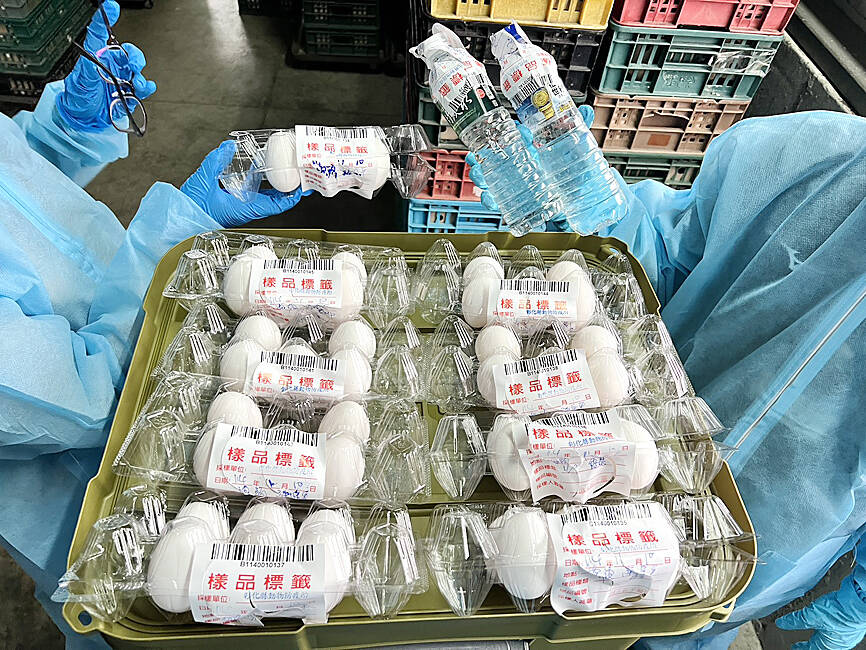
Photo courtesy of the Changhua County Government
The store was asked to remove the contaminated eggs from shelves and to stop selling eggs from Wenya Livestock Farm.
Tests on the eggs also detected 0.05 parts per million (ppm) of fipronil and its metabolites, which is in excess of the 0.01ppm limit.
It was “unimaginable” that Wenya Livestock Farm continued to sell eggs, despite being placed under movement control by the central government, Shih said, adding that the ministry asked the local government to investigate and hold people responsible for the distribution of eggs accountable.
Speaking on the sidelines of the Global Health and Welfare Forum in Taiwan in Taipei, Shih said the FDA is this week to increase the frequency of random inspections on eggs in the market.
“The expanded inspections will be conducted according to risk evaluation,” he said, adding that he would not go into detail about the inspections, so that egg dealers would not have time to prepare.
Problems are easier to detect through unannounced inspections, the minister added.
Risk stratification would also be used, so the first target would be eggs labeled “C,” or “cage eggs,” Shih said.
The FDA and agricultural agencies would together review the conditions of egg farms, including stock density, and assess the risk levels of cities and counties, to decide how the inspections should be carried out, he said.
A NT$39 receipt for two bottles of tea at a FamilyMart was among the NT$10 million (US $312,969) special prize winners in the January-February uniform invoice lottery. FamilyMart said that two NT$10 million-winning receipts were issued at its stores, as well as two NT$2 million grand prizes and three NT$200,000 first prizes. The two NT$10 million receipts were issued at stores in Pingtung County and Yilan County’s Dongshan Township (冬山). One winner spent just NT$39 on two bottles of tea, while another spent NT$80 on water, tea and coffee, the company said. Meanwhile, 7-Eleven reported three NT$10 million winners — in New Taipei

Considering that most countries issue more than five denominations of banknotes, the central bank has decided to redesign all five denominations, the bank said as it prepares for the first major overhaul of the banknotes in more than 24 years. Central bank Governor Yang Chin-lung (楊金龍) is expected to report to the Legislative Yuan today on the bank’s operations and the redesign’s progress. The bank in a report sent to the legislature ahead of today’s meeting said it had commissioned a survey on the public’s preferences. Survey results showed that NT$100 and NT$1,000 banknotes are the most commonly used, while NT$200 and NT$2,000

The Centers for Disease Control (CDC) yesterday reported the first case of a new COVID-19 subvariant — BA.3.2 — in a 10-year-old Singaporean girl who had a fever upon arrival in Taiwan and tested positive for the disease. The girl left Taiwan on March 20 and the case did not have a direct impact on the local community, it said. The WHO added the BA.3.2 strain to its list of Variants Under Monitoring in December last year, but this was the first imported case of the COVID-19 variant in Taiwan, CDC Deputy Director-General Lin Ming-cheng (林明誠) said. The girl arrived in Taiwan on

ANNUAL EVENT: Two massive Pokemon balloons are to be set up in Daan Park, with an event zone operating from 10am to 6pm This year’s Taipei Floral Picnic is to be held at Daan Park today and tomorrow, featuring an exclusive Pokemon Go event, a themed food market, a coffee rave picnic area and stage performances, the Taipei Department of Information and Tourism said yesterday. Two massive Pokemon balloons are to be set up in the park as attractions, with an exclusive event zone operating from 10am to 6pm, it said. Participants who complete designated tasks on-site would have a chance to receive limited-edition souvenirs, it added. People could also try the newly launched game Pokemon Pokopia in the trial area, the department said. Three PokeStops are


 RSS
RSS