


Newly inaugurated Chinese Nationalist Party (KMT) Chairwoman Cheng Li-wun (鄭麗文) yesterday pledged that her party would defend democracy and revive the economy, while opposing the government’s plan to increase defense spending to more than 3 percent of GDP next year.
Cheng made the remarks as she succeeded Eric Chu (朱立倫) in a handover ceremony at the party’s 22nd National Congress in Taipei, attended by KMT officials including Legislative Speaker Han Kuo-yu (韓國瑜), Deputy Legislative Speaker Johnny Chiang (江啟臣) and Taipei Mayor Chiang Wan-an (蔣萬安).
Cheng said Taiwan faces heightened tensions in the Taiwan Strait and a rapidly changing global economic order.
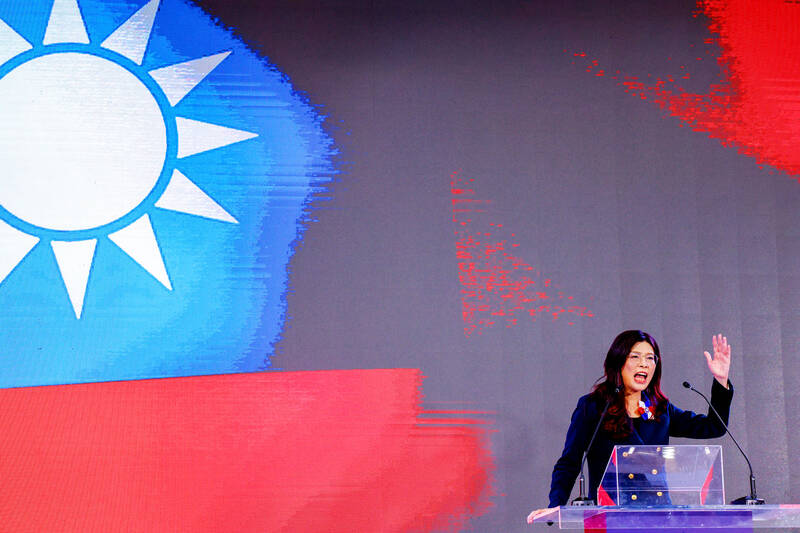
Photo: RITCHIE B. TONGO, EPA
The Democratic Progressive Party’s (DPP) long-term rule is eroding Taiwan’s democracy and rule of law, she said, adding that the KMT bears a heavy responsibility to restore order and address the nation’s problems.
Cheng said the party is confident it can demonstrate unprecedented unity and pledged that under her leadership, it would defend democracy and freedom, revive the economy, and pursue long-term cross-strait peace.
The KMT hopes to turn “Taiwan’s worst times into its best” while continuing to reform, grow stronger and attract young talent, she added.
Cheng said she hopes the KMT would not only be Taiwan’s most important and largest political party, but also an organization that serves the public interest, helping vulnerable communities and assisting people in every corner of Taiwan.
Chu urged the party to unite under Cheng’s leadership, saying that only through unity can the party grow stronger and better.
“We only have one KMT and unity is our only path,” Chu said.
In an interview with Agence France-Presse yesterday before the event, Cheng said that Taiwan cannot afford to hike its defense budget to more than 3 percent of GDP.
“The US’ expectations far exceed what we can reasonably afford,” Cheng said.
“Taiwan is not an ATM. We really do not have that much money,” she said.
“We certainly have the determination to defend Taiwan, but it is not a blank check. That is why I said we must have a reasonable defense budget,” she added.
The government has proposed a budget of NT$949.5 billion (US$30.88 billion), or 3.32 percent of GDP, for defense spending next year.
It is also plans to seek up to NT$1 trillion over seven years in special funding to upgrade the nation’s air defense systems, and increase capacity to produce and store ammunition for wartime.
It is unclear how many KMT lawmakers support Cheng’s views, but she insists it is the “vast majority” of the party.
Chu previously said the party supported increasing defense spending to more than 3 percent of GDP, but opposed Taiwan buying US weapons and equipment to resolve its trade deficit.
“If cross-strait relations are peaceful and stable, we do not need a pointless arms race,” Cheng said, adding that dialogue with Beijing was the best option.
The “status quo” between Taiwan and China “cannot remain unchanged forever,” Cheng said, adding that that there would inevitably be a “process of change.”
“What we are working hard for now is to prevent it from escalating into war, but rather toward reconciliation and peace,” she said, adding she is willing to meet with Chinese President Xi Jinping (習近平).
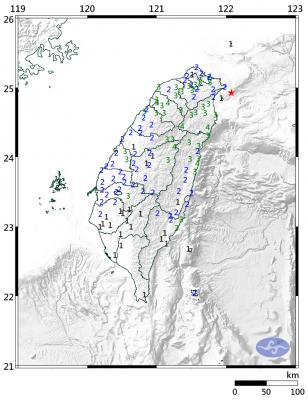
A magnitude 6.1 earthquake struck off the coast of Yilan County at 8:39pm tonight, the Central Weather Administration (CWA) said, with no immediate reports of damage or injuries. The epicenter was 38.7km east-northeast of Yilan County Hall at a focal depth of 98.3km, the CWA’s Seismological Center said. The quake’s maximum intensity, which gauges the actual physical effect of a seismic event, was a level 4 on Taiwan’s 7-tier intensity scale, the center said. That intensity level was recorded in Yilan County’s Nanao Township (南澳), Hsinchu County’s Guansi Township (關西), Nantou County’s Hehuanshan (合歡山) and Hualien County’s Yanliao (鹽寮). An intensity of 3 was
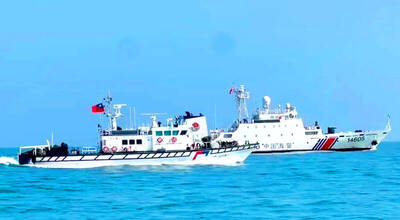
Instead of focusing solely on the threat of a full-scale military invasion, the US and its allies must prepare for a potential Chinese “quarantine” of Taiwan enforced through customs inspections, Stanford University Hoover fellow Eyck Freymann said in a Foreign Affairs article published on Wednesday. China could use various “gray zone” tactics in “reconfiguring the regional and ultimately the global economic order without a war,” said Freymann, who is also a nonresident research fellow at the US Naval War College. China might seize control of Taiwan’s links to the outside world by requiring all flights and ships entering or leaving Taiwan
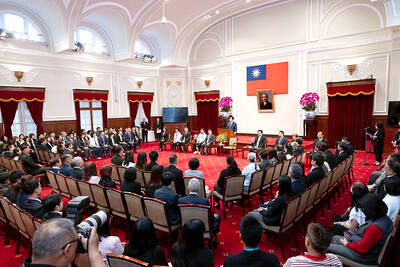
The next minimum wage hike is expected to exceed NT$30,000, President William Lai (賴清德) said yesterday during an award ceremony honoring “model workers,” including migrant workers, at the Presidential Office ahead of Workers’ Day today. Lai said he wished to thank the awardees on behalf of the nation and extend his most sincere respect for their hard work, on which Taiwan’s prosperity has been built. Lai specifically thanked 10 migrant workers selected for the award, saying that although they left their home countries to further their own goals, their efforts have benefited Taiwan as well. The nation’s industrial sector and small businesses lay
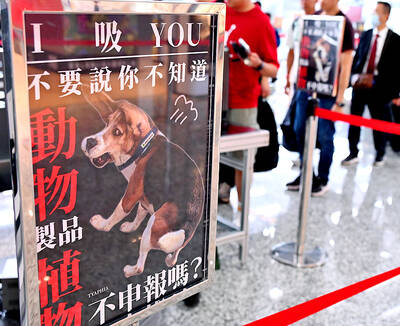
Quarantine awareness posters at Taiwan Taoyuan International Airport have gone viral for their use of wordplay. Issued by the airport branch of the Animal and Plant Health Inspection Agency, the posters feature sniffer dogs making a range of facial expressions, paired with advisory messages built around homophones. “We update the messages for holidays and campaign needs, periodically refreshing materials to attract people’s attention,” quarantine officials said. “The aim is to use the dogs’ appeal to draw focus to quarantine regulations.” A Japanese traveler visiting Taiwan has posted a photo on X of a poster showing a quarantine dog with a


 RSS
RSS