

Many people with psoriasis are mistakenly believed to have a contagious disease and are treated unkindly, such as being refused service at hair salons, the Psoriasis Association Taiwan said yesterday, as it announced an online certification for hairstylists to learn about psoriasis.
The association invited a man with the condition, surnamed Chang (張), to share his experience at a news conference in Taipei ahead of World Psoriasis Day today, to raise awareness about psoriasis and psoriatic arthritis.
Chang, 55, said that he worked long hours under stress while he was an entrepreneur in his 30s and it unexpectedly triggered psoriasis.

Photo: CNA
He developed red, scaly patches and white flakes on his skin, he said.
Because of his condition, Chang said he was afraid to wear short sleeves or take off his cap in public.
He was sometimes treated unkindly, such as when getting his hair cut, where he was rejected or told to buy anti-dandruff products, he said, adding that once he went four years without a haircut.
Linkou Chang Gung Memorial Hospital dermatologist Huang Yu-hui (黃毓惠) said psoriasis is a non-contagious, long-lasting autoimmune disease that causes inflammation of the skin.
Aside from genetic predisposition, environmental factors can also trigger an onset, such as stress, infection or skin injuries, Huang said.
Psoriasis can occur at any age, but often has two peaks of onset: between age 20 and 29 and from 50 to 59, she said.
Among people with moderate-to-severe psoriasis, there is a higher prevalence of scalp involvement (about 56 percent) and facial involvement (about 49 percent), she said.
Some people experience extreme itchiness and scratch their scalp causing injury to the skin and increased infection risk, so treatment aims to suppress inflammation and reduce itchiness during flare-ups, Huang said.
In addition to skin injuries and an increased risk of infection from scratching, many people with psoriasis experience anxiety, association secretary-general Wang Ya-hsin (王雅馨) said, citing Chang’s situation at hair salons.
To encourage people with psoriasis to step into hair salons, the association this year collaborated with doctors, academics and hairstylists to launch a “psoriasis-friendly hairstylists alliance,” Wang said.
The association invited a hairstylist, Miyake of Hungkuang University’s Department of Hair Styling and Design, who has designed hairstyles for many entertainers, to make a video teaching other stylists how to carefully design and execute hairstyles for people with psoriasis, Wang said.
After hairstylists watch the online course and pass an exam, they would receive a certificate from the association and the university, she said, adding that the association would also put their salon on its online list of psoriasis-

Taiwan’s growing defense preparations might be sending a stronger signal to the US than to Beijing, highlighting the need for Taipei to tailor its deterrence efforts to different audiences, a US security academic said yesterday. Stanford University Freeman Spogli Institute for International Studies fellow Oriana Skylar Mastro made the comment during a Taipei Security Dialogue panel examining lessons Taiwan could draw from the wars in Ukraine and the Middle East. Mastro said she was impressed by Taiwan’s increased defense spending, emphasis on asymmetric capabilities and efforts to prepare society for conflict, but questioned whom those initiatives were influencing. She said when she asked

A total of 400 foreign “high- level” professionals have been naturalized as Republic of China (Taiwan) citizens over the past decade as the government has eased nationality rules to attract talent from a wider range of fields, the Ministry of the Interior said yesterday. The 400th high-level professional, who works in the electronics industry, was approved for ROC citizenship on Aug. 26, the MOI said. The MOI quoted the newly naturalized citizen as saying that Taiwan is a leader in fields such as semiconductors, electronics manufacturing, artificial intelligence development and energy technology. He also said

SIZE MATTERS: Large ships are politically attractive as visible symbols of national defense, but small surface combatants are more likely to survive an initial strike Taiwan needs to restructure its naval fleet from focusing on large warships, which are “sitting ducks” for China’s advanced tracking technology, to smaller, stealthy corvettes that are harder to detect but retain sufficient firepower to deter a Chinese invasion, a Taiwanese academic and a former US military commander said in an article published on Friday in the journal Foreign Affairs. Taiwan does not need a fleet capable of competing with the Chinese navy for traditional control of the Taiwan Strait, but rather “sea denial” capabilities that would prevent China from freely using the waterway, Taiwanese aerospace and security expert Holmes Liao
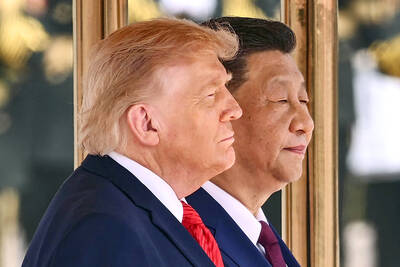
China has warned that it could cancel a planned US-China leaders’ summit if Washington approves new arms sales to Taiwan, a Japanese media outlet quoted sources as saying yesterday. US President Donald Trump, “apparently eager to showcase some diplomatic achievements ahead of November’s midterm congressional elections, places great importance on holding the summit with Chinese President Xi Jinping (習近平),” Japan’s Kyodo News reported. “While preparing for Xi’s upcoming trip, China has restated its position that the Taiwan issue is a ‘red line’ in bilateral relations,” the report said. The report said that when Xi met with Trump in Beijing in May, Xi said


 RSS
RSS