


A large majority of Taiwanese support the building of a “T-Dome” for air defense, and agree that China should renounce the use of force to change the “status quo,” the latest public opinion survey released by the Mainland Affairs Council (MAC) showed.
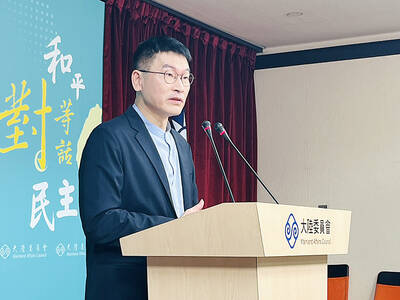
In the survey, 81.8 percent of respondents disagreed with Beijing’s official position that “there is only one China and Taiwan is part of China,” MAC Deputy Minister Liang Wen-chieh (梁文傑) said at a news conference on Thursday last week.
About 75 percent supported President William Lai’s (賴清德) Double Ten National Day speech, urging Beijing to abandon the use of force or other coercive measures to alter the cross-strait “status quo,” while a similar proportion backed accelerating the development of the “T-Dome” system, he said.
Photo: Taipei Times
Meanwhile, 79.4 percent agreed with Lai’s statement that the Republic of China (ROC) and the People’s Republic of China (PRC) “are not subordinate to each other,” and that “the PRC has no right to take military action against Taiwan.”
In addition, 86.4 percent supported the government’s stance that Taiwan is willing to engage in dialogue with China on the basis of mutual respect to promote peaceful coexistence and shared prosperity, Liang said.
A total of 77.2 percent of respondents said they supported the government’s regular checks on civil servants, military personnel and public-school teachers to ensure they have not registered for Chinese residence permits, taken up employment or obtained Chinese national ID cards, Liang said.
Meanwhile, 63.8 percent agreed that government employees who travel to China, Hong Kong or Macau without prior approval — and without reporting their itineraries and meeting purposes as required by law — should face disciplinary action, he said.
“The survey results indicate that Taiwanese are strongly determined to resist China’s intimidation and coercion, which has been a stable, long-term trend,” he added.
The survey also showed that 69.9 percent of respondents disagreed with the notion that peace can only be guaranteed by adhering to the “one China” principle and the so-called “1992 consensus,” while 87.8 percent opposed China’s military drills around Taiwan.
Regarding Beijing’s cognitive warfare efforts, 83.7 percent of respondents opposed Beijing’s recent move to display “wanted” posters featuring Taiwanese military officers, complete with personal information, saying that they conducted cyberattacks and hacking operations against Chinese facilities, Liang said.
The council cited Chinese President Xi Jinping’s (習近平) “five-point” proposal — delivered in his Jan. 2, 2019, address marking the 40th anniversary of the “Message to Compatriots in Taiwan” — in which Xi outlined applying the “one country, two systems” model to govern Taiwan and redefined the so-called “1992 consensus” as meaning that both sides of the Taiwan Strait belong to “one China” and should work together toward unification under the Chinese motherland.
This agenda is firmly opposed by mainstream public opinion in Taiwan, the MAC said.
“China’s slogans and proposals regarding Taiwan are all designed to erase the ROC, annex Taiwan and force unification with the PRC,” Liang said. “These positions deny the existence of the ROC, which is why mainstream public opinion in Taiwan remains firmly opposed to Beijing’s rhetoric.”
The MAC continues to urge “positive and mutually beneficial cross-strait engagement” as the main responsibility of both sides, Liang said, urging Beijing to “take a pragmatic approach toward Taiwan’s mainstream views,” and to abandon the use of military threats and other hostile tactics.
The survey was commissioned by the MAC and conducted via telephone interviews from Oct. 17 to Monday last week among Taiwanese adults aged 20 and older. It collected 1,070 valid responses, with a confidence level of 95 percent and a margin of error of 3 percentage points.
LOW RISK: Most nations do not extradite people accused of political crimes, and the UN says extradition can only happen if the act is a crime in both countries, an official said China yesterday issued wanted notices for two Taiwanese influencers, accusing them of committing “separatist acts” by criticizing Beijing, amid broadening concerns over China’s state-directed transnational repression. The Quanzhou Public Security Bureau in a notice posted online said police are offering a reward of up to 25,000 yuan (US$3,523) for information that could contribute to the investigation or apprehension of pro-Taiwanese independence YouTuber Wen Tzu-yu (溫子渝),who is known as Pa Chiung (八炯) online, and rapper Chen Po-yuan (陳柏源). Wen and Chen are suspected of spreading content that supported secession from China, slandered Chinese policies that benefit Taiwanese and discrimination against Chinese spouses of

ALIGNED THINKING: Taiwan and Japan have a mutual interest in trade, culture and engineering, and can work together for stability, Cho Jung-tai said Taiwan and Japan are two like-minded countries willing to work together to form a “safety barrier” in the Indo-Pacific region, Premier Cho Jung-tai (卓榮泰) yesterday said at the opening ceremony of the 35th Taiwan-Japan Modern Engineering and Technology Symposium in Taipei. Taiwan and Japan are close geographically and closer emotionally, he added. Citing the overflowing of a barrier lake in the Mataian River (馬太鞍溪) in September, Cho said the submersible water level sensors given by Japan during the disaster helped Taiwan monitor the lake’s water levels more accurately. Japan also provided a lot of vaccines early in the outbreak of the COVID-19 pandemic,

PROMOTION: Travelers who want a free stopover must book their flights with designated travel agents, such as Lion Travel, Holiday Tours, Cola Tour and Life Tours Air Canada yesterday said it is offering Taiwanese travelers who are headed to North America free stopovers if they transit though airports in Japan and South Korea. The promotion was launched in response to a potential rise in demand for flights to North America in June and July next year, when the US, Canada and Mexico are scheduled to jointly host the FIFA World Cup, Air Canada said. Air Canada offers services to 13 of the 16 host cities of the tournament’s soccer games, including Toronto and Vancouver; Mexico City, Guadalajara and Monterrey in Mexico; Atlanta, Georgia; Boston; Dallas; Houston;
The US approved the possible sale to Taiwan of fighter jet spare and repair parts for US$330 million, the Pentagon said late yesterday, marking the first such potential transaction since US President Donald Trump took office in January. "The proposed sale will improve the recipient's capability to meet current and future threats by maintaining the operational readiness of the recipient's fleet of F-16, C-130," and other aircraft, the Pentagon said in a statement. Trump previously said that Chinese President Xi Jinping (習近平) has told him he would not invade Taiwan while the Republican leader is in office. The announcement of the possible arms


 RSS
RSS