


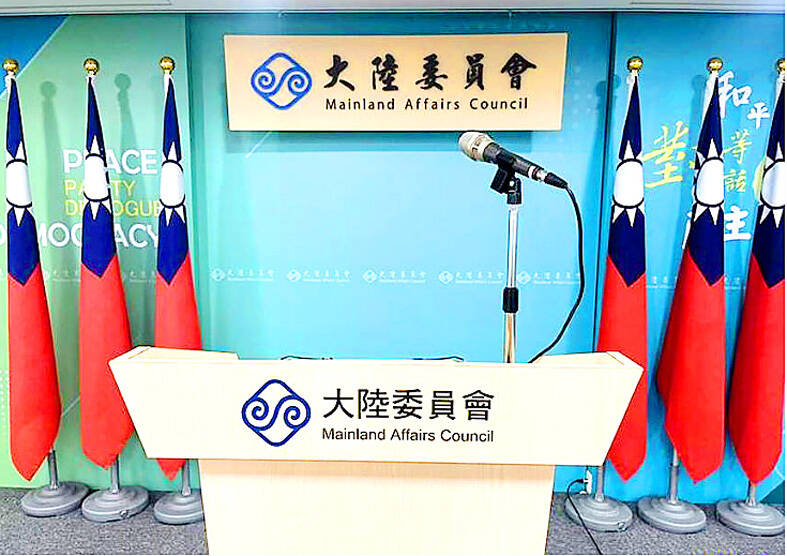
The Mainland Affairs Council (MAC) yesterday slammed Beijing’s designation of Oct. 25 as “Commemoration Day of Taiwan’s Restoration,” calling it a move to “fabricate” the claim that Taiwan belongs to the People’s Republic of China (PRC).
The decision by the Chinese authorities to establish a so- called “Commemoration Day of Taiwan’s Restoration” is an attempt to “belittle our country and fabricate the claim that Taiwan belongs to the PRC,” MAC said in a statement issued last night.
As Taiwan’s top agency for cross-strait affairs, the MAC said the Taiwanese people “will never accept” such a move, criticizing Beijing for trying to amplify a false historical narrative and one-sided political framework of “one China across the Taiwan Strait” and “one China internationally.”
Taipei Times file photo
“Taiwan Retrocession Day commemorates Oct. 25, 1945, when representatives of the Republic of China (ROC, Taiwan’s official name), on behalf of the Allied powers, accepted the surrender of Japanese forces in Taiwan,” MAC said.
The council also noted that the Chinese Communist Party (CCP) had not yet established the PRC in 1945.
“Taiwan Retrocession Day has nothing to do with the PRC, nor with the CCP, which made no positive contribution to the war against Japan,” it said.
MAC’s statement came after China’s state-run Xinhua News Agency reported earlier in the day that China’s Standing Committee of the National People’s Congress (NPC) — the top legislative body in China — had adopted a decision to designate Oct. 25 as the “Commemoration Day of Taiwan’s Restoration.”
The decision, made in accordance with the PRC Constitution, stipulates that the state “hold commemorative activities in various forms” on Oct. 25 to mark the commemoration day, the Xinhua report read.
“The restoration of Taiwan is an important outcome of the War of Resistance [against Japanese Aggression] and a compelling proof of the Chinese government’s recovery of sovereignty over Taiwan,” Xinhua said, citing the decision.
“It is also an important part of the historical fact and legal chain that Taiwan is an integral part of China,” Xinhua added.
According to the report, Shen Chunyao (沈春耀), director of the NPC Standing Committee’s Legislative Affairs Commission, told the committee that the ceremony to accept Japan’s surrender “in the Taiwan Province of the China war theater of the Allied powers” was held in Taipei on Oct. 25, 1945.
“From that point on, Taiwan and the Penghu Islands returned to China’s sovereign jurisdiction,” Shen added.
He said establishing the commemoration day and holding commemorative activities “at the national level” would serve purposes such as honoring the “indisputable fact that Taiwan is an inalienable part of China” and consolidating the international community’s “commitment to the one- China principle.”
It can also motivate “all Chinese to strive together for national reunification and national rejuvenation,” Shen added.
Before the Chinese government designated Oct. 25 as the “Commemoration Day of Taiwan’s Restoration” yesterday, the Taiwanese government had already designated the day “Taiwan Retrocession Day and Memorial Day of Great Victory at Kuningtou Kinmen” and made it a public holiday in 2025 after a 24-year hiatus.
That decision was made after a vote in the Legislature supported by the opposition parties but opposed by the governing Democratic Progressive Party.
“Taiwan Retrocession Day” had long been a public holiday in Taiwan until December 2000, when the then-president Chen Shui-bian’s (陳水扁) administration revised the law, announcing that from 2001 seven national holidays — including “Taiwan Retrocession Day” — would be retained only as commemorative days with no day off.
To the ROC government, “Taiwan Retrocession Day” commemorates the transfer of control of Taiwan proper and the Penghu Islands from Japan to the ROC on Oct. 25, 1945, after 50 years of Japanese colonial rule. That transfer date was nearly four years before the founding of the PRC on Oct. 1, 1949.
Despite the ROC government’s relocation to Taipei in late 1949 at the end of the Chinese Civil War, Taiwan and the outlying islands of Penghu, Kinmen and Matsu remain under ROC control to date and have never been ruled by the PRC, which claims sovereignty over these areas.
As 2025 marks the 80th anniversary of the end of World War II, the ROC and the PRC have clashed multiple times over their respective roles in the Second Sino-Japanese War and over commemorations such as Sept. 3 Victory over Japan Day and Oct. 25 Taiwan Retrocession Day.

TRAFFIC SAFETY RULES: A positive result in a drug test would result in a two-year license suspension for the driver and vehicle, and a fine of up to NT$180,000 The Ministry of Transportation and Communications is to authorize police to conduct roadside saliva tests by the end of the year to deter people from driving while under the influence of narcotics, it said yesterday. The ministry last month unveiled a draft of amended regulations governing traffic safety rules and penalties, which included provisions empowering police to conduct mandatory saliva tests on drivers. While currently rules authorize police to use oral fluid testing kits for signs of drug use, they do not establish penalties for noncompliance or operating procedures for officers to follow, the ministry said. The proposed changes to the regulations require
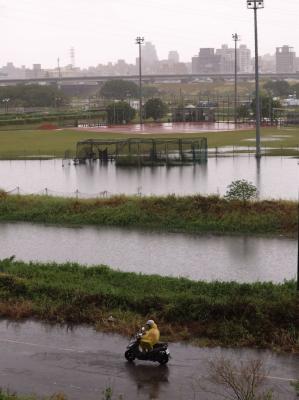
Taipei, New Taipei City, Keelung and Taoyuan would issue a decision at 8pm on whether to cancel work and school tomorrow due to forecasted heavy rain, Keelung Mayor Hsieh Kuo-liang (謝國樑) said today. Hsieh told reporters that absent some pressing reason, the four northern cities would announce the decision jointly at 8pm. Keelung is expected to receive between 300mm and 490mm of rain in the period from 2pm today through 2pm tomorrow, Central Weather Administration data showed. Keelung City Government regulations stipulate that school and work can be canceled if rain totals in mountainous or low-elevation areas are forecast to exceed 350mm in

1.4nm WAFERS: While TSMC is gearing up to expand its overseas production, it would also continue to invest in Taiwan, company chairman and CEO C.C. Wei said Taiwan Semiconductor Manufacturing Co (TSMC) has applied for permission to construct a new plant in the Central Taiwan Science Park (中部科學園區), which it would use for the production of new high-speed wafers, the National Science and Technology Council said yesterday. The council, which supervises three major science parks in Taiwan, confirmed that the Central Taiwan Science Park Bureau had received an application on Friday from TSMC, the world’s largest contract chipmaker, to commence work on the new A14 fab. A14 technology, a 1.4 nanometer (nm) process, is designed to drive artificial intelligence transformation by enabling faster computing and greater power

China Airlines Ltd (CAL) yesterday morning joined SkyTeam’s Aviation Challenge for the fourth time, operating a demonstration flight for “net zero carbon emissions” from Taiwan Taoyuan International Airport to Bangkok. The flight used sustainable aviation fuel (SAF) at a ratio of up to 40 percent, the highest proportion CAL has achieved to date, the nation’s largest carrier said. Since April, SAF has become available to Taiwanese international carriers at Taipei International Airport (Songshan airport), Kaohsiung International Airport and Taoyuan airport. In previous challenges, CAL operated “net zero carbon emission flights” to Singapore and Japan. At a ceremony at Taoyuan airport, China Airlines chief sustainability


 RSS
RSS