


The Chinese Nationalist Party (KMT) caucus said it aims to pass special statutes governing the appropriation of subsidies and funds in Hualien County’s disaster-stricken Guangfu Township (光復) as well as 23 priority bills in this legislative session.
More than 1,500 homes in the town were damaged by flooding after a barrier lake in the Mataian River (馬太鞍溪) burst, triggered by rainfall brought by Super Typhoon Ragasa, the KMT caucus said.
The special budget plan is necessary, as it would help with the town’s recovery, it added.
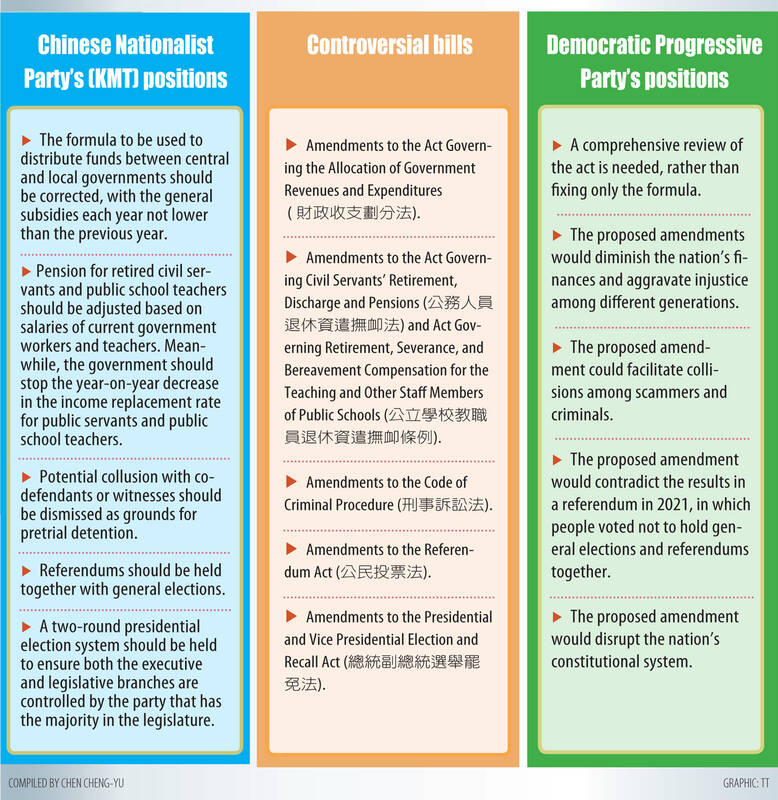
The caucus also proposed amendments to articles 37 and 67 of the Act Governing Civil Servants’ Retirement, Discharge and Pensions (公務人員退休資遣撫卹法).
The proposed amendment to article 37 would require the government to stop decreasing year-on-year income replacement rate for civil servants, and adjust their pension whenever there is salary adjustment for the government employees.
The proposed amendment to article 67 would tie civil servants’ pensions to inflation, as measured by the consumer price index (CPI). It would stipulate that the monthly pension received by retired civil servants, as well as the monthly compensation or survivors’ annuity received by their surviving family members, be adjusted when the CPI’s cumulative growth rate increases or decreases 5 percent. The adjustment rate would be determined jointly by the Examination Yuan and the Executive Yuan, taking into consideration the nation’s economic conditions, government finances, and the funding ratio of the pension and compensation fund.
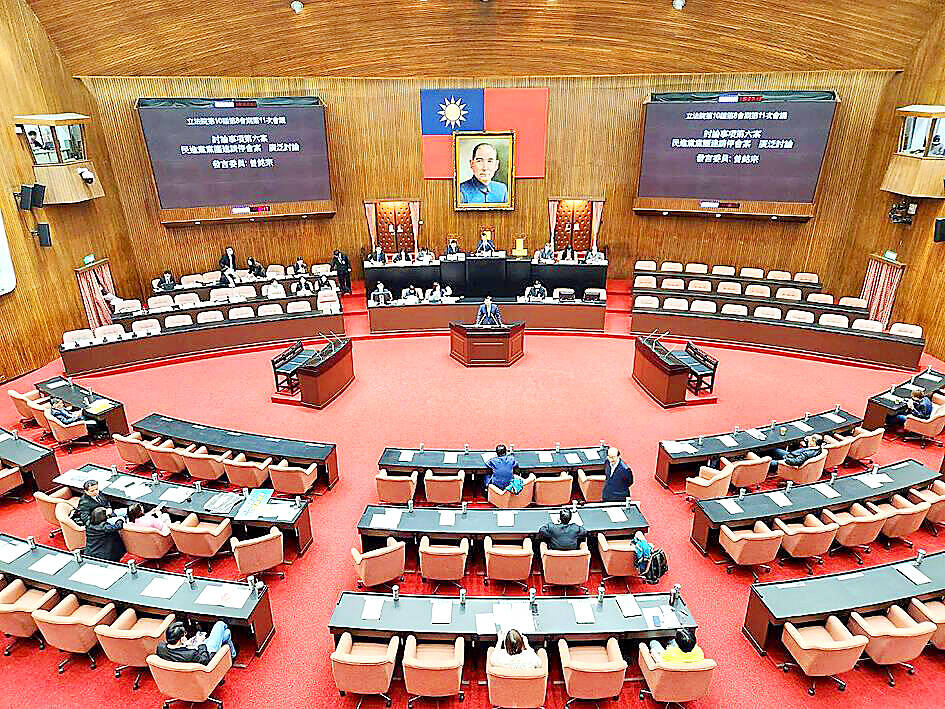
Photo: Taipei Times
In addition, the proposed amendments would stipulate that a review of the adjustment would be conducted at least once every four years.
Although some KMT legislators said the adjustment of civil servant pension funds would be triggered by cumulative CPI rate of 2 to 3 percent or minus-2 to minus-5 percent, the caucus has not declared its stance on the method and frequency of such adjustments.
Key amendments to the Act Governing the Allocation of Government Revenues and Expenditures (財政收支劃分法) would clearly define the central government’s responsibilities regarding both general and project-based grants to local governments, the caucus said.
The aim is to prevent the Executive Yuan from “arbitrarily” cutting subsidies, and to reduce disputes between central and local authorities, it said.
The caucus also proposed a “draft act governing central government subsidies to special municipalities and county (city) governments,” which it said aims to codify the existing subsidy mechanisms. The proposed act would stipulate the total amount of centrally allocated revenue could not be lower than the amount allocated in the fiscal year preceding its enactment.
Other priority bills include draft acts on artificial intelligence, young people, news media and digital platforms, platform delivery management, and protection of workers’ rights.
They also include amendments to the Presidential and Vice Presidential Election and Recall (總統副總統選舉罷免法), Employment Services (就業服務法), Climate Change Response (氣候變遷因應法), Basic Environment (環境基本法), Road Traffic Management and Penalty (道路交通管理處罰條例), Soil and Water Conservation (水土保持法), Slopeland Conservation and Utilization (山坡地保育條例), Housing (住宅法), and Fraud Crime Hazard Prevention (詐欺犯罪危害防制條例) acts.
Meanwhile, the Taiwan People’s Party (TPP) caucus said that its priority bills include an amendment to the Referendum Act (公民投票法) to allow referendums to be held alongside general elections, and a special law for absentee voting.
It said it would propose amendments to the Code of Criminal Procedure (刑事訴訟法), particularly regarding the grounds for detention, and to the Environmental Impact Assessment Act (環境影響評估法) to prevent solar power development from damaging national land.
TPP legislative caucus director Chen Gau-tzu (陳昭姿) said the party would also push for a surrogacy bill as well as amendments to the Assisted Reproduction Act (人工生殖法) to include same-sex male couples.
Additional reporting by Lin Tse-yuan

REASONS FOR TRAVEL: An assistant professor said that proposed amendments to penalize drivers if they used drugs overseas would not deter people from traveling People who operate a motor vehicle under the influence of marijuana would have their driver’s license revoked, even if they used the substance while overseas, the Ministry of Transportation and Communications said yesterday, citing proposed amendments to the Road Traffic Management and Penalty Act (道路交通管理處罰條例). The amendments would also authorize the government to revoke the licenses of people determined to have used Category 1 or Category 2 narcotics, even if they were not operating a vehicle while under the influence of drugs, as well as ban them from taking the license test for three years, the ministry said. People aged 18 or

GLOBALGIVING: ‘ Caving to external pressure is not acceptable for an organization that has cultivated justice reform and human rights for 30 years,’ one NGO said A slew of non-government organizations (NGOs) have withdrawn from the GlobalGiving fundraising platform after it announced it would use “Chinese Taipei” instead of “Taiwan” from next month. The Taiwan Good Rice Association wrote on Facebook on Friday that it was informed on April 28 via a teleconference call of the change, which was made because the platform wanted to operate in China. Taiwan Good Rice is to terminate all cooperative relationships with GlobalGiving in response to the platform’s “unilateral and non-negotiable” decision to remove references to Taiwan, the NGO said. “Taiwan is in the official name of Taiwan Good Rice Association and the

HEAVY WEATHER: Typhoon Jangmi is due to crash straight into the Ryukyus as airlines look to shift flights to larger aircraft or cancel flights to Okinawa entirely Taiwan’s international air carriers announced flight adjustments over the weekend as Typhoon Jangmi is forecast to hit the Ryukyu Islands today and tomorrow. The Central Weather Administration (CWA) upgraded Jangmi from a tropical storm to a typhoon at 8am yesterday, with the eye located 580km south of Naha city. It was moving north at 19kph. Today, China Airlines’ CI-120, CI-121, CI-122 and CI-123 flights between Taoyuan and Naha, Okinawa, have been canceled as well as CI-132 and CI-133 between Kaohsiung and Naha. EVA Air’s BR-112, BR-113, BR-186 and BR-185 flights between Taoyuan and Naha are also canceled. Low-cost carrier Tigerair Taiwan canceled IT-230,
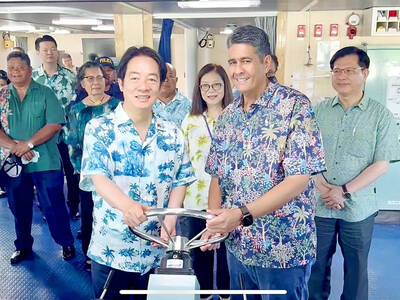
MULTIPRONGED APPROACH: China has sought to pressure Palau across a number of fronts, but the island nation has staunchly resisted overtures to ditch Taiwan Palau has been firm in backing Taiwan despite Chinese pressure that uses tourism economics, cyberattacks and criminal infiltration as tools to threaten the Pacific ally into renouncing its recognition of Taiwan as a sovereign state. The Presidential Office yesterday announced that Vice President Hsiao Bi-khim (蕭美琴) would visit Palau from Saturday to Wednesday next week at the invitation of Palauan President Surangel Whipps Jr. Whipps in April said in an interview that China had outspokenly asked Palau to “denounce Taiwan.” “And we have said: ‘We have no enemies, but nobody tells us who our friends are,’” he said. Whipps has told reporters multiple times


 RSS
RSS