


The High Court on Thursday began hearing an appeal in the case of Taiwanese independence advocates accused of damaging the Republic of China (ROC) national flag, with a ruling expected on Oct. 29.
The case dates back to October 2015, when a group led by Chen Yi-ting (陳儀庭) used knives to slash dozens of ROC flags and break flagpoles erected along a bridge in New Taipei City during Double Ten National Day celebrations.
Chen Yi-ting, Chen Miao-ting (陳妙婷), Liu Pei-hsuan (劉珮瑄), Hsu Ta-wei (徐大為) and Liao An-chi (廖安祈) were later apprehended and admitted carrying out the act.
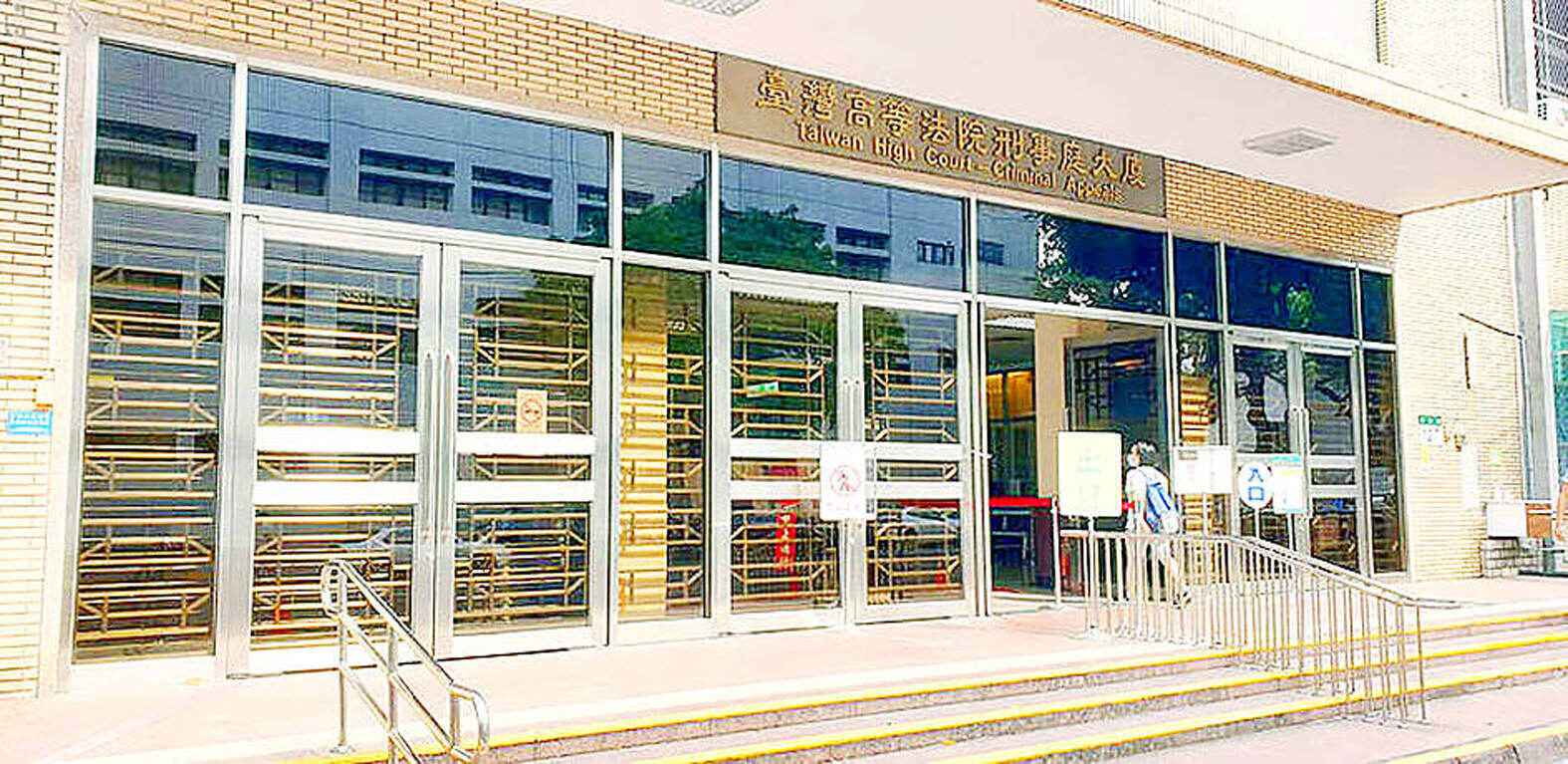
Photo: Yang Kuo-wen, Taipei Times
They were charged under Article 160 of the Criminal Code, which criminalizes publicly damaging or insulting the national flag, an offense commonly referred to as “insulting the national flag.”
In its first ruling, the New Taipei City District Court found the five defendants guilty of the “offense of insulting the national flag,” sentencing each to 20 days in detention.
The sentences were commutable to fines of NT$20,000.
Chen Yi-ting, Chen Miao-ting and Liu filed appeals, while Hsu and Liao did not contest the verdict.
Chen argued that the case was about freedom of expression and the right to define one’s national identity.
“That flag does not represent my Taiwan nation. If it were my national flag, I would defend it with my life,” he said.
In its second ruling, the New Taipei City District Court acquitted the three appellants. The judges cited Article 11 of the Constitution, which guarantees freedoms of speech, writing, publication, and expression in all forms, which is not limited to words or speech alone.
Prosecutors appealed the acquittal.
The High Court later held that the “offense of insulting the national flag” infringes on the constitutional guarantees of freedom of expression and freedom of thought, and that the punishment prescribed under Article 160 contravened the principle of proportionality.
In 2017, instead of continuing the trial, the High Court referred the matter to the Constitutional Court for interpretation, but the case had stalled amid a backlog at the Constitutional Court.
With the case unresolved for eight years, the High Court convened a new panel of judges in August to reopen proceedings, and the three appellants were summoned to appear at Thursday’s hearing.
At the opening session, the defendants argued that damaging the national flag was a form of political expression protected by the Constitution.
They said they did not intend to insult the emblem of the ROC, and therefore the charges should be dismissed.

NATIONAL SECURITY: Authorities are working to confirm the identities of the military personnel involved and investigating possible illegal conduct and regulatory violations Authorities are probing possible national security implications after Kinmen police and immigration officers on Sunday found a Chinese woman allegedly posing as a tourist while engaging in prostitution involving more than 10 military personnel. The woman, surnamed Chen (陳), has since been deported, authorities said, adding that investigators are still working to confirm the identities of those implicated, as the records only listed code names and aliases. The case stemmed from a report received by the Kinmen District Prosecutors’ Office on Friday last week from the Jinhu Precinct of the Kinmen County Police Bureau. On Sunday, police, along with the National Immigration

GLOBALGIVING: ‘ Caving to external pressure is not acceptable for an organization that has cultivated justice reform and human rights for 30 years,’ one NGO said A slew of non-government organizations (NGOs) have withdrawn from the GlobalGiving fundraising platform after it announced it would use “Chinese Taipei” instead of “Taiwan” from next month. The Taiwan Good Rice Association wrote on Facebook on Friday that it was informed on April 28 via a teleconference call of the change, which was made because the platform wanted to operate in China. Taiwan Good Rice is to terminate all cooperative relationships with GlobalGiving in response to the platform’s “unilateral and non-negotiable” decision to remove references to Taiwan, the NGO said. “Taiwan is in the official name of Taiwan Good Rice Association and the

HEAVY WEATHER: Typhoon Jangmi is due to crash straight into the Ryukyus as airlines look to shift flights to larger aircraft or cancel flights to Okinawa entirely Taiwan’s international air carriers announced flight adjustments over the weekend as Typhoon Jangmi is forecast to hit the Ryukyu Islands today and tomorrow. The Central Weather Administration (CWA) upgraded Jangmi from a tropical storm to a typhoon at 8am yesterday, with the eye located 580km south of Naha city. It was moving north at 19kph. Today, China Airlines’ CI-120, CI-121, CI-122 and CI-123 flights between Taoyuan and Naha, Okinawa, have been canceled as well as CI-132 and CI-133 between Kaohsiung and Naha. EVA Air’s BR-112, BR-113, BR-186 and BR-185 flights between Taoyuan and Naha are also canceled. Low-cost carrier Tigerair Taiwan canceled IT-230,

Chinese Nationalist Party (KMT) Chairwoman Cheng Li-wun (鄭麗文) yesterday briefed her party’s Central Standing Committee regarding her scheduled visit to the US between Monday next week and June 16, saying that her purpose would be to persuade the US that the Republic of China (ROC) Constitution was a “one China” constitution that would foster stable and peaceful cross-strait relations. The ROC Constitution is the most important defense for all Taiwanese citizens, as it upholds our democracy and has contributed to our robust economy, which aligns with international and US interests, she said. “We would not be troublemakers and drag the US under,”


 RSS
RSS