


The military has deployed multiple medium and close-range air defense missile and artillery systems, anti-drone countermeasures and combat unit to defend Boai Special District (博愛特區), a defense official said yesterday. Boai District is home to the Presidential Office Building, the Ministry of National Defense and many other government buildings.
The official made the remarks after Japanese newspaper Sankei Shimbun in a report on Wednesday said China has expanded its military training mock-up of government buildings in Taipei, which includes the Presidential Office Building, by almost 300 percent since 2020.
Satellite images obtained by think tank Japan Institute for National Fundamentals of the 1,066km2 Zhurihe Training Base in Inner Mongolia, China’s largest military training ground, showed a newly constructed 280m tunnel connecting the mock Presidential Office Building to the mock Judicial Yuan, the report said.
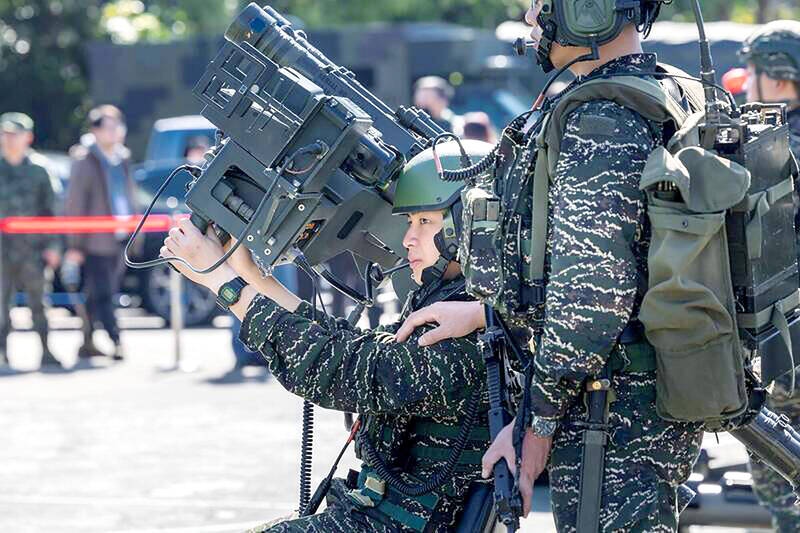
Photo: Screen grab from the Ministry of National Defense’s Facebook page
Institute researcher Maki Nakagawa said that Beijing’s aim was to pressure Taiwan and send the message that even if Taipei builds tunnels, the nation’s leaders cannot run.
The report said that the mock-ups were to prepare for a potential invasion of Taiwan and are published as part of psychological warfare against the nation.
The Chinese People’s Liberation Army (PLA) has been making mock buildings of the Presidential Office Building, the Judicial Yuan and the Ministry of Foreign Affairs for at least a decade, it added.
China Central Television in 2015 broadcast footage of the mock Presidential Office Building during live army exercises, and satellite images showed that construction for the mock Judicial Yuan building began in 2020 and was completed in 2021.
Next to the Judicial Yuan is a replica of the Ministry of Defense’s Reserve Command building, which began construction in November 2023 and was completed in April.
Satellite images from July 2022 showed the PLA erecting roadblocks at the crossroads leading to the fake Presidential Office Building and the Ministry of Foreign Affairs building, then clearing them before advancing with armored vehicles.
Then, the following month the PLA deployed multiple armored vehicles and brigade-sized troops to combat the forces defending the Presidential Office Building.
Since August, armored vehicles and roadblocks could be seen on roads around the mock Presidential Office Building, suggesting that training continues, the report said.
An anonymous Taiwanese official yesterday acknowledged that the satellite images of the training base showed that the PLA has significantly improved the accuracy of the mock-up’s structures and terrain.
The increased precision of the reproduction indicates an intent to utilize the site to train PLA forces in conducting strikes against Taiwanese political and military leadership in the area, they said.
Taiwanese armed forces have responded by bolstering the defensive network protecting the Greater Taipei Metropolitan Region and its special zone, they added.
The focus on defensive operations in and around the nation’s capital during the recent iterations of the annual Han Kuang military exercises has vastly improved Taipei’s defenses, the official said.
The military has also deployed Patriot air defense systems and National Advanced Surface-to-Air Missile Systems (NASAMS) around Taipei to create overlapping missile interception zones in the air, they said.
Stinger missiles from Avenger weapon systems, Double Mount Stinger systems and man-portable launchers, as well as automated close-in defense emplacements supplement Patriot missiles and NASAMs for intercepting low-flying targets, they added.
The Presidential Office Building is protected by anti-drone systems deployed along the structure’s defensive perimeter, the official said.

NATIONAL SECURITY: Authorities are working to confirm the identities of the military personnel involved and investigating possible illegal conduct and regulatory violations Authorities are probing possible national security implications after Kinmen police and immigration officers on Sunday found a Chinese woman allegedly posing as a tourist while engaging in prostitution involving more than 10 military personnel. The woman, surnamed Chen (陳), has since been deported, authorities said, adding that investigators are still working to confirm the identities of those implicated, as the records only listed code names and aliases. The case stemmed from a report received by the Kinmen District Prosecutors’ Office on Friday last week from the Jinhu Precinct of the Kinmen County Police Bureau. On Sunday, police, along with the National Immigration

GLOBALGIVING: ‘ Caving to external pressure is not acceptable for an organization that has cultivated justice reform and human rights for 30 years,’ one NGO said A slew of non-government organizations (NGOs) have withdrawn from the GlobalGiving fundraising platform after it announced it would use “Chinese Taipei” instead of “Taiwan” from next month. The Taiwan Good Rice Association wrote on Facebook on Friday that it was informed on April 28 via a teleconference call of the change, which was made because the platform wanted to operate in China. Taiwan Good Rice is to terminate all cooperative relationships with GlobalGiving in response to the platform’s “unilateral and non-negotiable” decision to remove references to Taiwan, the NGO said. “Taiwan is in the official name of Taiwan Good Rice Association and the

HEAVY WEATHER: Typhoon Jangmi is due to crash straight into the Ryukyus as airlines look to shift flights to larger aircraft or cancel flights to Okinawa entirely Taiwan’s international air carriers announced flight adjustments over the weekend as Typhoon Jangmi is forecast to hit the Ryukyu Islands today and tomorrow. The Central Weather Administration (CWA) upgraded Jangmi from a tropical storm to a typhoon at 8am yesterday, with the eye located 580km south of Naha city. It was moving north at 19kph. Today, China Airlines’ CI-120, CI-121, CI-122 and CI-123 flights between Taoyuan and Naha, Okinawa, have been canceled as well as CI-132 and CI-133 between Kaohsiung and Naha. EVA Air’s BR-112, BR-113, BR-186 and BR-185 flights between Taoyuan and Naha are also canceled. Low-cost carrier Tigerair Taiwan canceled IT-230,

Chinese Nationalist Party (KMT) Chairwoman Cheng Li-wun (鄭麗文) yesterday briefed her party’s Central Standing Committee regarding her scheduled visit to the US between Monday next week and June 16, saying that her purpose would be to persuade the US that the Republic of China (ROC) Constitution was a “one China” constitution that would foster stable and peaceful cross-strait relations. The ROC Constitution is the most important defense for all Taiwanese citizens, as it upholds our democracy and has contributed to our robust economy, which aligns with international and US interests, she said. “We would not be troublemakers and drag the US under,”


 RSS
RSS