


President William Lai (賴清德) discussed Taiwan’s position and strategies to strengthen the global defense of democracy, economic security and supply chain resilience in a video address to be shown at the Concordia Annual Summit in New York.
The speech, titled “Better Together for a Safer World — Taiwan’s Role in the Age of Uncertainty,” focuses on Lai’s touchstone policies, including values-based diplomacy, whole-of-society defense resilience and supply chain resilience, the Presidential Office said.
The speech is to be streamed at the event at 9am Taipei time today.
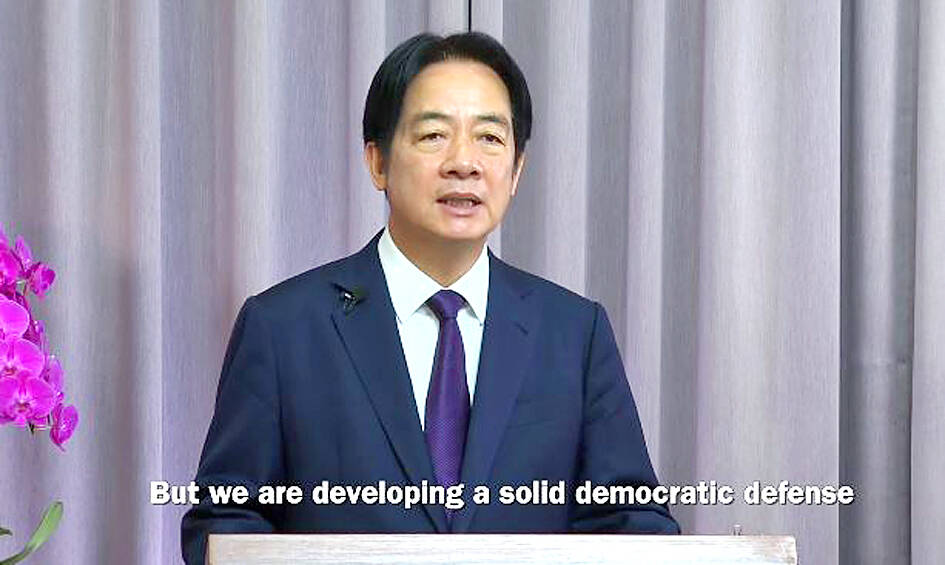
Photo: Screen grab from the Presidential Office’s Web site
Lai began his speech by saying that Aug. 15 marked 80 years since the end of World War II, a conflict that taught the world “aggression fails, unity prevails.”
“Taiwan stands on the front line of the first island chain in the Indo-Pacific and directly faces the threat of authoritarianism,” he said, describing the global landscape as “volatile.”
“Taiwan has long faced military intimidation, information warfare and other compound threats from China,” he said. “Democratic partnerships [are] the sole path to maintaining lasting peace, and building a stable and prosperous world.”
“Taiwan will continue to be a pilot for world peace and a force for global prosperity,” he added.
Lai outlined three key strategies under his administration.
First, values-based diplomacy would allow Taiwan to work closely with like-minded countries on the foundation of respect for human rights and rule of law, he said.
Despite its exclusion from the UN, Taiwan has consistently proven that it is a reliable global partner under the slogan “Taiwan Can Help,” Lai said.
Second, Taiwan would continue to bolster supply chain resilience as a key player in the global semiconductor supply chain, leveraging advantages in chip manufacturing and end-to-end industrial clusters, he said.
Third, Taiwan has been working to enhance its national defense capabilities through his whole-of-society defense and resilience initiative, and plans to achieve defense spending of 3 percent of GDP by next year and 5 percent by 2030, to align with NATO standards, Lai said.
Taiwan is “advancing cybersecurity, combating disinformation and enhancing our citizens’ media literacy,” he added.
“We firmly believe that there is strength in unity, and that we can achieve a bright future only by working together,” Lai said in his concluding remarks.
The New York-based non-profit organization Concordia hosts the “largest and most inclusive nonpartisan forum alongside the UN General Assembly,” discussing topics such as global economy and trade, democracy, security, and geopolitical risks, according to program information.
Additional reporting by CNA
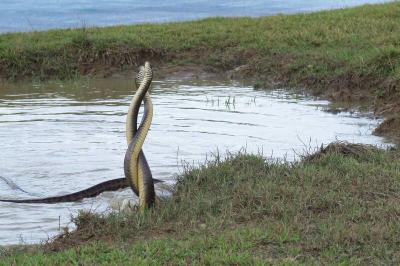
Kenting National Park service technician Yang Jien-fon (楊政峰) won a silver award in World Grand Prix Photography Awards Spring Season for his photograph of two male rat snakes intertwined in combat. Yang’s colleagues at Kenting National Park said he is a master of nature photography who has been held back by his job in civil service. The awards accept entries in all four seasons across six categories: architectural and urban photography, black-and-white and fine art photography, commercial and fashion photography, documentary and people photography, nature and experimental photography, and mobile photography. Awards are ranked according to scores and divided into platinum, gold and

More than half of the bamboo vipers captured in Tainan in the past few years were found in the city’s Sinhua District (新化), while other districts had smaller catches or none at all. Every year, Tainan captures about 6,000 snakes which have made their way into people’s homes. Of the six major venomous snakes in Taiwan, the cobra, the many-banded krait, the brown-spotted pit viper and the bamboo viper are the most frequently captured. The high concentration of bamboo vipers captured in Sinhua District is puzzling. Tainan Agriculture Bureau Forestry and Nature Conservation Division head Chu Chien-ming (朱健明) earlier this week said that the
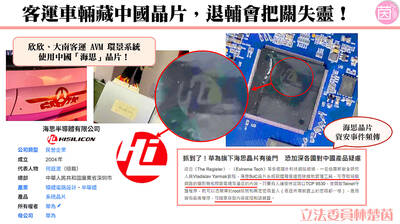
BREACH OF CONTRACT: The bus operators would seek compensation and have demanded that the manufacturer replace the chips with ones that meet regulations Two bus operators found to be using buses with China-made chips are to demand that the original manufacturers replace the systems and provide compensation for breach of contract, the Veterans Affairs Council said yesterday. Democratic Progressive Party Legislator Michelle Lin (林楚茵) yesterday said that Da Nan Bus Co and Shin-Shin Bus Co Ltd have fielded a total of 82 buses that are using Chinese chips. The bus models were made by Tron-E, while the systems provider was CYE Electronics, Lin said. Lin alleged that the buses were using chips manufactured by Huawei subsidiary HiSilicon Co, which presents a national security risk if the

The National Immigration Agency has banned two Chinese from returning to Taiwan, after they published social media content it described as disrespectful to national sovereignty. The agency imposed a two-month ban on a Chinese man surnamed Liang (梁) and a permanent ban on a woman surnamed Yang (楊), an influencer with 23 million followers, in October last year and last week respectively. Minister of the Interior Liu Shyh-fang (劉世芳) yesterday said on the sidelines of a legislative meeting that Chinese visitors to Taiwan are required to comply with the rules and regulations governing their entry permits. The government has handled the ban and


 RSS
RSS