


The government is planning to tighten regulations on cosmetic surgery, including ranking the safety risks of cosmetic procedures and setting qualification standards for the personnel that can perform them, Minister of Health and Welfare (MOHW) Shih Chung-liang (石崇良) said on Sunday.
The minister’s comments, made on the sidelines of the Taiwan Healthcare Reform Foundation’s 25th anniversary event in Taipei, come after a man died on Wednesday last week at a clinic in Taipei while under anesthesia after undergoing penis enlargement surgery.
The clinic owner and surgeon was found to have been involved in several previous medical disputes and had been fined, but had changed his name twice and the clinic’s name a few times.
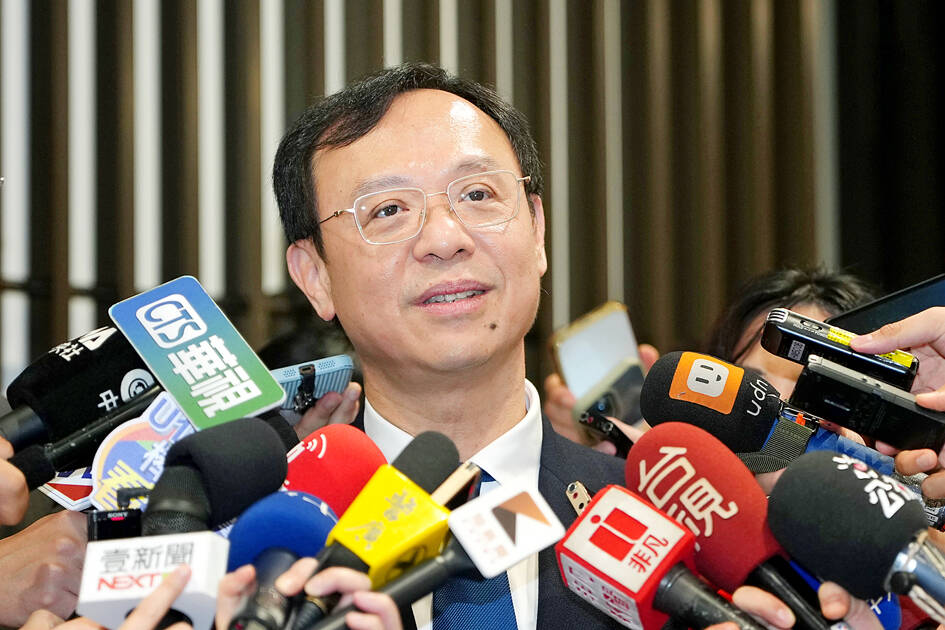
Photo: Chen Yi-kuan, Taipei Times
In the wake of several major incidents or deaths involving cosmetic surgery in the past few years, the ministry would seek to amend the Regulations Governing the Application of Specific Medical Examination Techniques and Medical Devices (特定醫療技術檢查檢驗醫療儀器施行或使用管理辦法), Shih said.
The amendments would target four main areas, the first of which is setting doctors’ qualifications for performing certain procedures according to their safety risks, he said.
Even low-risk procedures, such as aesthetic injections or laser treatments, should be performed by doctors that have at least finished their two-year postgraduate clinical training, and should not be performed by graduates that have only finished their internships, he added.
“We do not wish to see the ‘chokubi’ phenomenon [in Taiwan], as it is not good for people or the quality of healthcare, and distorts the nature of medical treatment,” he said.
Chokubi is a term used in Japan to describe the trend of young doctors joining private cosmetic clinics immediately after medical school.
Regarding high-risk procedures, the amended regulations would require that surgeons finish certain specialty training, Shih said.
Second, investigations and supervisory inquiries should be launched after a major incident, and the clinic must be ordered to improve within a given time, he said, adding that the clinics should also receive the Joint Commission of Taiwan’s Aesthetic Medicine Quality Certification for four years.
Third, the names of cosmetic clinics that have breached medical regulations and been suspended for more than three months should be publicized along with the doctors’ license numbers, to ensure people can identify them even if they change their name or their clinic’s name, Shih said.
Last, medical treatment for injuries caused by cosmetic procedures should not be covered by the National Health Insurance, as it is unfair to use state resources on such injuries, and the cosmetic clinic should be responsible for paying the medical cost, he said.
The ministry plans to announce the draft amendments to the act next month, and following a 60-day public comment period, the amended regulations could take effect by the end of the year or early next year, he said.

UPGRADE: The Kang Ding-class frigate is replacing its Chaparall missiles with Tien Chien II and Hua Yang VLS, which would provide it with long-range, 360° air defense Taiwan plans to produce 1,200 to 1,376 Hai Chien II missiles (海劍二, Sea Sword II) — also known as TC-2N — to serve as the standard air defense system of the navy’s surface combatant fleet, a source said yesterday. Last week, the Hai Chien II, the naval version of the Tien Kung II missile (天劍二, Sky Sword II), completed a live-fire test in waters off the National Chungshan Institute of Science and Technology’s Jiupeng facility (九鵬) in Pingtung County’s Manjhou Township (滿州). The MIM72 Chaparral and other dated air defense missiles that currently arm Taiwanese ships have inadequate range to combat Chinese

REASONS FOR TRAVEL: An assistant professor said that proposed amendments to penalize drivers if they used drugs overseas would not deter people from traveling People who operate a motor vehicle under the influence of marijuana would have their driver’s license revoked, even if they used the substance while overseas, the Ministry of Transportation and Communications said yesterday, citing proposed amendments to the Road Traffic Management and Penalty Act (道路交通管理處罰條例). The amendments would also authorize the government to revoke the licenses of people determined to have used Category 1 or Category 2 narcotics, even if they were not operating a vehicle while under the influence of drugs, as well as ban them from taking the license test for three years, the ministry said. People aged 18 or

HEAVY WEATHER: Typhoon Jangmi is due to crash straight into the Ryukyus as airlines look to shift flights to larger aircraft or cancel flights to Okinawa entirely Taiwan’s international air carriers announced flight adjustments over the weekend as Typhoon Jangmi is forecast to hit the Ryukyu Islands today and tomorrow. The Central Weather Administration (CWA) upgraded Jangmi from a tropical storm to a typhoon at 8am yesterday, with the eye located 580km south of Naha city. It was moving north at 19kph. Today, China Airlines’ CI-120, CI-121, CI-122 and CI-123 flights between Taoyuan and Naha, Okinawa, have been canceled as well as CI-132 and CI-133 between Kaohsiung and Naha. EVA Air’s BR-112, BR-113, BR-186 and BR-185 flights between Taoyuan and Naha are also canceled. Low-cost carrier Tigerair Taiwan canceled IT-230,
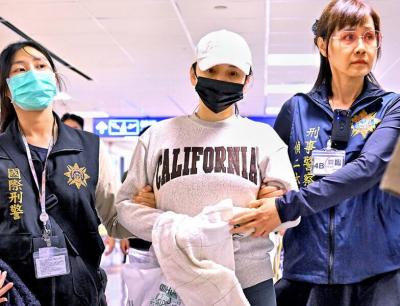
Johanne Liou (劉喬安), a Taiwanese woman who shot to unwanted fame during the Sunflower movement protests in 2014, returned to Taiwan last night after being deported from the US. She is to stand trial in Taiwan for charges involving embezzlement, fraud and drug crimes. The Criminal Investigation Bureau (CIB) said it took her into custody at Taiwan Taoyuan International Airport and would first question her before transferring her to the New Taipei District Prosecutors’ Office. She was arrested upon disembarking a flight from San Francisco that landed shortly before 7pm. Liou absconded to the US in 2019 after jumping bail


 RSS
RSS